Wednesday, 9 December 2020

Winter games

Saturday on the unloading road

Only 3 degrees on Saturday morning, and a biting wind. Winter is knocking on the door, and the Santa Special trains were out, bringing happy punters to visit the famous old man.

Less famous old men were working on the unloading road at Toddington. Wednesday saw half of it levelled and packed, but with a high spot. Could a heavy loco be shunted up and down it to push things back into place?

It could, and the weapon of choice was the class 45, pushed cold by a shunter.

But first, the good news that services have resumed again, now in the guise of 'Santa Experiences' (as per new headboard). Two locos were out on Saturday, and here is the first one leaving Toddington, being heavy tank loco 4270.

In the box is loco volunteer Alex, reaching out as far as she can with the token hoop.

'It can deal with dips this deep'

After the commercial side was done, we set to work. Mark offered us the loan of his laser level, which was gratefully accepted. Once we had understood how it worked, that is.


We then cautiously had a little go ourselves, and were soon delighted with its ease of use.

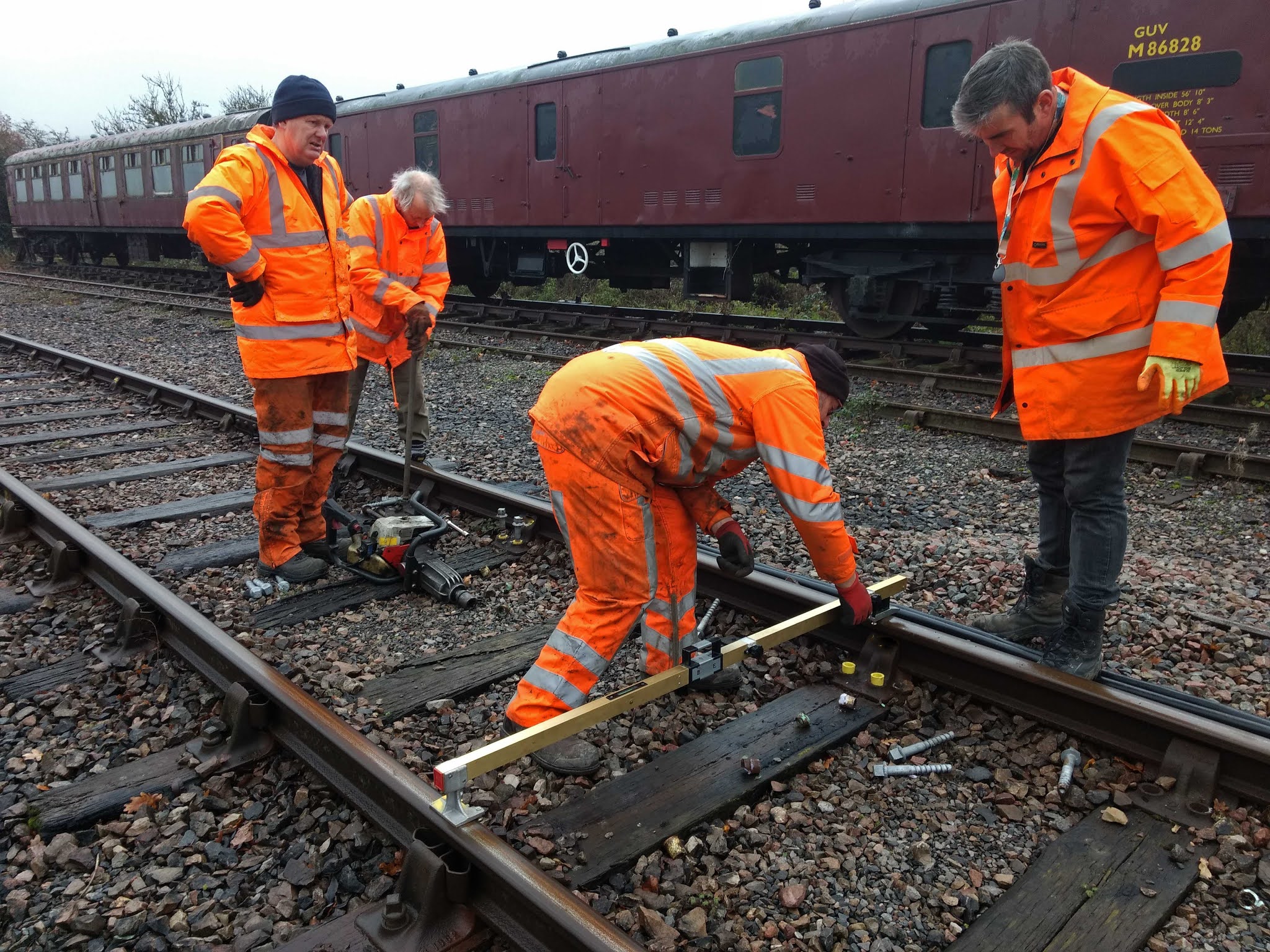
It meant that Bert Ferrule had nothing more to do from now on than to stand there and produce a series of beeps, while Dave struggled with the fiercely resisting Duff jack.


Meanwhile, back in the shed, a loco frame had been stripped of its wheels and suspended in mid air. We won't give the game away, except to say that the cards have been thoroughly mixed and this loco is not now where it was in the shed last week. Which one is it?


And then, out of the mist....


..... comes.....

Dinmore Manor! But you already knew that, didn't you? It's the second locomotive on duty Saturday, shunting to attach to the second rake and take happy (and fare paying) punters to the North Pole a few miles away.


Meanwhile men were struggling to pack the unloading road. It was really hard work. After half the road was packed on Wednesday, we had to do it all over again, and more, after the class 45 had marked its weighty presence. Many of the sleepers needed a further 3 inches of lift. They really did, we couldn't believe the laser level at first and went to check with a builder's level as well, but the gap under the sleepers was true.

So get packing!


This shows us nearing the end of the new building, with a visible dip on the left still outstanding.


The occasional passage of a train was always a welcome relief to the very tiring activity of shovel packing. GWR 4270 is about to pick up the hoop a second time from signalman Alex.


With the hoop safely on board, the regulator can be cracked open a bit until the train reaches the end of the 10mph station limits speed limit, quite some distance away.


One more click - one more click - just one more click...

Andy holds the laser level and tells Nick and Steve when the desired height is reached, but it's a task of Sisyphus. Every 'last click' just pushes the jack further into the soft ground underneath, and you never seem to reach that level. And it took two of us to force the handle down, such was the resistance.


Here is the result at the end of the day. The whole stretch has been straightened and lifted. Part of it for a second time, after it was steam rollered by the class 45. The steam roller will now pass a second time, and no doubt the whole thing will need to be lifted once more. Hopefully it will then stabilise a bit, with all the new ballast we pushed underneath it. (Update - the second passage of the steam roller Cl 45 was on Saturday evening, and the track has apparently held up quite well this time)

The Santa Specials are very successful, earning us a useful mention on the local BBC Midland news. However, due to arrangements necessary to achieve social distancing the actual passenger figures are only half those of last year. At least we are allowed to generate some cash; not all railways have been so lucky.


Tuesday on the Broadway canopy completion project

Back to work on fabrication at last! But it was jolly cold, 0.5 degrees to start with, but at least we were out of the wind and during the day the temperature rose as the sun popped out.

So where did we leave off? We were making the embellishments around the bottoms of the two supporting columns that will go left and right of the staircases. Last time we had made up 8 panels.


This time Neal and John clamped two sets of 4 panels together with angles and G clamps. The result was carefully measured and tapped into place.


John then tack welded the 4 sides together, here with the frames of our mystery loco suspended in the background.


You can't look at welding of course, so we've hidden the light behind John's body.


In this picture the photographer hid behind the lifting jacks, and let the camera see the welding and snap a picture.


We can also see Neal grinding off the welds on the first box, as John is making up the second.


Then it was time to take the car for an MOT, so we don't know how far they got at the end of the day.

On leaving, there was just time to take this picture:

In the NW corner of the car park containers and portacabins have been moved to make room for a new way through from the former garden centre car park. The idea here is that this new approach road will give direct access to the main car park, without having cars passing in front of the station buildings, where there is always a crowd of pedestrian comings and goings. Cars in a hurry going N-S and passengers not paying attention going E-W is not a good mix, so this new approach will give us a better flow. It's a small part of the much larger plan to redevelop the entire Toddington site. When we have some money.


Wednesday

Still no work on the Usk project, as some of our critical members are off sick. Fingers crossed that they can get themselves sorted, as we miss them!

Wednesday's activities were devoted to further moving of sleepers on the Broadway extension, the same job as a fortnight ago. Only this time we were better at it, having established a system, and two gangs, one preparing the cribs and the other one doing the actual moving.

This picture shows two members of the moving gang first thing. Those sleepers can be quite reluctant to push along, even with a Duff jack, so at times we had to double man the jacks.


It became apparent that the sleepers could be reluctant to move for quite minimal reasons, just a handful of stones could suffice.


Once we had these cleared away, we reverted to single manning and here Andy and Martin are capably managing a jack each.

In the distance the digging out gang could be seen, here at Peasebrook, preparing our next job.


Their enthusiasm was surprising to some...


We are multi taskers - Sunday, an Elf, today, a shoveller. But the hat was the same.

A fortnight ago we did this sleeper moving for the first time, and managed one in the morning, and one in the afternoon.

Today, we managed 6 in total, each involving three sleepers (with two neighbouring ones being moved a bit as well, to get the spacing equal). So we were much more efficient.

All that hard work deserved a nice picnic and a chat. How lucky we were that there was a tiny bit of sun, and no rain like the last few days.

Pity we had to sit in the shadow of a sewage plant!


More of Derek Palmer's 1963 steam photographs

Here is the next batch of slides that Derek Palmer took in the spring of 1963. At the moment, we are still in the Oxford area, although later you will see that he started to roam, so then we will see some other, non WR trains as well.


A Worcester to Paddington train passing Wolvercote, viewed across part of Port Meadow on 14 March 1963.

We're wondering what type of locomotive it is, so here is a crop with an enlargement:

What do you reckon, is that a Castle?


Next is 6954 Lotherton Hall with a freight train on the down relief passing Moreton Cutting, between Cholsey and Didcot on 28 March 1963.

Lotherton Hall was a 1943 built locomotive that managed a 21 year career. Not as long as it might have had, but longer than all of the BR Standards. It was scrapped by Cohens in November 1964. It spent most of its life based in the Bristol area, and at the time Derek took the picture its home shed was St. Philips Marsh, from where it was also withdrawn about a year after Derek took the picture.

Then it's 7013 Bristol Castle passing Moreton Cutting on the up fast on 28 March 1963.

Bristol Castle had a much better service life of a respectable 40 years. This loco entered traffic as GWR's 4082 in 1924, and was launched as Windsor Castle. What about the change of name then?

The story is that in 1924 it was the Royal locomotive and was driven by King George V himself from Swindon works to Swindon station on April 28th 1924. In February 1952 King George VI died and inconveniently the Royal engine was actually being overhauled in Swindon works, and was unavailable for the funeral train. What to do?

Solution: Swap the identity with another loco! 7013 Bristol Castle was chosen, and became 4082 Windsor Castle. And the other way round too. Afterwards it was decided to let things rest, so only the commemorative plaques were reinstated on the original Royal engine. Sadly, neither engine was preserved and the example in the picture was cut up in January 1965 at Cashmore's in Newport.

30840 Urie S15 Class passing Moreton Cutting, light engine, on the down relief line on 28 March 1963. 

This LSWR designed engine was built by the SR in 1936. It wasn't named and we don't know much about it. It was a freight engine, and seven examples have been preserved. This one was cut up in November 1964, so had a respectable life of 28 years.


Finally, it's 7900 St.Peter's Hall passing Moreton Sidings with a York to Bournemouth train on 28 March 1963. At the time, this locomotive was shedded at Oxford, appropriately because St.Peter's Hall was part of Oxford University. However St.Peter's Hall was given collegiate status in 1961 and became St.Peter's College. 

St. Peter's Hall was a BR build of the GWR design and entered traffic in 1949. It spent its life mostly going up and down the GWR main line to Bristol until 1952 when it was moved to Oxford shed, which fits in with this slightly unusual train of Southern green coaches on their way to the sunny south out of the university city. The loco was cut up after a brief 15 year career in April 1965.      

Derek continues to say that beyond the footbridge in the distance there was a spot where, ten or so years before this, my father, brother, and I used to spend the day watching the trains having cycled there from Oxford where we lived.

Happy days!


Wednesday, 2 December 2020

Back to work, in small teams

Saturday along the line

Teams of six were allowed on Saturday, on essential maintenance, so that is what we did at Winchcombe, where one or two issues had been identified following a longer track survey.


While we were working in the yard, we could see a crowd of elves being rehearsed for the Santa specials. They are well organised, came back a report from a participating elf. All is ready for a host of vising children to Santa, including a newly erected a large marquee.


In the picture we are re-checking the gauge in an area where some widening had been detected.


On removing the chair bolts over a stretch of several yards we began to see what had caused the gauge widening. The bolts were almost all bent! You can just about make it out on this example.

The wider gauge here was still within maintenance limits on a static basis, but we felt that dynamically there could be excesses and so we decided to exchange all the chair bolts along the outer side of the curve for new ones, with new ferrules.

That made a surprising difference, because at the end of the job we were now well within tolerances again. Job done !


The same track survey had found two cracked concrete sleepers at Didbrook. The sleepers here are of a war time economy type, being pierced with two oval holes each, and shorter than modern sleepers. As we have no replacement sleepers of this type, we decided to fit tie bars here, to ensure that there would be no spread of the gauge while a longer term solution is found. 


This row of sleepers is from the very early days, being less than a mile from where the relaying of the line started at Toddington, and in general terms the quality of the track components improves with each extension as we forged south, reaching CRC in 2000.


In the picture you can make out the three tie bars we fitted, with Didbrook 2 bridge in the background. 


Then the tie bar gang returned to Winchcombe, where Dave, Tim, Nick, Chris and Steve were on a trickier problem, working to remove a dipped joint by the yard foot crossing.

The dip in the rail joint wasn't helped by a defective wooden sleeper nearby, so before packing the joint it was decided to replace it. Chris is bolting down on the left, as Dave waits on the right with the drill to put new holes in the replacement sleeper.


This is what remained of the defective sleeper - it was a GWR type throughbolter, so could only be removd by splitting it down the middle.

One of the bolts has been painted white to highlight it, as it was loose. This is why we don't reinstate throughbolt chairs, as they eventually work loose and cannot be tightened.

With the sleeper replaced by a new one the track was lifted and here Dave can be seen packing ballast under the low area.

Dave has a healthy crowd of critical supporters to tell him where he is going wrong....


While doing these repairs we noticed that the 'end post' on the insulated joint was thin and failing, so while all the tools were out we thought we'd open up the fishplates and replace it.

Ha-ha, not so fast, As usual, there is always a snag, and in this case only 3 of the 4 bolts would come apart.

Dave attacked the reluctant one with the disc cutter, with a huge trail of sparks for us to watch.


The failing end post was examined most critically by Dave....


... and was then replaced by a new one, which Dave can be seen pushing down between the ends of the rails here.


There it is, in position, that little red stripe. Not much, for a lot of work. In fact the other 3 bolts seemed very stiff to remove, which told us that the rail was pulling on them in the other direction. The solution to that is to unclip the whole 60ft of rail, wriggle the bolts loose, then clip it all up again.

But job done. Next?


Ah yes, there is still that little detail of sawing the top of the end post to level with the rails. Not a job that should be left to a passing 100 ton locomotive.


Answers to last week's quiz

(with the questions, to make it a bit easier to see)

1 The South Devon Railway and the London and Croydon used the Atmospheric system instead of locos which railway under construction was used as a test site?

A:  Wormwood Scrubs, West London Railway

2 When British Railways was formed how many track gauges did they have? (Excluding the systems in the various Works)

A: Five - Standard (4’-8.5”), Vale of Rheidol (1’-11.5”), Corris (2’-3”), Welshpool & Lanfair (2’–6”), Nantlle (3’-6”}

3 Where was the first steel rail laid in Britain?

A: Derby 1857

4 Which of the following country’s main line railways does not run on the left? France, Japan, South Korea, Mexico

A: One - Mexico

5 Which country shares Ireland’s track gauge?

A: Australia, State of Victoria

6 Ex BR Mark 2 carriages have operated in which countries outside UK

A: Three: Israel, New Zealand and Republic of Ireland

7 Which country was the first to adopt the metre gauge?

A: India 1872

8 Which 3 countries both have 5’-6” and metre gauge?

A: India, Brazil and Bangladesh

9 Which was the first steam loco built for British Railways in their Workshops

A: 3218 completed Swindon Jan 2 1948

10 Who built the first Railway Locomotive for Russia?

A: Robert Stephenson & Co 1837 (for the Tsarskoye Selo Railway)

11 The GWR is famous for carrying out 171 miles of gauge conversion in 3 days. Which company converted 1806 miles in 24 hours?

A: Louisville and Nashville (USA)

12 Where in UK do 2 passenger carrying railways of different track gauge cross each other on the flat?

A: Porthmadog, Cae Pawb crossing of BR and WHR

13 Which is wider the Spanish track gauge or the Indian track gauge?

A: India - 1676mm, Spain is 1663mm

14 In which neutral country could wartime locos from the Allies and Germany be found working alongside each other?

A: Turkey.

15 Where is the longest stretch of straight track in the world?

A: Nullarbour Plain, Australia 297 miles

16 How many track gauges are there in Australia?

A: Three – 4’-8.5”, 5’-3” and 3’-6”

17 What is the track gauge in Thailand?

A: 1000mm

18 What is the longest scheduled train journey you can make in the same carriage?

A: Moscow to Vladivostock - 5772 miles (the longer Moscow to Pyonyang service is suspended)

19 In World War 1 what was the track gauge for the Trench Railways?

A:  600mm

20 What is the heaviest weight of rail used for regular traffic in the world?

A: 141 lb/yard

With thanks to Malcolm, from - Canada!


Where else abroad are readers of this blog located....? Leave a comment and say!


Derek's 1963 steam pictures:


Here is 7031 Cromwell's Castle on a Worcester to Paddington train having just left Oxford station on 26th February 1963. Viewed from a little used footbridge but conveniently placed for photographing trains.


7031 Cromwell's Castle was delivered in 1950 and made it to July 1963, a sad 5 months after this picture was taken. That's a service life of just 13 years!


Next, Derek took this super picture of an 8F plodding along with a rake of Windcutters:


Ex LMS 8F 48385 is seen on a southbound freight on the main line passing Sandford, which is between Oxford and Radley on 6th March 1963. 

This grimy freight loco was delivered just before the end of the war, in February 1945. It led a pretty meandering life around the centre of England, pulling iron ore and coal trains. At the time of the photograph was it shedded at Wellingborough, where it remained for 15 years in a row. In its final 4 years it had 4 allocations though, and ended its service life at Croes Newydd in October 1966. That's a life of almost 22 years, a bit more respectable than the mighty Castle, but still far short of what it could do.


7005 Sir Edward Elgar is seen approaching Radley with a Worcester to Paddington train on 6th March 1963. 


Sir Edward Elgar started life in 1946 as Lamphey Castle. In 1957 the Castle was changed to a Composer, to mark the centenary of Sir Edward Elgar's birth. Sir Edward Elgar was born and died in Worcester, and just like him 7005 spent all its life linked to that town. For 18 years the locomotive pulled Cathedrals Expresses between Paddington, Worcester and Hereford.

After a brief allocation to Southall shed she was withdrawn in 1964 and cut up by Cohens in January 1965.


The next one is a view of a northbound freight taken from Godstow, looking across the northern part of Oxford's Port Meadow looking towards Wolvercote on 14th March 1963. 

The idea of such a passing shot is a good one, but in practice the houses in the background have spoiled the silhouette and it's a bit difficult to make out what sort of locomotive it is.

Can anyone say?

Here is an enlargement of the same scene...

Finally, another view across Port Meadow on 14th March 1963, this time with a Bournemouth to York train.


Again there is a cropped enlargement, which gives a better view of the locomotive with, what looks like a Southern PMV in tow. 


Derek then reminisced a little further:

This photo reminds me of an English lesson at Grammar School when I was in the second form (year 8 in modern parlance). The teacher was a dour and humourless character and the lessons were very formal. On one occasion he introduced a collaborative poetry creation lesson. He was inviting a submission for a following line to the one he was writing on the board, which was 'Across the wide and level plain'. He had barely finished writing and hadn't even turned round before the class wit called out 'With clouds of smoke there comes a train', to much mirth from the rest of the class and reducing the style to one of mere doggerel.

Port Meadow is an expanse of flat land between the railway and the River Thames stretching from Walton Well Road to Wolvercote, and is even mentioned in the Domesday Book (1086). It is now designated as a Site of Special Scientific Interest having never been ploughed.


More next week!


Wednesday on the Usk hut.... er, no

Our planned resumption of platform building activities had to be cancelled today, as only two Usketeers were available. Two others are off sick, one is recovering, and a fourth is sheltering from COVID. And so the Usk cookie crumbles. Let's hope we can resume next week.


A small group of two from the C&M dept. did work on the stop block end, but as it got dark towards the end of the day we have no pictures of the result. Maybe next week then.


Twelve men then met for the PWay briefing, which we joined.

It's not the same out here, as in the mess coach with hot tea and a doughnut... roll on that vaccine!

We then proceeded to Toddington, where we addressed the unloading road again.


We need to straighten the track, then pack it to a certain level, just below that of the floor of the adjacent loco shed.

The first thing to do is measure it, know where you are.


Then you can 'tweak' the track, using that handy new building that has appeared as a prop.


Don't scratch our Dogfish now!
In the meantime a member of the loco dept, was filling up the two Dogfish with Type 1 fill, which was to be dropped to pack the track.


In the time that the two hoppers were being filled, we took a half hour off to chew our sandwiches. This was in the doorways to the shed, where a brazier had been lit, but there wasn't much heat coming from it really, just the pungent smell of smouldering wood.

Christmas decorations were being draped around Saturday's locomotive as we ate.


After lunch, a last check to make sure the unloading road was now straight, the result of the morning's efforts.


Not bad, eh? 


It had better be, it's going to be set in concrete!


A large diesel shunter then gingerly made its way down the track, heading for the two Dogfish in the car park.


The two hoppers were picked up and very slowly the type 1 was allowed to trickle out through the centre doors.


Underneath the lantern...


While the discharge was going on we couldn't work of course, and had to stand aside.


Volunteering is about more than just the work, it's a social thing. Robert here explains to Rob how someone sideswiped his car, and then laid the blame on him too! The cheek!


After the train had passed we found this beautifully laid trail of infill. Now the packing could start.


We had the sighting boards with us, and set these up to get a level track, which was jacked up at intervals. Then it was a question of shovelling the infill underneath. The ground under the track was still surprisingly wet, and the jacks went down as much as they went up. Hopefully the drainage of the fill will deal with that.


Here's the shovelling and packing gang. We managed a bit over half of the stretch today, good for a first attempt. We left a request for the track to be 'steamrollered' during the next few days with something heavy like P&O being shunted up and down a few times. This will settle the track now (and not later, once the concrete is down) and also deal with a small high spot we found, where the base level was not low enough. We'll be back on Saturday to pack the remainder, and deal with any final adjustments that will be needed.

John in his amusing Russian hat. Well, Lee thought it was amusing...

Finally for today, we wish you a cheery good bye from 'Gospodin' John, the man with the Russian hat and in charge of the hopper door.  
За здоровье!