Monday at Broadway.
A hot and muggy day.
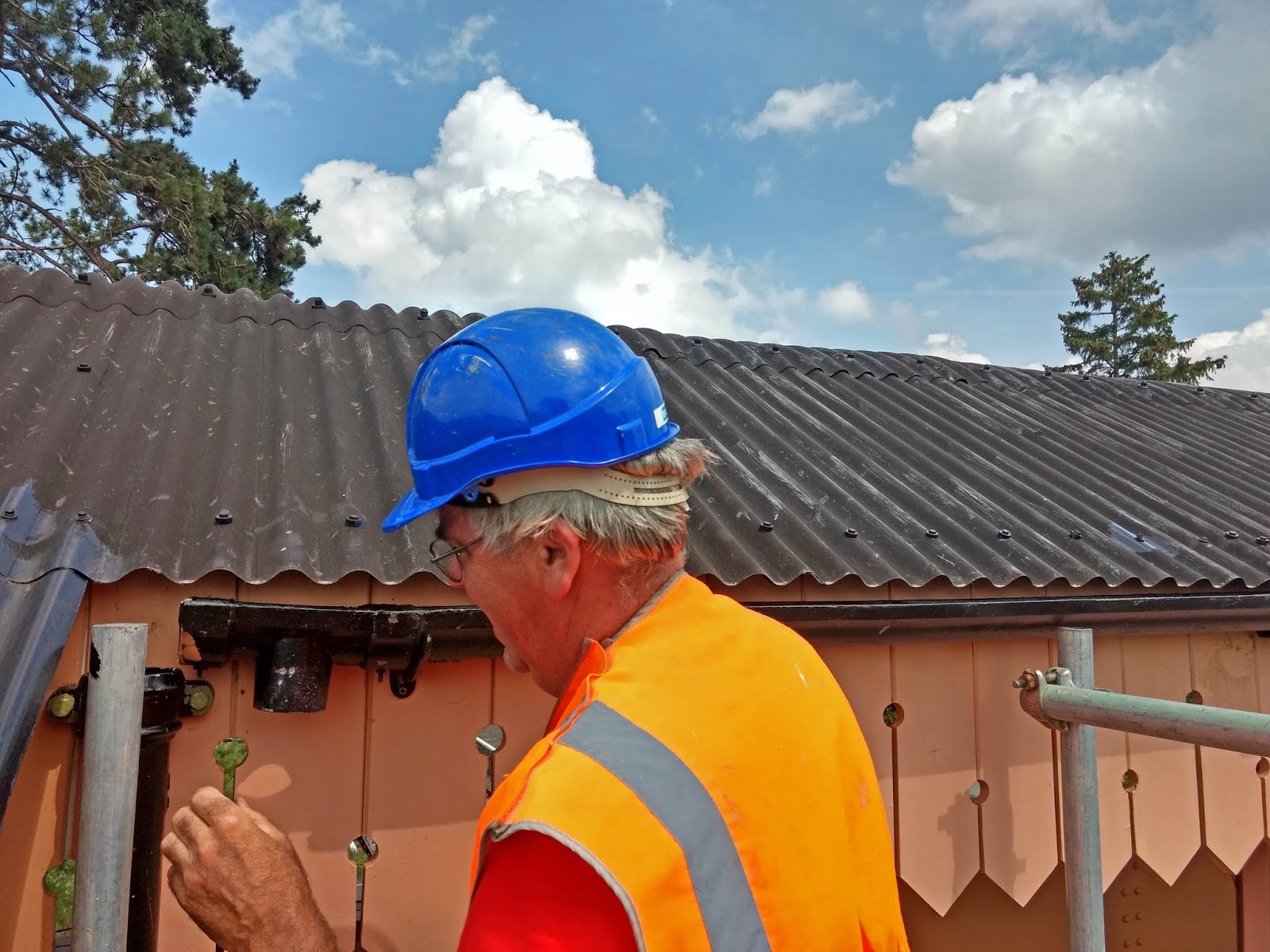
The forecast was for thunderstorms and rain, but we never got them, so had a great day on the footbridge with the roof sheets on the P2 side.
The bent sheets for the intermediate landing are now almost ready, thanks to a quick visit by Neal on a normally non-working day for our little gang to get an extra coat of paint on and hurry the job along.
Today we were able to mount them.
The first one is on, and this is the gap for the two others.
Once we have the landing ones on, we can do the straight sheets above and below them. The bent sheets were therefore key for roofing the P2 steps.
After manhandling the rather awkward sheets up the scaffolding, trying not to scratch them too much, they went on quite quickly.
Here is Neal screwing down the second of the three sheets.
In this picture all three landing sheets are on, and Neal has just placed one of the straight sheets above. That has to go on top of the landing sheet, but under the ones above. In places these are two even three sheets thick, so it's quite a wriggle to get them in and then secured down.
Here is Neal with the second straight sheet, and the third just just on camera on the right. They are very awkward to lift up, and despite the thin gauge selected here, surprisingly heavy.
At lunch time we had the three landing sheets on, and two of the three straight ones above.
You can almost feel the heavy, muggy air in this grey photograph. It was hot too.
While we were fitting the sheets today, we had help from the FoBS team, who added another coat to some of the last 6 sheets that we have prepared, ready to go on.
It seemed like a bright idea to fit the lower sheets too while we were at it and it remained dry, but first Neal had to fit some cross members for the sheets to rest on - some of the gaps were quite big for the thinnish sheets.
This cross member involved a steel bracket (prepared earlier, Neal has this all in his head) and then a length of timber, sawn at an angle, between the two sides.
Here is the new cross member finally in place.
Note that now, mid afternoon, the sun has come out as well.
Now we have mugginess, and heat. Arghhhh...
On the other platform, by the station building, John spent the day T washing and primering the metal structure of the steps there. It's a long job. He even got some of the dark stone undercoat on, but to do that of course you need something in primer to put it on and a lot of the steelwork is still in the zinc.
At the end of the afternoon we got to the second of the three lower sheets.
We didn't do the last one, as we had run out of the special screws. And tiredness began to set in.
Here is an overview of the roofing work of the two footbridge steps, left and right.
As you can see, on the left where we were working today there is one more sheet to go, then three more, and that's it for the roofing.
We still need the scaffolding for the mouldings, but think we can put up the sides of the steps without scaffolding. We'd have to put the treads on though.
The mouldings are next on the list, but this is where we are thinking ahead.
Wednesday on the goods platform.
A dull day, but dry, Great! Ideal weather for laying blocks.
There were only 4 of us, everyone seems to be on holiday somewhere. The usual Wednesday PWay bash had to be cancelled due to low numbers, and this nearly happened on Saturday too.
This is the wall as seen when we started first thing.
4270 was the first loco to make an appearance, one of two 'kettles' in service today. Here it is just doing the token exchange with the Winchcombe signalman.
We started laying at the buffer stop end, where Jonathan took this picture.
He calls it 'Flower Power'. Flower, because of the Poppies, and Power.... well surely it can't be because of this pair of oldies heaving away there?
When 4270 came steaming back with the first train out of CRC we were already doing quite well with the first of the two courses we put on today.
Paul always waves, in the hope of getting a friendly wave or a smile back from an attractive young lady. So far, not all of the conditions were ever fulfilled.

We had a huge palletful of blocks to start with, and a barrow of fresh mortar.
Maxie was sputtering away well today, although we did discover that she is dribbling a bit about her carburettor.
You get that, with advancing years.
We had a new Usketeer today in Jonathan, whom we let loose with the shovel. He backed up Paul with a sloppy mix.
Paul has got his shorts on, because it's summer, see. Doesn't matter what the actual weather is though.
The King was the second kettle out today. Paul's lack of waving hints how slack jawed he was to find Bert Ferrule, in full working regalia, on the footplate. Whaaaaat? Isn't orange on the footplate 'verboten' as it ruins everyone's picture?
 |
| These are also fishplates. |
Out in the yard 3 volunteers spent the day in the dark, damp depths of the GUV sorting out fishplates. As their skin was starting to go all wan in the dark they decided to carry on sorting out in the fresh air, and here have discovered a palletful of them. Oh happy day.
A quick sortie into the C&W carpentry workshop between mixes found Neal from the canopy gang setting up the router to make the mouldings for the footbridge.
In the picture he is holding the head, to which the desired cutting shape is attached. The grey bit underneath is a test length of the finished product.
This is how the spinning head carves the desired shape, in this case one of two channels. The head belongs to C&W, and the blades were provided by Neal.
Consternation though when Neal set everything up, and it turned out that the head was 1.5mm - yes, one and a half tiny millimeters - bigger than the spindle onto which it is supposed to fit.
C&W had the head for years, but never tried it out in practice.
An urgent visit to a tool shop is now planned, as we really need to get on with this. It was all meant to happen today.
After lunch we resumed at the stop block end, and now with a second course.
It would be the 9th out of the 11 required.
The crazy concrete sleeper is just resting there, waiting to go somewhere else.
We'll be building a wall right round this.
4270 regaled us with a nice departure quite close to where we were working. You can hardly miss such a heavy freight engine, and 8 on.
A few of the blocks got broken in vain attempts by Julian to split them lengthways down the middle. In order to save money we incorporated a few bits of Julian's wreckage in the wall today.
We got through 2 pallets and a bit today, say 150 blocks. Here is Peter just loading another (half) pallet on to the Permaquip trolley, ready for next time. We put down courses 8 and 9, leaving 10 and 11 to do on the portion nearest the stop block.
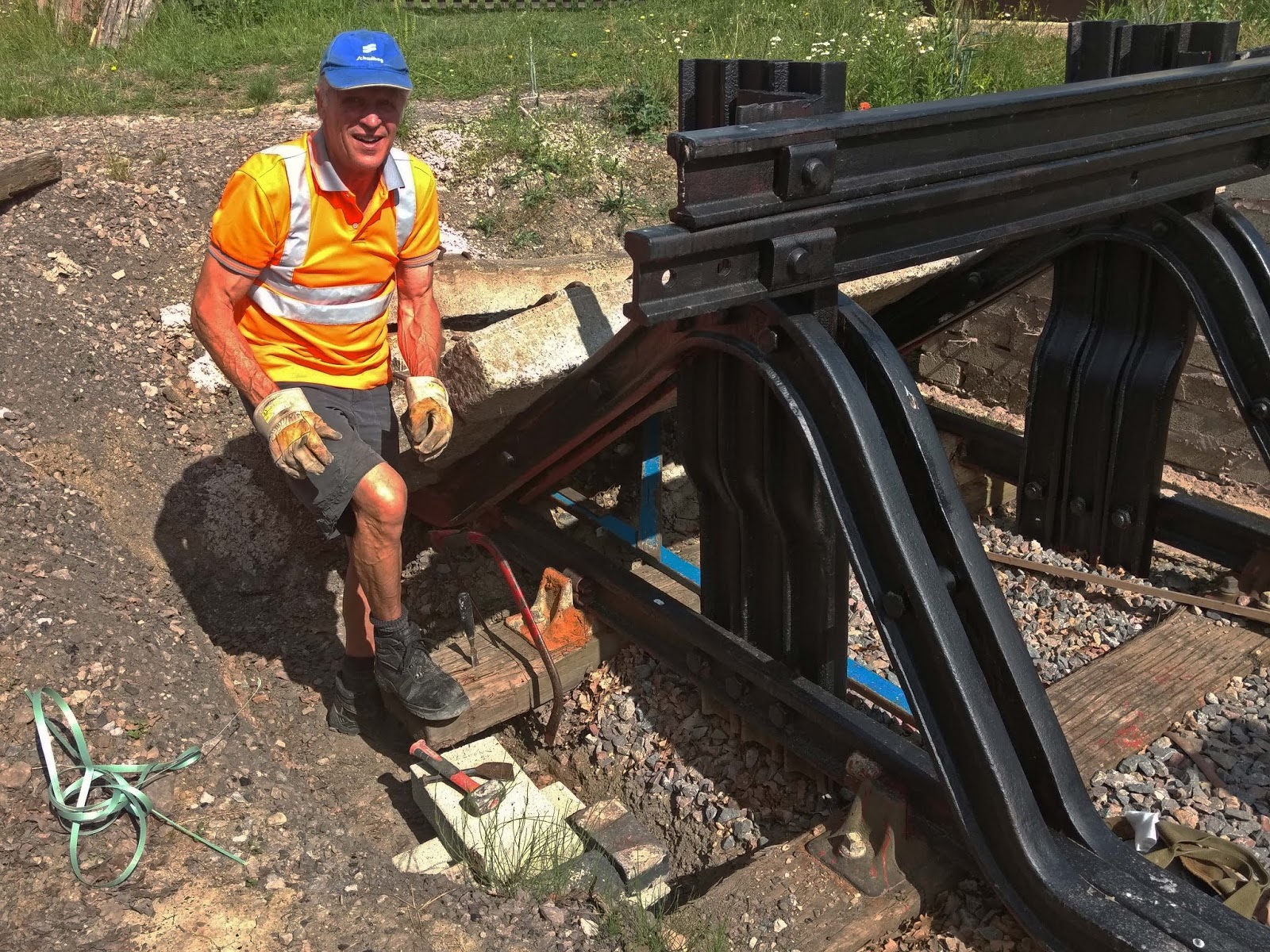
This is the view at the close of play. The straight part of the wall is nearing completion, with just two courses to do. That should be about one day's work. Then we have the return round the stop block (which should be interesting, how is that going to work then?) and a few yards down the other side to hold the terrain back.
Around 15.30 we began to develop interest in a cup of tea from the Coffeepot. Interest grew as we cleaned up Maxie, the dirty mortar barrow, the shovels with hardened on mortar on them, and the unused cement to throw back into the hut.
We had a quick look at the King, as we trudged wearily up to the Coffeepot, arriving there at 15.50.
We paused only to look back at the arriving class 26, which appears to be 60 years old this year.
Well that is considerably younger by several years than the average age on the wall building gang.
But we digress, we had good, strong tea on our minds.
Unfortunately we ran into a locked door at the Coffeepot! Oh horror. Surely it couldn't be closed at 10 to 4? We always sit there as the last diesel comes in.
An attempt to score 4 cups of tea from the window of the buffet car of the waiting train was severely whistled back by the guard. Stand clear ! Foiled again.
Seeing our thirsty plight, this very kind station staff gentleman - he was a true gentleman - vanished round the back of the kitchen and reappeared bearing gifts: 4 steaming cups of tea.
Just what we needed. We collapsed on a bench and sipped. What a day it's been. And it ended well.
Time to reflect on a milestone reached yesterday too. We posted image No.
1000 (!) on the John Lees section of the 'Early GWSR' Flickr site. The latest batch is based on prints that John took in 1986. Usually John took slides, but for a short period in 1986 he changed to colour prints, and these have no also been scanned. Due to this they are out of sequence, as we aim in principle to have a +/- chronological series in the album. Rearranging them within Flickr has proved too complicated, so please bear with.
The web address for John's collection is this:
https://www.flickr.com/photos/73536293@N02/albums/with/72157664738875108
We hope you like the nostalgic journey into the early days of our railway.
Looking over the fence - Dean Forest
A quick trip to a neighbouring steam railway - the Dean Forest at Norchard. It was a much smaller scale than the GWSR, and a different atmosphere. Each steam railway has its own. Here, there were 5 coaches and an Austerity on a 5 mile trip up a steep valley
This is the current terminus, Parkend. When prolonged, Speech house would be the next stop, right in the middle of the forest. Mrs. Blogger loved it.
Parkend seemed very authentic, down to the open gents urinal (OK, now with a roof)
Operationally, the rugged and powerful Austerity seems ideal for this railway, with its relatively short but quite steep stretch of line.
Among the original artefacts at Parkend is the footbridge, an open design with cast iron posts at the end.
Closer inspection of the post revealed a familiar maker:
E. FINCH
1899
CHEPSTOW
This is of course the company that made all the ironwork on the Honeybourne line. You can see their worksplate on the station canopies of Toddington and Broadway, on the footbridges (just Broadway now), the aqueduct (now replaced) and the road and rail bridges along the line.
We stopped here at one point. Have we run out of water already? Surely not? We hadn't, this was just a neighbour on an exercise.

What was really appealing was the opportunity to travel in this, a 1947 engineers saloon, designed by Hawksworth and built for the GWR in 1947. It is one of only 6 that survive, out of 7 built.
Here it is in all its glory. For an extra £3 return you sat in a beautiful interior with some original furniture too.
Imagine sitting at this end, and listening to the Austerity hacking away uphill right in front of you!

Here's a picture from the inside. Very likely the furniture is so large it couldn't be taken away for disposal, and hence has survived.

There are two saloons, with a central kitchen, guards compartment (with upholstered seat!) and a toilet. There's a desk, with its own light and a clock above.
Those observing the track at the windowed end have 4 buttons to contact the engine driver, guard or attendant. Large levers release steps down to the track, and there's a bell like on an auto coach to warn people ahead.
The Dean Forest railway as you probably know has a mixed heritage of both GWR and Midland. Lamp posts from both companies are dotted about the Norchard site, and we found this one particularly interesting. It is, unusually, lettered '
GWR Co' as well as the foundry (illegible) underneath. Several foundries supplied lamp posts to the GWR.
The GWSR can sell replica GWR lamp posts, and one of these in fact now stands at Norchard.
What struck us at the Dean Forest was their sense of own history. There is a small but superb museum about the railways in their area, and an excellent bookshop next door if you want to know more.
We still need to set up some fire buckets at Broadway. They are long, like the one in the foreground, and the brackets are cast, as in this picture. If you can help with either long buckets or cast brackets, drop us a line at breva2011 (at) hotmail.co.uk.