The 2025 PWay relay gets under way.
It kicked off on Wednesday 8th January. That was Usketeers day, but thanks to Walt we have three pictures of material being delivered to the site.

STEVIE was used to bring the 'Cube' with our tools, and a supply of bearers.
Earlier, a shunter had brought up the mess coach and generator van (north end of the site) as well as an Elk loaded with rail, a couple of lengths of which we plan to use in the relay.
While we will be using the same rails again, we do intend to cut off the crippled ends and weld two rails together. That will eventually result in a small gap, which will be filled with the replacement rail.


After dropping off the Cube and a pallet of bearers, STEVIE returned home to Winchcombe. He's not required on the job, most of which will be done with the Telehandler.

Here's our little halt, which we saw used by a travel company in an advert in a copy of a recent railway magazine. So it seems to typefy something for travellers. No credit was given for the photograph, which also featured 7903.

We parked in the layby just short of the bridge.
The same layby was also deemed suitable by someone to dispose of a large oven by the roadside. We shall alert the council, and the cost of retrieval will fall on us council tax payers...
Walking up the trackbed we were impressed by what had been achieved already on the first day. We've got 300m of wartime economy sleepers to replace with heavy duty concrete CS1 types, in all 17 panels between Didbrook 2 bridge and Hayles Abbey Halt. It's part II of an operation started two years ago, when we relaid between Didbrook 1 and Didbrook 2 bridges.

During the first day all but two of the rails had been declipped, fishplates removed and the rails tipped out to one side.

But first, tea in the mess coach, and yesterday's doughnuts. They were fine, as the temperature in the mess coach was even lower than in a fridge.
But a word of warning: Be careful how greedily you bite into your custard doughnut! Check first where the filler hole is, and bite from there.
Failure to observe this simple precaution, often forgotten in haste, will result in tell tale blobs of custard following the careless consumer round the mess coach.


After that we started tipping over all the sleepers to be removed. This is so that the Telehandler can scoop them up.
Rotating the sleepers was quite hard on Thursday, as they were frozen solid in the ground. Two, or even three men on bars were needed on each sleeper.

This job, rather repetitive, was quite tiring, so we treated ourselves to a break in the sun.
Very nice.

This picture is to show why we are undertaking this job. The wartime economy concrete sleepers are shorter than normal ones, thinner and have two holes in the middle. They are designed for modest axle loads, say for wagons in a yard.
Because of the holes in the middle the rebar is close to the surface, and this is a point of failure, now that we are 80 years from the end of the war in question.
The sleepers are still going to be useful to us, but in sidings from now on. The 600m Didbrook section is the only area on the railway where they were used back in the 1980s.

We managed to turn over the 400 odd sleepers by lunch time, and in the afternoon we started to collect them up.
Here Simon is slowly scooping them up one by one, quite a slow job.

At the end of the day we had cleared 5 of the 17 panels. A good start. Later the sleepers will be loaded on a warflat and taken to Winchcombe.
The site needs to be cleared by the weekend, as a contractor with a digger is coming next week to level the site, ready for relaying.
Friday 10th January.
The coldest day yet, but having signed up, we needed to go, and not let the team down. On arrival it was minus 4 1/2 degrees, and all day long, it didn't rise much above that.

It was strangely beautiful though, and very peaceful.
We had tea, and then set about lifting the remaining 12 panels of sleepers into piles alongside the up line.
Only an hour into the job we received a request to take the Ranger down to Winchcombe, and once there, assist Walt with the RRV.

The purpose was to load a pair of new insulated rails, which needed to go to Skew Bridge, where on another day they would be inserted into the main line to replace older insulated joints that were always moving.

We sped off to Skew Bridge, and watched Walt arrive in the morning gloom. Not only was it colder on Friday, but there was little or no sun about.

We lifted the two joints off, and placed them in the former 4 foot.

Paul explained that these elongated insulated joints were originally manufactured for CWR, and were glued at the centre. We will insert them into the track, and have the ends welded on to the original rails left and right.
This arraangement will save on maintenance in the future.
Then it was back to Winchcombe, and along the old up line, over Chicken Curve, along the Defford straight and into Hayles.

Here the stacking of the old wartime economy sleepers was advancing steadily.

Prising the old sleepers out of the frozen ballast was no sincecure, despite us turning them all over the day before. It had of course frozen again overnight, as low as minus 6 degrees.

'Look behind you' - it's the end of the section by the works train.

The piles by the trackside were growing steadily, as new recruit Dave guides in another delivery.


The pressure was on, because here is the contractor already, with his 13 tonne digger, all ready to go.
On Monday, so hold your horses.

In the last few moments of the dusk we lifted another load of 4 sleepers.
All was peaceful, as we trudged back to our cars.

On the way back we recalled planting a second pine sapling at the end of the platform at Hayles. This one we surrounded with a large plastic flowerpot to make it more visible, but it was mown over anyway. Probably by the Robo-mower that we hire in, where the operator stands some distance away.
It looks as if the little sapling is still alive, even if substantially shortened, so we might take another look when it gets warmer, and protect it with some stakes if it continues to show signs of life.
Monday at Broadway.
Neal and Yours Truly went down on this first warmer day of the year. Warmer means plus 5 degrees, rather than the below zero temperatures that we have been having.

However, as usual it was windy at the south end of Broadway station, and it remained distinctly chilly working there.
That we weren't just being wimpish can be illustrated by some buckets of water that we left ready for use by the mixer - these each had an ice floe in them, and it stayed there all day, despite apparent outside temperatures of 5 degrees.
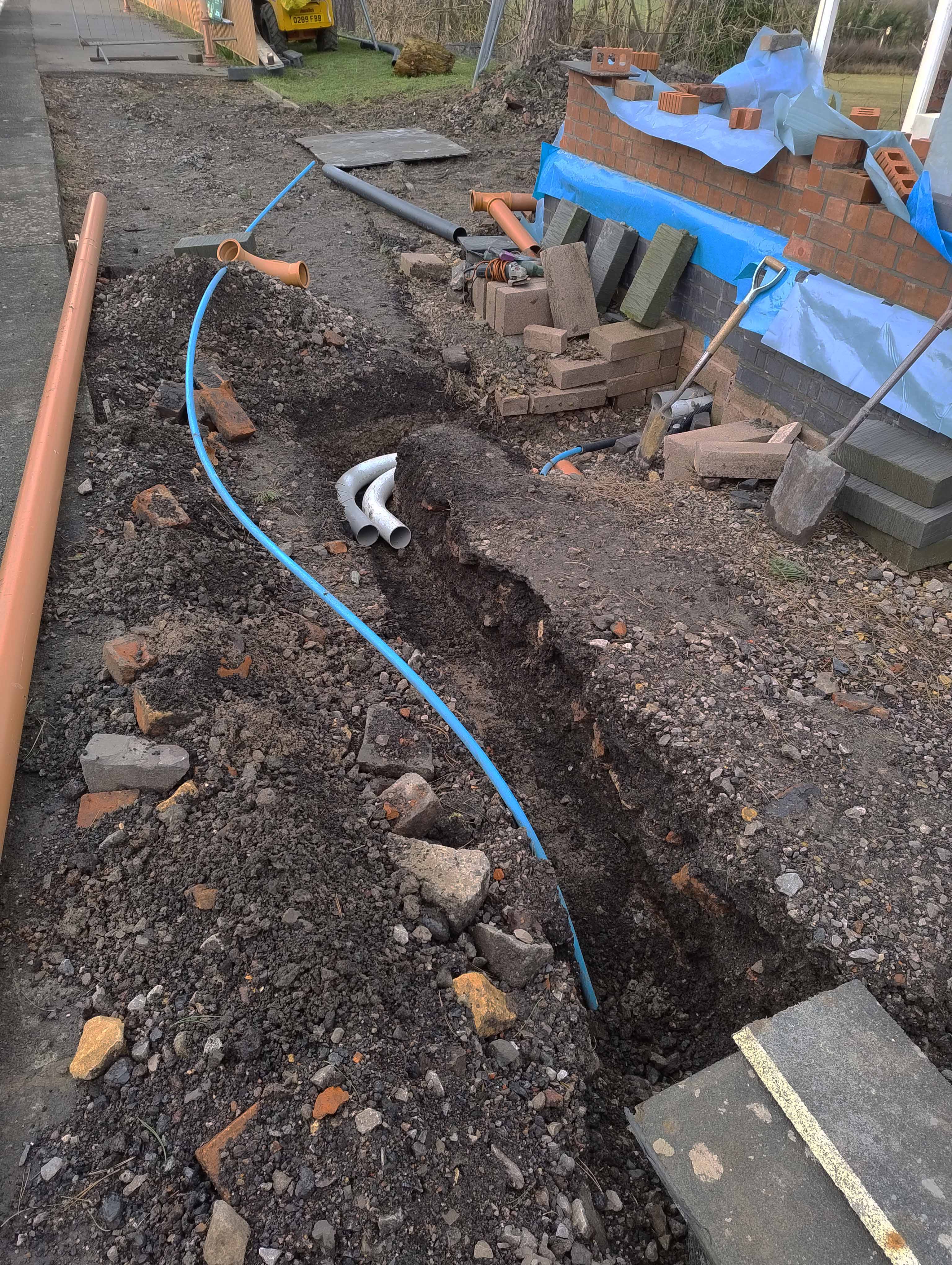
We're waiting for a digger to be ordered again - the wagons are back at Broadway, empty - so in the meantime Neal continued with the fitting and burying of the various conduits. It's amazing how many there are, of all types.
Monday's activity was on the two that lead into the store room on the end. These conduits in turn come from the store room on P1. What a lot of effort we have already expended on getting this set up, starting with the deep hole into P1, the trench under the tracks, and hacking our way through two solidly built platform walls.

The water supply pipe also forms part of this trench. We're trying to use as much second hand stuff as possible - these two bends have been knocking about Broadway for ages, and are stamped 2005! Now they finally have a use underground.

This shot is from mid-afternoon, as Neal did more afterwards. The conduits are in, draw strings are in situ, and the trench has been back filled. It needs to be too, if we want to run the dumper along here again.
After this Neal connected a conduit that comes in from the main building on the right. You can just see a hint of it from the short bit of wood with a trace of blue rope. That conduit too was connected to the central pit, and to round the job off a final segment of large diameter pipe was placed on top, and also back filled.

Yours truly spent the day in the mess hut, where our two new benches are stored.
The GWR bench is missing several upholstery buttons, has paint on it and has been vandalised by plunging a knife into it several times. We're coming round to the idea of having it recovered, so useful discussions are being held by the Winchcombe C&W upholstery team. We have also located a business in Cradely Heath which will make you replacement buttons. On the spot, if you bring your own material.
What is not yet clear is how these buttons are secured and hold the material down, as with the solid wood seat the back is not accessible. We will investigate.
The Midland bench is being stripped of the old, dark varnish, revealing light oak underneath.
Whether the MR upholstery (redone by BR Wolverton) is authentic still remains to be discovered. It does lack the delicacy of the GWR bench, being just a large length of material, wrapped right round underneath the front. The bottom is now plywood, no doubt replacing the earlier straps that would have held the horsehair in.
Some extra photographs of the winter works from Paul
Paul, head of our PWay department, was kind enough to share his snapshots of the start of the winter relay, from Wednesday last week to Saturday inclusive.

This is the start, or another way of looking at it, the end of the previous relay of the same economy sleepers two years ago.
We're at Didbrook 2 bridge, one of the few that were ever rebuilt in concrete.

This is the other end, 300m away, just outside Hayles Abbey halt. It's actually wooden sleepers here, but old ones, with many throughbolters. We're refreshing the whole lot.
The work started with the removal of the rails.


Thursday, as you read above, saw the rotation of all the 400 sleepers involved, and that in sub zero temperatures. They were stuck solid in the frozen ground, and could not be picked up by the forks of the Telehandler like that.
Yours Truly is marching down the trackbed on the left, having forgotten his eye drops in the mess coach. Instructions from the chemist: apply every 2 hours, and keep refrigerated - no problem last week, we just kept them in our outside pocket!

Paul has a drone, so was able to take this excellent overview of the entire relay site. The little green bit in the middle is a Portaloo, but most of us don't bother with that...


Yours truly with new recruit Dave guide the Telehandler into the pile with its fresh load. Then each sleeper is settled down with a bar, to make sure that the pile is steady and the sleepers in line with each other. Later they will be stacked on the Warflat and taken to Winchcombe.

Here's a detail shot of the wartime economy sleepers, all in a row. These were laid in about 1984. At the time we counted ourselves lucky to receive so many concrete sleepers, but in reality their design, economical with concrete, means that they are too short to take the axle loadings demanded, and too fragile, given the two holes in the middle. Many have therefore snapped, and we've had to put several tie bars in.
No more now.

Just a few more sleepers to lift on Friday, at the end of that day. The Telehandler is parked on Didbrook 2 bridge, the start of our works from the north.

Soon after the hired in contractor started the job of scraping off the ballast that was still useful, and levelling what was underneath.
He's been hired in for two weeks, but will probably finish sooner than that.
Then it's a question of putting back 300m of track, as fast as possible. Race trains are in sight!
Tuesday at Broadway.
Our first bricks laid in 2025! It was finally warm enough again.

John carried on along the back, standing on the pallets we placed there to stop his feet getting covered in sticky clay.
Here he finished off the 7th course, and then completed the second half of the eighth course along the back. The far end already has a ninth course.
The expanse of bricks is inreasingly looking enormous. It will not be relieved by any windows, a. because the original waiting room did not have any windows along the back, and
b. To make the building secure along the back.

We made and used the usual two mixes, all for stretchers. Last thing John swung round the corner and built a tower at each end. This can then be quickly infilled with a 9th and 10th course next time.
The front still has only three courses, due to dumper and digger traffic possible along the front. But as it has lots of doors and windows, it should be faster to build than the back, which is solid brickwork.
Wednesday with an Usketeer.
We had a last minute dropout today - Dave. Paul and Yours truly managed on their own to set the world to rights, over coffee and a bikkie in the weighbridge.

As we mulled over the biscuits we noticed - more strikingly than ever - how the floor of the weighbridge hut is damp. There are constant black (damp) and white (dried out) rings around the bricks in the floor. We voiced a plan to provide the floor with a damp proof membrane, that shouldn't be too hard to do.
FoWS were eager, and soon had the furniture out of there, so that is ready for that rainy day, when we can't work outside.

We took away the planks covering the pit - they are well rotted and need replacing - and made up a barrow of mortar. That was soon followed by a second, with Paul laying bricks in record time.

Last week's pier is on the right, and the second being built today is on the left. In between is the balance arm of the weighing mechanism. It bends upwards just where we are working, something which we will need to accommodate. The idea confirmed today is to lay a lintel across the piers, then push in mortar until it is tight up against the very old, rusty RSJ above (visible under the red bricks).

At the end of the day we covered the pit again, but this time with fresh timber. This is hardwood timber off the old Henley in Arden footbridge. It's also got two coats of Creosote, so should last a long time.
In other business...


FoWS would like to see a GWR lamp post here. In an early 1900s photograph of a boy's band marching past here you can see such a lamp post just this side of the gate post.
PWay today:
Pending the readiness of the trackbed at Hayles for re-laying, the gang was active outside the Winchcombe signal box today. It was a fine, sunny day, and quite a large gang.

 |
| Well, this is nice..... |
In the absence of the mess coach, the morning briefing, tea, biscuits, brownies, snowballs, shortcakes and left over mince pies (gagh...) were taken in the visitor centre.
An opportunity to really relaaaaax....
But then came the hard bit - digging out timbers on the northern loop points.


This is a very busy part of the railway, so it has to be in top class condition. This winter non-running period is our chance to do something about it.
Luckily the team was quite a large one, so the hard work was shared.

Contractor work on the Didbrook 2 to Hayles section.
Simon very kindly allowed us to use these photographs of the contractor in action on the trackbed.

Here he is just starting at the Hayles end. He's taking off the top ballast for later re-use, as it's of quite good quality.
If the underneath is reasonable, we will be able to re-lay directly back on top of it.

A longer distance view of the start of the work at Hayles.

Here the digger has already worked his way well along the 300m stretch, and on the left you can see piles of re-usable ballast

The digger is making use of a laser level mounted on a container to achieve a level grading of the trackbed.

Time for a pause and a chat with Bob from the PWay gang.
Looking at the level trackbed we'd say he's doing a pretty good job here.

Looking back along the cleaned up trackbed we'd say that when this photograph was taken the chap was already at least half way home. He's booked for up to 2 weeks, but it may already be possible now for relaying of the trackbed to start as early as this Saturday.
At the time of writing this still needed to be confirmed.


