Thursday, 12 December 2024

Digging again.

Saturday, the next storm.

After Bert, was it Dave? No, Darragh... well, we liked the idea of 'Storm Dave', esp. as we have three Daves on the team.

It was a bitter cold and windy Saturday. The Met Office suggested 60mph winds for our area and a temperature of maximum 5 degrees, which would feel like minus 1. Well, that was accurate!

We met in the mess coach for tea and buns, casting anxious eyes outside, to see if the weather would let up, but it never. Brave were those who were willing to trundle backwards into the north westerlies, with nothing but a canvas sheet over their heads.


North westerlies, this way.....


Eventually we faced the inevitable, and got up to go to work.

The first job was to load up 5 rubber crossing pads. They are surprisingly heavy - too much even for a group of 4 of us - so the Telehandler had to intervene.

We stood in puddles, and made the best of what our workwear could offer us.

Wanna come and join us?


Soon we were on site at Peasebrook, with two vans, the Ranger and the Telehandler. Here there was a dip - once again, in a section only recently professionally tamped - over some distance. This would require numerous lifting jacks, a largish gang and kinder weather.

The wind whipped the raindrops like needles onto our faces.

We decided to do an easier job this time.


A few hundred yards further south we were in a very slight cutting, and this already made a difference.

Here was the designated place for a small crossing of rubber pads, to allow the contractor with the remote controlled robo flail to cross to the other side.


After some pushing and shoving - this second hand stuff is never a perfect fit - we got the 4 pads in, and we shovelled some ballast on each side to make a ramp.


We then moved further south still, to a public crossing not far from Stanton Fields. This is where the track changes sides, and this point would make a useful crossing for our vehicles as well, but not at the right angle that there is at the moment. Additional pads would make it useable for us too.


Yours truly was part of the gang that installed this crossing for the public, back in 2015.

The moment we were finished a jogger appeared from out of the undergrowth and used it! He was the first, and he had perfect timing.


We felt that more pads would be better here, so will need to come back for a second session. By now it also started to get dark.

This could be seen from the waiting Santa train that we met in Winchcombe station on our return.


There was one benefit from the cold weather - a good steamy picture.


Once more the valiant enginemen set off south, only to have to return in reverse, straight into the North Westerly.

Brave indeed.

After the train had gone, the tired elves trudged back to their waiting area for a 20 minute rest.

The penguins, now in a permanent (no longer temporary) basic plywood hut on the platform kept on singing.


Monday at Broadway.

Dealing with the aftermath of the storm, and then back to brick laying. 

The storm did no real damage to Broadway station, but it did blow off all the hessian and polythene sheets that covered our work.

The trees are still up, but we learned of the intention to remove a further 6 next week. Perhaps it is indeed safer that way, but it seems clear that, with all the trees already removed in prior years, it won't be long before they are all gone. They are such an iconic part of the atmosphere at the station.

Other pines have been planted on the Malvern side, north of the station.

Here's our opening shot for Monday. You can see the window cills along the front, and at the back John is busy laying bricks.

The wagons are back again, empty. After some delay, the digger has been hired back for Thursday, and its first job will be to take away the ramp, and dig out the foundations for the canopy end supports.


During the day John worked along the southern half of the back, where he laid a sixth course.

As you can see, brick laying is powered by tea.


This is the same shot again, but now from the outside.

At the end of the day the sixth course was done half way along the back, and half way along the southern end.


Wednesday with the Usketeers.

Back at Winchcombe by the weighbridge, our second day here.

We had barely sat down inside the hut for an initial cup of coffee, when there was a furious rat-a-tat-tat that went right through the walls. It was a colleague from our C&M department with an SDS drill, drilling holes in the foundations for the underpinning. Good Morning to you, too!
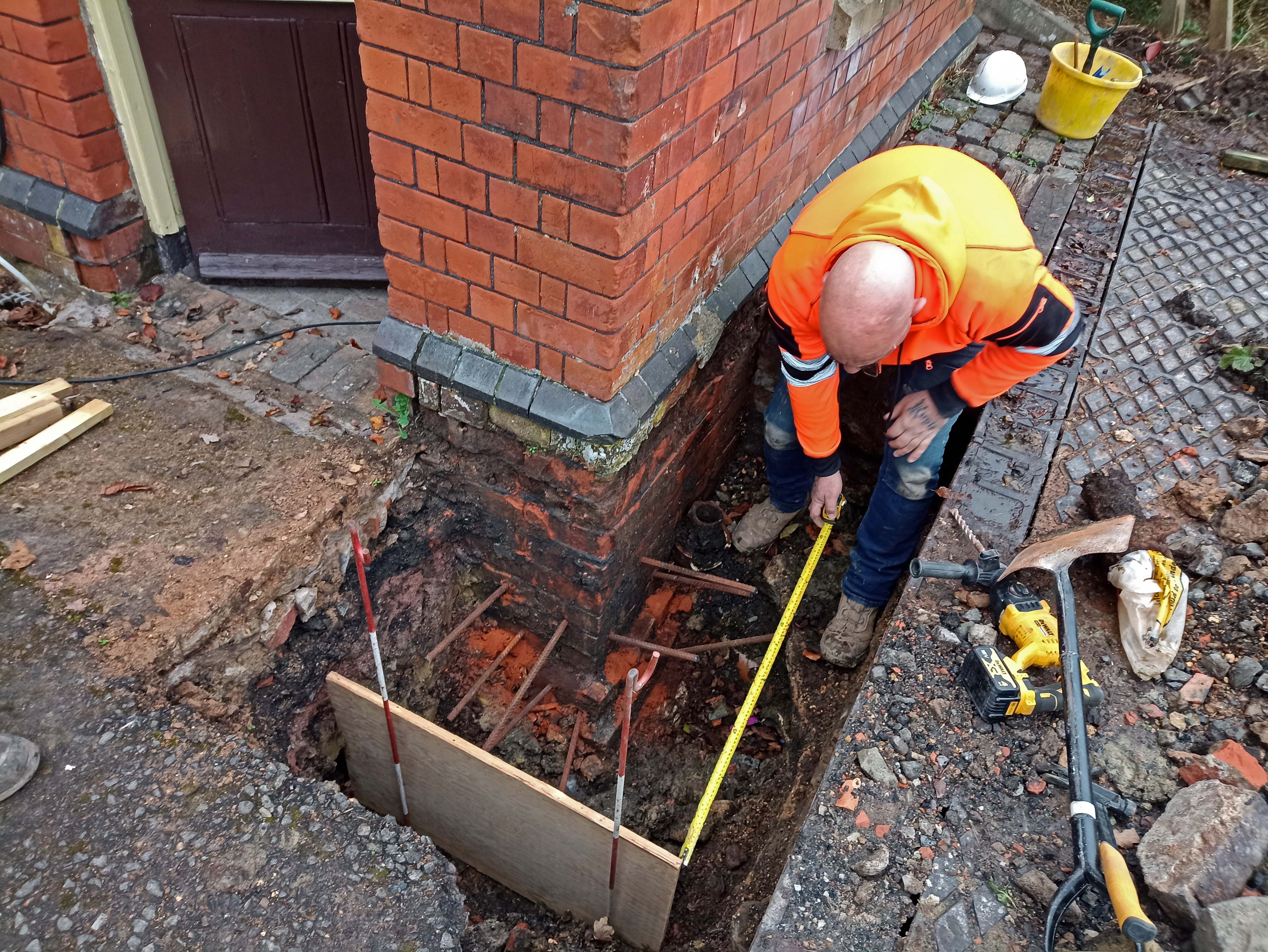


The C&M guys didn't waste any time, minutes later the rebar had been hammered home, and shuttering was being put in.


The Telehandler then came up, with its bucket loaded with ballast and a concrete mixer. 

In the meantime, Paul was readying the site where the Usketeers were to work: Under the front wall, underpinning a failing lintel.

The first thing to do here was to clean out the pit, and make it ready for the construction of two piers that will support the front wall with its crack.

This rusty RSJ had no discernible function, and was so badly gone that it came away in Paul's hands. We took it out.


Concrete was soon being poured into the underpinning pit on the corner.

Paul, Dave and Yours Truly then prepared the ground for the construction of the two supporting piers in the pit.

One pier would be 48 bricks, we calculated, so we went to get these. The bricks are from Verney Junction, so have seen prior railway use. Regular readers will have seen us demolishing part of the platforms there, prior to the East-West link being built through the site.

Yours Truly spent a lot of time cleaning out the pit of debris and mud. The bottom needs to be clean for the piers to have a good footing.

We also dug into the mud under the weighbridge table. Here it is between 1 and 6 ins deep, the 6 ins being around the outside, where coal dust fell down the slot.

Up above is a large 'X' shaped beam, and this holds up the weighing table. It is balanced on a long beam running L to R in the picture, which connects it to the balance inside the hut.

We believe the weighbridge was upgraded after the war, with a larger table and balance mechanism. The pit was also rebuilt in blue bricks, whereas the original one was in reds. In places you can see a combination of both.

Next week should see a start being made on the construction of the two supporting piers for the failing lintel.


PWay at Hunting Butts.

This is an area where we have repeated trespass, despite our best efforts to stop it.


The southern portal of the short (90m) Hunting Butts tunnel is protected by these Armco barriers dug into the ground. That should deter anyone, you'd think. Not so, they managed to get underneath and pry open one of the barriers.

Today's job was to fit a rail across them all, so that they could not be pried open individually.


The result of the vandals' visit, just a few days ago, was further graffiti spraying of some of the goods vehicles kept there. Wooden vans that were once kept there were burned out and have since been removed, but the amount of space we have elsewhere on the line is very limited.

The PWay gang also collected a lot of potentially burnable material for disposal elsewhere.

Our catch pits are also being opened and the lids thrown in. In this one we have fitted a blue secure cover underneath, which is bolted down.

You can imagine why the railway is not keen on using the last 3/4 mile of track we own towards Cheltenham, because of the vandal activity in this area. There is a big housing estate nearby.


Another job today, while we were down there, was to place more rubber pads for the robo flail crossing.

This one is between Gotheringon and Bishops Cleeve.


Finally, at Cheltenham Race Course, a timber was replaced on the northern turnout of the loop.

A busy and interesting day for the gang.


Broadway P2 waiting room - the cills.

As readers will have noticed from the previous blog, we are now high enough at the front to start placing window cills.

We have in store the six that fit along the front, but need to order two more for the end windows. The cills under the canopy (the 6) are slightly different from those in the open on the end (the other two). We therefore need to order two more, and because of their different form this is a special order.


One of our kind readers had taken the initiative to support us with the cost of three of the window cills. They're marked in green above. The front ones cost us £97 each, and the two end ones £422 each. Those are a bit different, and need new moulds making.

If you want to join his initiative, or know more, send us a blogger contact form (top right).


Wednesday, 4 December 2024

A new project.

Friday at Broadway.

'Bert' has passed, and so has the overnight frost, so we are back on brick laying.


During a visit to the signal box, we were surprised by this large helicopter.

It approached Broadway from the west, then circled it once, before flying off over the Cotswolds Edge.

A man in the open door on the side was looking down on us.

Down below, you can see that the empty wagons have been returned. We now need to arrange for the digger to be re-hired.


While John was laying bricks along the back of the building, we cleaned the remaining blues found in the previous excavations, and added them to the two pallets a bit further up north.

We also reduced to small pieces of rubble another wheelbarrow load of broken bricks and concrete. This was tipped further along as well, where the platform as currently is has dropped a little as the infill consolidates.

The main job for the brickie's support, next to making up mixes of mortar, is to cut bricks in half. This is to enable him to simulate English bond with short headers (which are in reality cut in half, and thus much shorter).

The work is very dusty. Everything goes pink. We create about 100 of these half bricks per brick laying day, and thus keep ahead of John (who is also laying strechers)


This brick laying, and indeed cutting, is gradually making an impact on our stocks. 

Here you can see two empty pallets, and a third nearly so. Behind is an original shrink wrapped pallet.

The three pallets in the foreground had randomly stacked bricks, which had been prepared for use in 2017, but were never used. Many are slightly chipped, due to the repeated manipulation of the slightly fragile bricks. Part of our job is to sort these out, and cut off any damaged ends and so turn them into (half sized) headers.


At the end of the day John had completed the fourth course along the back, and also along the northern gable end.

A fifth course was started at the back. John is wary of doing anything along the front, as Neal could come through there at any time in the hired in digger.


Saturday, out with the gang.

Ten of us on Saturday, a good turnout. Last Saturday was only 5, plus Bert, the storm.


Saturday's mission was concrete sleeper replacement, so here we are loading a couple of spares.

Two are already out there. 


The jobs were at Broadway. Here we are by the lovely, but currently useless bracket signal.


We had the mini digger with us, but it took so long to change the buckets from wide to narrow that the gang got bored, and dug the first one out by hand. The ballast here was brand new and not too big, so digging into it was easier than usual.

A cracked sleeper.


We got the two sleepers in question out, and to one side. With two exceptions, the gang here asked to replace them is the same one that put them in there in 2017.

That'll teach us!

Just ahead is Broadway station, and the draw was the PWay train, with mess coach, in the platform by Christmas. We did it too.


Below on the right is the council owned Broadway station car park. Although there were no trains, it was heaving, and full right down to the bottom.

Mrs. Blogger, on a mission to scour Broadway for Christmas presents, was one of the 'Parkees' and reported seeing us up above.

We however were busy shoveling, to back up Lee on the Robel.

We had a whole fleet of vehicles with us as well - Andy's van, the Transit with the tools and spare sleepers, the Ranger and Trailer for the mini digger, and finally David in the Telehandler for the muscle.


Then we moved down 3/4 mile to the next pair that needed replacing. This was by the fixed distant. 

Only just after lunch now, and the skies were darkening already.


This time Dave was ready and with the right bucket, so the exchange of sleepers went swiftly.

The mini digger certainly helps a lot, we were very grateful.


 Putting the ballast back is still done by hand, then we Robel pack the scene.

This was the fourth sleeper that we replaced. It has a large chip missing. It's not a severe fault, but since it was marked up and we had all the kit on site we took it out.

All four replaced sleepers were lifted on to the new white Transit, to be taken back to Winchcombe. They are still good for a siding replacement. 

We were quite impressed with the new Transit's performance under load. The engine still had quite a bit of pull, and the handling was fine. A Citroen tipper we had (since sold) was gutless, and tended to wallow under load. So this one is a big improvement.


Monday, back on bricks.

We pick our working days depending on the weather (and personal availability). Monday was good for both, so we were off again.


John worked along the back again. Half in this picture is up to the fifth course.


At the end of the day he had completed the fifth course along the back. It was a shorter day, not only because of the daylight, but also as rain was forecast for the afternoon.

So we stuck to two mixes, which basically completed the back on the fifth course. All in fiddly little half bricks.


Neal came after lunch...

The front is ready for some window cills on the third course, so Neal had a happy hours setting these out, and trying out various combinations of bricks around them.


In response to a blog question, the cills we had were dirty after 10 or so years in store, outside. Neal did a good job on them with a pressure washer.

We were also two cills short, and these have been ordered.

The new door frames are expected around Christmas. It's all moving along.


Wednesday with the Usketeers.

We are back ! And we have a new project - The repair of the Winchcombe weighbridge hut, one of the few original buildings from 1905.

Here it is on the left. The weighing mechanism is intact, and fully functional.

In the very early GWSR days the railway sold off unused land at Winchcombe, and this allowed two houses to be built adjacent to the station approach. The neighbour here - newly arrived, and already a volunteer on the railway - has inherited a garden that is so close to the weighbridge hut that there is less than a foot all the way round it. And the inside of the weighbridge hut is very damp. That is the situation that we have today.

The gate into the yard is a modern farmer's gate, and there is a (currently unfunded) idea to convert this to a wooden GWR style 5 bar gate. The original gate posts (that led into the goods yard) are still in situ. A GWR lamp post would also be in the right place on the island.


The FoWS were mystified by a persistent leak from the gutter in the middle of the front.

Closer investigation by the Usketeers revealed that this was caused by one of the gutters sinking, due to a long crack that went round the arched window, and right down to the bottom


The cause of the crack looked to be a stone lintel that crossed the weighbridge beam pit. The lintel was cracked.

The Usketeers made a proposal to rectify the cracked lintel, and rebuilt the front wall, back up to the top. 

This was accepted, and today was our first day on site.


Well, that first day on site was celebrated with coffee and doughnuts. Here you see a beaming Dave and Paul, with a very substantial balance mechanism on the right. It is very much bigger than the modest balance that we found in the weighbridge hut at Usk, a situation that puzzled us. The more so as the weighing table had '1945' cast into it.


We decided that a joint approach to the subsidence with our nearby friends from the Construction and Maintenance dept. would yield the greatest amount of brain power, for what would prove to be a rather complex problem.

Here is C&M Martin examining the failed stone lintel.

This turned out not to be stone at all, but a pair of thin RSJs in very poor condition, boxed in by weak concrete and chicken wire.


Other members of C&M also dropped by to see if they could help analyse the dynamics of the crack in the facade.

We eventually worked out that the weighbridge must have been renewed at the end of the war (contemporaneous with a rather ugly 1940s toilet block that was found on site when we took over in 1981) and the new mechanism, taking up to 20 tonnes, was much bigger, and installed a few inches higher than the 1905 original.

Over time the ground level around the hut had also been raised, so that the hut was no longer proud of the ground level, but actually set below it. This also contributed to the damp inside it.


Close examination of the crack also showed that the main reason for it was subsidence of the corner here, possibly exacerbated by water in the downpipe (removed, next to the spade) which possibly led to just a nearby soakaway.


The team from C&M soon got to work digging out the corner, to see where the water actually went to.

It was agreed that the Usketeers would start on the failed lintel, by building two supporting towers underneath it.


Larger digging means were brought in, as the failing corner became more apparent, with 3 courses of spalled bricks at, or just below, ground level.

It was decided to underpin the failing corner, for which we had to get back to the original foundations.


The Usketeers expressed concern at the debris in the very narrow passage around the back of the hut as well. This clearly had not been addressed, perhaps since the plot was sold 45 years ago.

To get at it, we had to remove the end of this hedge, which had a failed picket fence inside it.


At the end of the day we had a very pleasant meeting with the new owner of the adjacent house, and she let us into her garden to view the situation at the bottom of the rear wall, which we could not see.

To our astonishment the tiny space left between our building and her garden was half filled with soil, a left over from the previous owner, who grew vegetables here. This easily explained the dampness along the rear wall in the hut.

The FoWS were keen to remove the soil and debris asap, and will do so later this week. We have the full and very kind collaboration of the neighbour, which is a relief.

When we return next week there will therefore be two work sites here then, and two teams working, helping each other.

It was a most useful start to a tricky problem. But we must look after our original heritage buildings.


PWay update.

A rather frustrating start to the day on Wednesday. Not only did the Ranger have a flat tire, but the replacement vehicle intended, the white Transit, turned out to have an incompatible socket at the rear, which meant that it could not pull our trailer to the intended work site. 

A timber was replaced on the Winchcombe south points, but we could have done so much more. Just bad luck, but we will prevail, it was only time that was lost.


One project that was able to be advanced was the fitting of several small new rubber matted crossing points alomng the line. This is to enable our contractor's flail mower to pass from one side of the track to the other.

This one here was installed in the Dixton cutting, near Prescott. More will be fitted.


A clear out of the S&T yard also unearthed a quantity of original insulators, mostly marked BR (W).

We have put them up for sale as you can see (in the Cotswolds Halt), togeether with a sample rail end, for door stoppers or mini anvils, or any length that you might desire.


The Broadway digger is coming back on site on Thursday, to fill the two wagons again. This time we will be excavating the pit for the foundations at the foot of the footbridge steps.