Tuesday, 9 April 2024

Loading for Broadway.

Friday at Toddington

Essentially a day for transfering the dumper back to Winchcombe for someone else to use. We will need it again when we get the chance to dispose of the second half of the spoil accumulated behind the footbridge.

We cleaned and greased up the little dumper, and ran it back onto the trailer.  Then back to Winchcombe, unload, reverse park the trailer (tricky....) and finally proceed to Toddington to check the P2 roof sheets we had bought and stored in the old garage. They are priceless, as you cannot get them any more, their grade of thickness is no longer available in the UK, only thin, garden shed sort of stuff. If stored in the open in piles they are at risk from damp creeping in between the 100 or so sheets.


There were rumours that the PWay would make a start on Saturday of placing the stop block at Toddington, and relaying 50 yds of track.

It was satisfying to see that the stock had indeed been shunted out of the way, leaving the site clear for us to get to work.

Goods vehicles with an exterior refurb will be stabled here, so it should look quite attractive.


Paul was about with the fork lift. He positioned the second hand 'economy' sleepers out of Didbrook by the new stop block area, so that they will be within easy reach for when we start work.

These concrete sleepers will replace life expired wooden ones, which, we were informed, were the first sleepers ever to be laid on the GWSR. (alongside the goods shed) So pretty old then.

A whining sound in the station drew our attention to 'STEVIE' trundling through, with the results of a lineside clear up session in the Broadway direction in tow.


Saturday with the gang.

A good day, we did something quite different on Saturday - the relay of that siding at Toddington, with the planned placing of a stop block. It was true then.

Tea and sweets were consumed in the mess coach, as well as a bag full of unusual goodies that David brought back from a visit to Japan.

What is this? Should we eat it? Does it need hot water to activate?

This 'foreign food' was treated with some suspicion, PWayers are traditional guys. But some items, notably a large wagon wheel type thing but with more marshmallow, turned out to be quite popular.


Then it was off to Toddington, where the now partly empty 'siding 2' awaited us. This is to be stripped and rebuilt from the white dumpy bags to a new stop block on the ballast in the foreground.

The first job was to free up the fishplates. This was quite easy, as all of the ground consisted of locomotive ash, which was easy to dig into.


Steam dept. members told us that these rails here were among the earliest ever laid on the GWSR, and as they were for sidings the quality was low, the best parts being used on the future running line.

Here is a typical fishplate, with just two holes. Rails were heavily worn and short, and chairs came from all sorts of places. The Mills keys were rusted in solid, and fell apart when hammered out.


Once again our RRV STEVIE came into his own, and removed the rails, all of about 5m in length, so a real kit of parts, this siding.


The rails were laid to one side, and will, surprisingly be used again later. They will support only stationary vehicles, for display.

After that it was the turn of Dave in the Telehandler to scoop out what remained of the sleepers and chairs.


This length of siding used to be the location of 'TINA', the steam dept. Mk1 mess room coach, and after that was sold, it held some box vans and a unit from a DMU.

With all that cleared you got a new viewpoint for passing trains.


Here is one of the more unusual chairs that we uncovered. It is marked LNWR (1846 to 1922) and has 4 chair bolts, two of which we have never seen before


Once all the sleepers had been scooped up by Dave - any loose GWR throughbolt chairs being wheeled off for transformation into boot scrapers by the 2807 supporters - it was time to scoop up the ash ballast so as to make a new bed for the replacement concrete sleepers. 


The ash was dumped into the, er, ash bin. Well, that's what it's for, isn't it? We had rather a lot of it though, hope it's big enough. 


More trains passed by our relaying site.
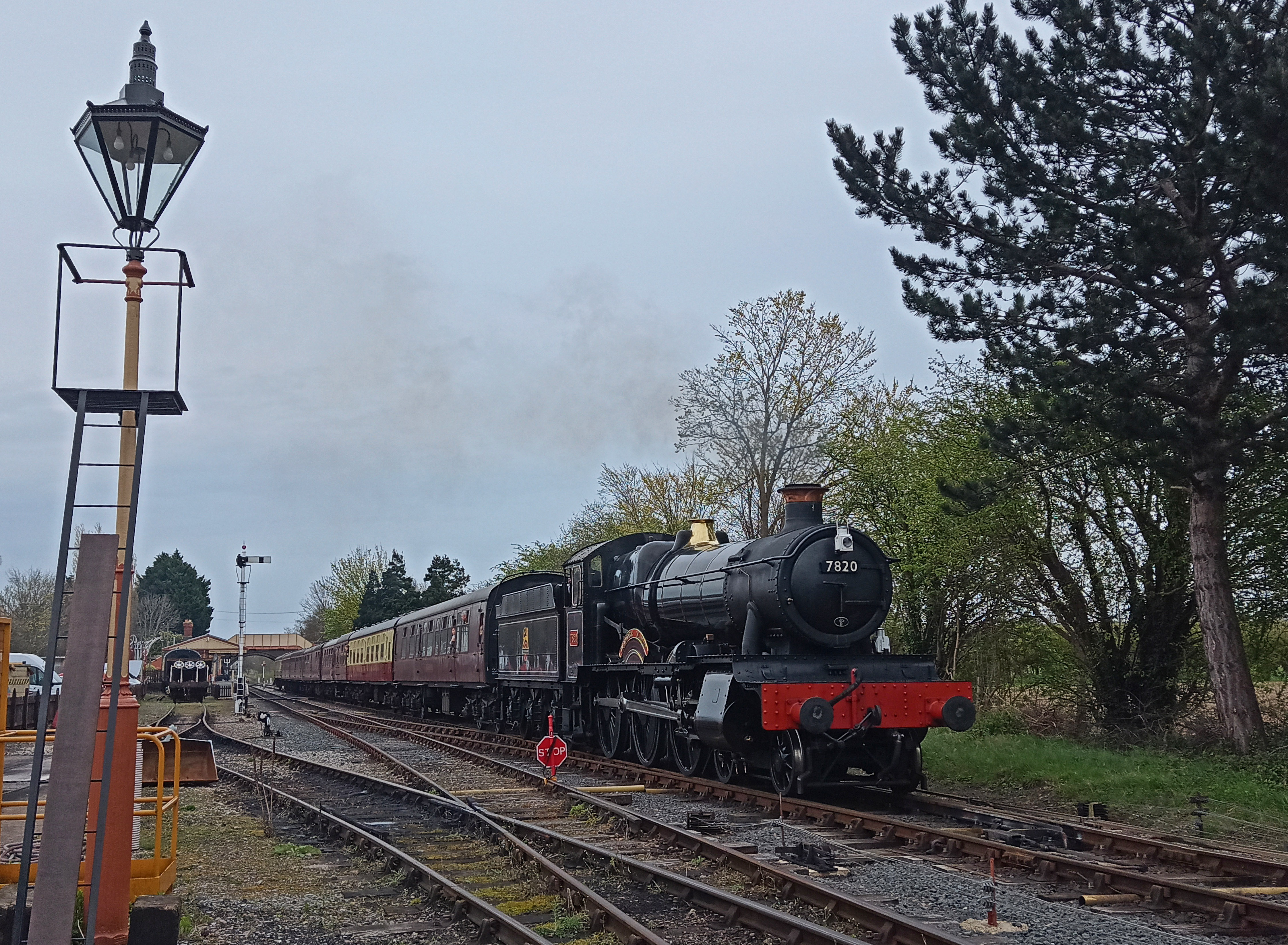
 

This time it was Dinmore Manor, being overlooked by the yard lamp rescued from the platform at Winchcombe. Now it's in a yard, as it should be.

The stop board is for the siding adjacent to the one we were working on. This is known as 'Siding 1', which your blogger finds confusing, as it is actually the former up line, which forms an extended loop from the yard throat. The siding we were working on therefore is known as 'Siding 2', although it is the first one with a dead end.


After starting to excavate the ash ballast we hit a conduit, which caused some consternation as it was not advised. This is what the gang is staring at.

However, it turned out that all 4 cables in it were disused, and indeed cut at some point. But not subsequently removed. 


Then it was a break for lunch, this time in the new mess room built on the end of the goods shed in similar style.

Out of the window you got a great view of the big fan of a diesel locomotive below. Who can guess which type it is? This was positioned to propel three empty wagons into the car park, ready for loading with supplies for Broadway on Monday.


Back outside, and STEVIE got busy scraping the bed of the siding with the bucket.

The result was a very level bed, as the arm was locked, and the RRV ran along rails. 


After levelling the bed it was time to try out a first sleeper.

These are the wartime economy sleepers, ex Didbrook. So nothing is wasted.


Here's the first sleeper laid in. The rails actually continue to where the photographer is standing, that was the next rail joint.

The conclusion was that the bed wasn't quite deep enough yet. It only takes one sleeper to be a bit high, and the whole track panel is too high as well.

That was as far as we got on Saturday.


As a reminder, these are the wagons that have been externally restored, and which will go on to the relaid piece of siding 2.

That will improve the look of the locomotive shed area from the passing trains.


At the end of the afternoon we had the opportunity of a couple more shots of railway activity. We enjoy PWay work, but there are side attractions too that we enjoy.

Bert Ferrule gets a great shot of 37 215 as it passes with the last train to CRC on Saturday.
Some moments later there was an opportunity for an unusual stock move, 7820 Dinmore Manor with three Dogfish wagons out of the Parlour Road siding. These were propelled up the line.


A bit of GWSR history.

John Lees' photographs, put on line here:

https://www.flickr.com/photos/73536293@N02/albums/72157664738875108

are always a useful source of the early years on the GWSR. What did that siding look like when we took over the line? Was it true (as some claimed) that it was the first ever track to be laid by the volunteers?

Here is the Toddington track layout in 1960, after passenger services were stopped. A double track main line, and a loop alongside the goods shed.


With all the track lifted, we see the area of interest to us, between the goods shed and the signal box, in early 1980.

Then, in August 1981, the first signs of track laying. A compound of corrugated iron sheets was created next to the goods shed, reinstating the two main lines. But not yet the loop alongside the goods shed, later known as siding 2. So the two main lines were the first to be laid, the loop came after them, not quite the earliest track then.

A year later, in August 1982, the compound was removed again, to reveal that the up line now had a kink in it, to increase the width of the six foot, as the up line was considered a siding. This kink has given us a headache today, in getting the relaid crossover to fit. Ideally, the up line would be relaid as such (and not as a siding with a wider six foot) but today there is a bracket signal in the way.


Loading up for Broadway.

Three of us stood ready on Monday to help load thirty tons (!) of materials for Broadway in the Toddington car park.

Once on site it became clear that no help was needed at all.
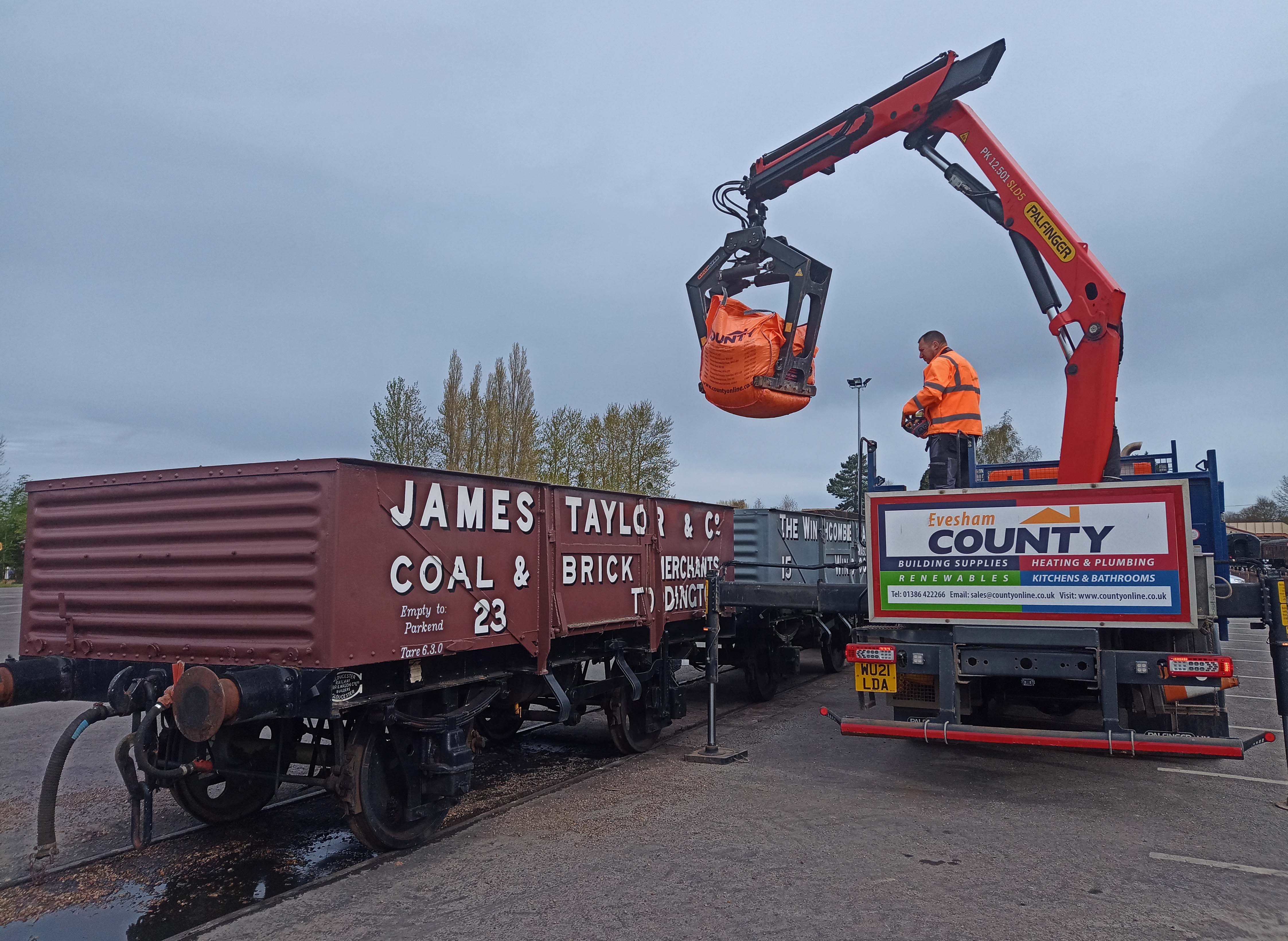


The supplier came with a grab lorry and loaded bags of type 1 material straight into the trucks. No need for help here.


Ten bags fitted in each truck, and then there were further bags of sand, which were placed on top.

The type 1 will go to support in the floor of the P2 building, while the sand is to make up mortar for brick laying.


Speaking of brick laying, the third wagon - the Mermaid - was then filled by another supplier with blues, and the balance of reds that had been stored by a supplier since the P1 building was completed. They were part of the original order.

The total supply of materials for Broadway P2 is over 30 tons.


On top of the bricks we lifted the 4 RSJ ring beams, held down by a thick strap.

This train of 3 wagons is now ready to go to Broadway for unloading. However, the intended date for doing this - this Friday - has had to be cancelled due to the unexpected non-availability of one of the key players.

A new date is being researched. It's not easy to get everyone in line, and then fit it within our (non-) running schedule.


Meanwhile, John set about cleaning more of the curved angles for the ridge purlins under the greenhouse, while Neal offered his help to Paul from the PWay, to further excavate the site of the siding that we were relaying on Saturday.

He used the small Telehandler from the Toddington site, which worked quite well.


Neal also figured out - completely for himself - how deep the excavation had to be, and then devised a system for checking the depth without a laser level. It involved - a length of string and a stick. Paul was astounded.

This kind gesture will save a lot of time on Wednesday, when the sleepers are expected to be laid in. The stop block is planned to be positioned on Thursday, using STEVIE, the RRV.


Paul and Yours Truly spent the afternoon sorting the second hand sleepers from the Stanway viaduct into re-usable, and those not. There's quite a pile of them, as you can see.  We stacked the first 96 on the Warflat on Tuesday afternoon, being two of the piles in the picture


This is the start of the 'not suitable for re-use' pile.

It is very strange, but these are hardwood sleepers and they are not lasting well at all. Many are rotting, starting at the ends. Several have fungi growing on them.

These here will have their base plates removed, and some other second life found for them.


The blog will be slightly more intermittent for a short while now, due to family commitments.


Wednesday, 3 April 2024

A grab lorry came.


Thursday at Toddington

A contractor came with a grab lorry to empty the three trucks from Broadway and take the contents to - Gotherington Skew bridge! Don't we have a railway line to there?

Here are the three trucks on the unloading road at Toddington. Neal is checking the unloading of the first truck. It will be four journeys to get them all cleared.


Once the first load has gone, Neal, Ian from the drainage gang and yours truly don the inch thick clay boots and shovel the bits missed by the grab into the middle for another go.

The operation went well, although slowly, as the grab was soon full of sticky clay that wouldn't come out any more.


Between the loads, and after shoveling the remains into the middle, we went to the mess room for a brew.

On the way, through the shed, we took this picture.

You can see the 2807 tender frames (upside down) and in the background the Peckett John, which is being rebuilt as a fill in job as time allows.


When we came back from tea it had started to rain and blow quite seriously. The sky was very disturbed. The first wagon was empty, and the second almost so.


The third and last wagon was the Mermaid, and once again we had to climb in, don the inch thick clay boots and shovel stuff into the middle.

You got a shovel full of clay, lifted it up (very heavy) and then threw it into the middle.

No you didn't, as the clay remained stuck to your shovel ! Cue much banging of shovels on the metal floor to get the damned stuff off.


The grab lorry went to Gotherington Skew four times, and the last journey, being empty, was a fill in one to take some of the PWay's big pile of concrete rubble away.

Huge pile of concrete rubble in the PWay yard.


Yours truly stood in the pouring rain and gusty wind to see the grab lorry pick up old sleepers, broken platform slabs, concrete rubble and S&T frames.

The PWay yard has been a dumping ground for years, sadly. But no more.

After taking out one lorry load - say about 20 tons - the pile was much reduced, although we would dare venture that there was enough left for the chap to come again. There is other scrap concrete around the site, esp old sleepers such as the broken wartime economy ones.


Saturday out with the gang.

Nice and sunny, but a modest turnout. C&W were shunting around us, to retrieve a plywood lined box van to have new plywood fitted. It seems that it was an economy van, with plywood fitted when built, so it's going to get more of the same, but of a better quality.

Here is our PWay train being shunted back and forth.

The white Transit, having 150.000 miles on the clock, seems to be weeping oil, so we left it at home and piled everything into the Ranger. Luckily we didn't need many tools this time. Some of us had to go in private cars, but as the work site was at Toddington with its big car park that was no problem.


The main job on Saturday was to lift and pack a number of dipped joints at the yard exit.

Bert Ferrule and Graham then went off to the end of the CWR north of the viaduct, to resume fishplate greasing southwards.

They made it to the Stow Road bridge.

The yard at Toddington gives a good view of the passing trains. On Saturday, being Easter, we can report that the trains were well filled, which is a relief. 6 carriages out of the 7 had people sitting at every window. 

A motorcycle group called at Toddington as well, so we are getting back into the swing of things.

The balancing working to P&O heading south was Foremarke Hall, but the shot was straight into the sunlight.

We debated where to eat our lunch. We are barred from the revamped cafe, even outside, if wearing orange. But that is what we look like, we are required to wear it.

As the sun shone brightly we decided to sit on the terrace outside the mess room.

Can you see it coming yet?

In the foreground is some of the Interflon kit. We have given up on one of the backpacks, and are using the little hand sprayers as the second. You really need two operators, one going down each rail.


This was the machine Nick and Dave were trying to see in the picture above. Unusually, and luckily for the photographer, the driver had a bit of steam on, while still in the 10mph station limits restriction. We then heard the lovely sound of a 3 cylinder pacific accelerating away.

Our next PWay project will be the installation of the stop block (in the car park at Toddington) and the relaying of 2 or 3 panels of track in front of it. These lengths will be occupied by 4 goods vehicles that have been cosmetically restored, to make the Toddington site look better from a passing train.


Monday on the steels.

Easter Monday, so trains ran, and two of us attacked the steel in the greenhouse again, trying to get the cleaning and painting job finished at last.

One of the two trains was hauled by a Growler on Monday (staff shortages was a reason we heard) and we posed this shot in anticipation of a noisy Growler type departure.

Alas! The loco went into stealth mode, and trundled away and out of the film as quiet as a mouse. Delete film....


Back on site found us working on the curved ridge purlin sections (sticking up in the background) and the big pile of angles (in the foreground).

We are almost through it all now. It all needs to be in red undercoat, if we want any protection from the weather at all. Once it's all done we can attempt some more fabrication. Purlins and trusses need to be made still.

Two curved sections remain to be cleaned, and one straight angle, which had been done before but succumbed to streaks of rust as only in primer. It just goes to show how this roof is not dry at all, despite many people saying how lucky we are to be able to work under a roof.


The forecast was sunshine and showers. We had a lot of sunshine to start with, hence the good progress on Monday.

But at about 4pm a big black cloud came over, and the rain hit the station, but, strangely, mostly missed the greenhouse. We were that close to it. 


At the time we were waiting for the last of the primer to go off so that we could apply undercoat before the end of the day. This was the view from the Trust hut. It's wet. The rain is bouncing off the tarmac.


Wednesday with the Usketeers.

Good progress again today, with two jobs on the go:

- Lengthening the diamond paver path to meet the road, and

- Landscaping the former site of the FoWS compost bins.

We have some absences coming up over the next month or so - funerals, courses, a holiday, so we thought we'd better get on with it.

Here is Dave making a start on removing the pieces of turf.


Down the side of the road John and Yours Truly worked on the former compost bin area.

On a railway, there is always a drainage ditch at the bottom edge of a cutting, and this one had been back filled by the compost bins. So our job today was to reinstate the ditch, and fill in a triangular area with earth and seed it.

Here you can see us making a start.


Mid morning Dave had finished the excavation of the area for the extra pavers.


The bottom of the new paver area was then filled with sand as a blanket from the clay, and next time we will lay the pavers on top here, on a bed of weak mix.


At the end of the day on the other side you can see that the reinstated ditch is almost there. The cutting side slope is also reinstated, leaving a long triangular piece along the road, which will be seeded. If we have time, we might also seed the cutting slope, as grass is better than ivy, bindweed and bramble. The time available depends on some absences that we mentioned above, and a new job that is earmarked for us, which is still waiting for payment from a sponsor. 

There is also potential brick laying work at Broadway, once the floor is in. That side of the business is rolling along nicely. We have got the wagons loaded with spoil away and emptied, and the next thing on the list is delivery of materials to Toddington, and then transport by rail to Broadway. That should happen mid April or thereabouts.


We had a quick look at the PWay gang today. They went fishplate greasing, and had a yard day.

Here Dave is just returning from levelling off some spent ballast in front of our site container.

Time was also spent on GWR throughbolter removal from still reasonably decent sleepers. By the oak tree we might be interested in the construction of a sleeper built bench round its base, and paul very kindly offered us the second hand sleepers that would suit.


Then we had a 'promo' card given to us by a correspondent from Rotterdam. It's for what looks like a reinforced fishplate. Googling the name and the product produced no hits, so you'll have to take it as it is.

In fact on the GWSR we use almost always so called deep skirted fishplates, like the one below from the Bluebell.


Wikipedia - Les Chatfield.

These seem to be developed versions of Alfred A Dixon's idea of having a reinforced section in the middle, where the stress is highest.

Note that, according to the promo card, numerous railways use Alfred Dixon's fishplates, except one - the GWR ! Probably had a version of their own.

Last but not least, hot off the press (well, two days ago):


Lineside photography under review.

Many regret the withdrawal of the lineside photographer's permits that we used to have.They were withdrawn some years ago now due to increased concerns about safety.

But these safety concerns have been addressed with a new photographers' facility, now in an early April test phase.


A new type of photographer's security enclosure is being trialled, seen in the above photograph being taken to a test location.


Here it is, ready for the first test. Participants will be able to buy day photography permits and enter the secure installation, safe in the knowledge that there is no risk at all to them, or to the railway.

The height of the security screen is unfortunately not adjustable, it's one size fits all. Smaller participants will need to project themselves in an up and down motion to see over the edge, and for this a rubberised floor is included. A forklift truck will be on standby to move the secure facility to a new location on demand, if a majority of participants inside can reach agreement.