Thursday, 21 September 2023

Lamp tops for Broadway

Friday at Broadway

With the help of the Friends of Broadway Station we have bought 6 new copper Windsor shaped 16 inch lamp tops for platform 2 at Broadway. The impetus for that came when the first half of the platform there was surfaced, and it was felt worthwhile putting up the final part of the lamp posts, planted there about 8 years ago now. There are 6 more such tops required for the other half of the platform, but funding for those has been deferred until the P2 building is up, and that part of the platform is no longer a building site.


It was a bright sunny day on Friday, and Neal and John can be seen carrying the tops down the platform.

On the right are the empty lamp posts, not for long now.

Here are the bodies and canopies spread out along the six posts.

We bought the tops from a coppersmith, changed the plain bolts for SS ones so that there's no rust in the future, and then had 'BROADWAY' stickers made for the glass.


We're not absolutely sure how the original names were embedded in the glass, but possibly a combination of enamel and etching. On top of that, we do not know of any companies that would do it for us, so we repeated what we did on P1, a sticker, which looks just right.

Here is a picture of the original in 1904. You can see that it had a gas burner in it, which would have come from the acetylene shed in the goods yard across the road. We have nearly the same, but with a lightbulb on the end.


Here's the first one going on. The glass is packed separately, four heavy packs in bubble wrap!
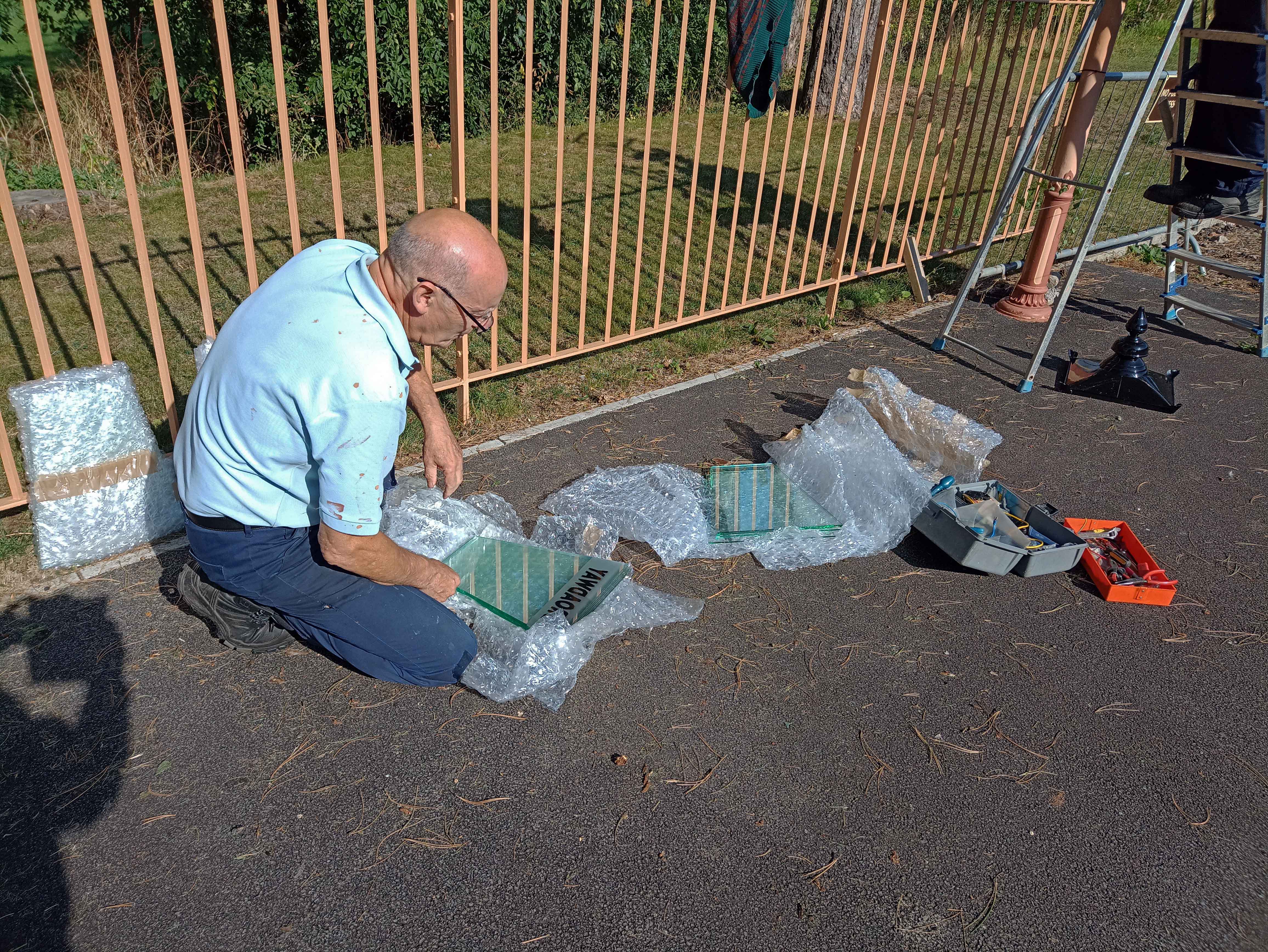


We had to lay it all out on the ground - plain glass, glass with a sticker, and door glass, which is slightly smaller. Unlike the (probably Chinese supplied) lamp tops on P1, these have a proper door on the side as they should.


Here they are in situ.

So much for heritage on P2.


On P1 however a shiny plastic plate has been attached to the quad royal poster board that we made to the GWR design.

To make sure that it was as authentic as possible for our museum railway, we went all the way to Wallsall to a specialist company to replicate the mouldings that go round these boards.

Under it is one of those now ubiquitous snap frames. We painted that black, in an attempt to disguise its bright aluminium impact. 

Also affected by the plastic are the 1950s era notices that are on this board, specially prepared by Alex.


Better news outside the cafe - two pairs of tables & chairs have been put outside. What a great idea! It makes the cafe look more welcoming, and the new tables are in use too, as you can see.


Sunday at Stanway House.

An afternoon of classic cars, tea and cake. A lovely event, and in the gardens of such a wonderful house too. And the fountain was on. Our visitors from Holland had never seen the like before, and all without pumps!


Stanway House, with a Bentley.


The famous 'Blower Bentley', with the blower mounted out in front.


And, last but not least, a member of the Broadway gang chugged past in his own veteran automobile.


Thursday with the Usketeers.

Once again a day later, due to personal commitments. Just as well, as the tail end of Hurricane Lee passed through Winchcombe on Wednesday morning.


It's beginning to be quite fresh in the morning now, leading to these more steamy pictures as the ECS arrives at Winchcombe to pick up the token for its trip further south.


As it's getting fresher, we are starting to think of winter food. Cup-a-soup will be back again soon, and this week Paul bought us bacon baps from Greg's. They were great.

As we are now on a post-holiday diet to shed some tummy fat, we turned down today a slice of fruit cake, a macaroon, a doughnut and a slice of cake in the cafe at Broadway. You can see where that paunch might have come from, and it's not just from Italy!


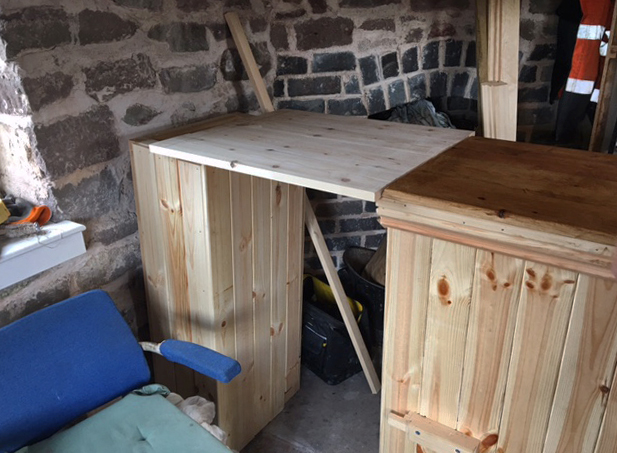
Paul spent the day on our counter, here on completing the skirting boards around it. Two more people inquired today about buying a round of drinks from it.

Maybe we are missing a trick?


Later Paul moved on to joining the short piece of counter to the wall. Here you see him making the end fit the rough wall exactly.


This is the end result. Look how well the wood follows the contours of the rough stone.

Paul was pretty pleased with the result, although as no compliments were forthcominmg from his team mates, he had to say so himself.

We shall compliment Paul on line!


Dave and Yours Truly worked on filling the gap around the paver path, and later sowing it with grass seed.

Here is Dave back filling the gap with earth, for which he was competing with the drainage gang, who were filling a hole around a low patch at the end.


At the end of the day the area around the path looked like this.

You can just about make out the grass seed around it, as we hadn't yet raked it in. And watered it.

Will it still grow this late in the season? We will find out next week.


The other exciting bit around the hut today was at the north end of the site, where the drainage gang were dealing with the top of a deep catch pit located here. It was too far down into the ground, and it needed raising, together with the ground around it.


The gang has also sourced 4 catch pit rings in plastic. This makes them much easier to manipulate, all previous examples having been made of concrete.

Jonathan brought the rings with the Telehandler. The 4 rings should make the edge of the pit 2ft higher.


The existing pit, the deepest on the railway, is in good condition but too low down, and does not have a lockable cover.


Once the edge of the pit was clean, the 4 new rings were placed on top and cemented all round.


Once the mortar was in place earth from the long pile by the fence was retrieved - thereby also helping to tidy up the yard a bit - and placed around the rings.


For lunch we had a visitor...

Jonathan again, now propping up the counter, or will it be a bar?

The height was carefully calculated, using the elbows of some of the team members. It leans just right! Then came the bombshell: 'Can I have a doughnut?'. The barefaced cheek! Oh well, if you don't ask, you don't get. We gave him one.


'Look what we've got'.

Near the end of the day we went to get the safe that we have been storing for a couple of years now. We got it from the current owner of the Broadway station B&B, and it is likely that it used to be in the station ticket office, until the building was demolished in 1963. Sadly it's placing in the rebuilt ticket office was declined, so it will now go in the heritage goods office, aka the Usk hut.


For the time being we have parked it inside the door of the hut, but when John has finished staining the inside of the counter it will go in the corner underneath, visible by anyone standing by the typewriter. So now it will have a definite home with us.


At the end of the day the drainage gang had completed their job of raising the catch pit, and back filling around it. They left the site nice and tidy.

An idea for this area would be to lengthen the goods platform to include the PWay train, which is due to be stabled here. Up against a platform getting ourselves and our kit in and out of it against a platform would be so  much easier. We already have the bricks and the copers (ex Swanbourne) so funds would only be needed for the foundations.


A look over the fence - Barnstaple, L&B.

During an earlier visit to an Exmoor Associates update meeting, we spent a morning in Barnstaple to see what was left of the narrow gauge railway that closed in 1935.

It is already clear that the reinstated railway will never go beyond Pilton yard, where the main works were. The rest of the line, to the (former) main line station to Ilfracombe, is too built up and in any case Pilton yard and the original terminus are not that far from the town centre anyway.

So what is there to see today?

First of all, an extract from Google Maps with the original trackbed coloured in. Apologies for the wobble at the end, it's the best we could do with limited drawing skills. It'll have to do!

Map by Google Maps.

Before we look at some on site pictures, a few words of explanation. The line entered Barnstaple along the river Yeo, crossing it by the green patch top right, where a short stretch is actually owned by EA - Raleigh Weir. It then ran along the back gardens of Yeo Vale Road to the triangular Pilton Yard, the likely future terminus. From there it crossed the main road and then ran along Rolle Quay, before bending round to the River Taw, where it met the standard gauge Barnstaple Town station on the line to Ilfracombe. That can be seen as a thin green line, now being a cycle path. Barnstaple town station is closed, as is another to the east of the town, Barnstaple Victoria Road. A third station, Barnstaple Junction, remains open south of the river, and today forms the end of the Tarka railway line (continuing as the Tarka Trail cycle path)


To start with then, this is the northern (sharp) end of Pilton yard, looking uphill.

A road leads along the back ends of the gardens of Yeo Vale Road and at first we thought that it was the old trackbed, but looking at the maps again it is probably not. The old trackbed most likely ran just to the right of the concrete fence in the centre, inside the car park today.


This is a close up of the northern end, and although the track looks like the old railway trackbed, we think it is actually to the right of the fence. There it is squashed by a newer fence, which itself runs alongside Alexandra road, visible on the map in a curve. This looks like a deviation round the town centre of the A39, so it's the verges of that which would need to accommodate the reinstatement of the line to Pilton Yard.


Out of curiosity we went down the track at the back of the terrace to see where it went.


It ends about half way along the curve made by the new A39 Alexandra road. We could be wrong, but our guess is that this isn't the old trackbed.


Back the other way then, looking south into Pilton yard, now a public car park.


The old building on the right looks suspiciously like a remainder of the L&B works. To the left of them, in the car park, was the goods shed, then further left of that, two railway sheds.

Here's a general view of Pilton yard, looking towards Barnstaple. The photographer stood on the old trackbed, with the track alongside Yeo Vale Road gardens on the other side of the concrete fence on the right.

The running line exited Pilton Yards through a narrow opening on the far left.


This is that narrow opening. It's still pretty intact.


But instead of leading to a small gated L/C over the A39 leading out of town, it now points to a new roundabout, with the A39 ring road (Alexandra Road) coming in from the left, and leaving by the right. Straight ahead is a wide new avenue that follows the line of the old trackbed to the river Taw along the trees in the background. 

This is one of the reasons why the last half mile to the railway station is unlikely to be rebuilt.


We also had a look a little further to the right. This is the bottom end of the River Yeo, just before it enters the Taw. Sailing ships came up to this point to exchange goods with the railway.


Standing on the new bridge visible in the picture above, you can see Rolle's Quay where the sailing ships used to moor. 

The narrow gauge railway ran down along the other side, left of camera.

The L&B trackbed here has been absorbed by another new road (North Walk), albeit a much more peaceful one than Alexandra road carrying the A39 traffic. It follows the curve of the railway as it swung round to parallel the Taw into the main line station.

Having turned through 90 degrees to approach the standard gauge station, we can turn back and see the cycle path of the line to Ilfracombe. The Taw is on the left. The mouth of the Yeo is the little irregularity to the left of the pedestrian, and the branch line crossed it via a swing bridge.

Now we can turn through 180 degrees and look east along the river. Those 4 gable ends in the distance are a problem for any reinstatement here, as they are new and built over the SG trackbed.


Stepping closer to those 4 gable ends - a large block of flats, where 'block' is the operative word - we can also see now a more distant gable end to the left of them. That is the SG station building, still existing.


Skip round the big block of flats, and you get a nice view of the old SG station building. It's pretty much intact, except that the canopy has been mostly glazed in. The building now serves as some sort of day care centre.


This is the other end of it, with more original canopy visible. To the right is a small square building...


... and that is the original signal box !

We're standing on the original, single track SG trackbed here. It's clearly squashed by another large, new building.


Walk round that curved red wall in the picture above, and you get to see the front of the original SG station. This side is pretty much intact, it even has an SR green enamel board with BARNSTAPLE TOWN STATION on it.

The L&B shared the station facilities, and did not have its own buildings here.

Just to the right is the mound of the old castle, and the town centre, with a nice covered market.


Next week, publication day is Thursday again, personal circumstances dictating. Sausage baps are already on order for that day!


Thursday, 14 September 2023

Back from gone away.

Friday 25th on steels.

Three of us on Friday (25th August), John came back just in time for the tricky manoeuvre to get the long, long fascia boards from the unloading road by the shed up to the 'greenhouse'.


We had the 8.30m fascia board and a shorter sibling on the pull along truck at one end, and on a little piano truck at the other. As a non-running day Friday had a car park clear of visitors, so we set out across the emptiness, with Neal pushing in the electric fork lift from behind, and John valiantly trying to steer at the front with a truck that had the front two wheels up in the air.


We got there in the end, but phew! What a journey. At one point the rear wheel of the little forklift dug itself its own little pothole and wouldn't be budged any more. We had to get the larger forklift to nudge it out again. Then we spread all 3 fascia boards out on trestles and pallets, ready for millscale and rust removal.


While we removed the surface scale et al Neal worked on the fourth purlin, which was completed at the end of the day. Heavy cloudbursts then followed, and we called it a day, feeling quite chuffed with what was achieved.


The latest position as per today (14.09) is that Neal and John have made all of the purlins now, including the ridge purlins, but without the curved arches as yet. Bunches of angle were also taken off the MACAW and stored under the 'greenhouse.'

Further work on the steels is now held up until funding for further, minor expenditure on the steels is agreed.


Blog back from the hols.

We're back from N Italy, charmed by the culture there, and a little overweight. But you go there for the food, don't you?

While we were away a few snippets of news trickled in, so we can share these with you. The PWay gang continued with a list of defects reported by a our track patrollers, sometimes in extreme heat. Walt kindly agreed to share these three videos with us:

STEVIE our RRV went out to Gotherington to pick up the bags of ballast that we had filled earlier.

In the stop frame video you can see him set off from Winchcombe, pass through the tunnel and load up at Gotherington Skew. The bags were then discharged at various locations. Doing it by individual bags is much more economical than with a 20ton Dogfish, as we can put just what we need, exactly where it is required.


In the second video you can see the bags being used on the loop at Gotherington, where the sleeper ends were exposed. They're so practical, those bags.

And then in the third video you get a cab ride view of STEVIE returning back to base, with a couple of bags left for next time. Now we have to fill them up again with the mini digger, which is quite a slow job but worth it as you saw.


Yesterday (13.09) this indeed happened, the bags were refilled, in record time. The lads felt that those bags were a really efficient way of spreading around smallish amounts of ballast. Saves money too. 


Here they are, all in a line at Gotherington skew.

Next to them are some of the wartime economy sleepers we lifted from Didbrook, waiting for their re-use in sidings.


Also on Wednesday we can see the gang hand tamping with the Robels some of that ballast that was spread there a week earlier.

The location is the Gotherington loop.


More Gotherington loop is revealed in this shot of our big Pacific passing down the main line.

Pictures by Paul.


Two Wednesdays on the Usk hut.

Dave, Paul and John were busy with both the diamond paver path, as well as the erection of the counter inside.


The paver path has passed the slab outside the door, and can here be seen reaching near the corner of the building, its intended maximum. That was two Wednesdays ago.

Inside, Paul has been back home to his garage, where he was making the final part of the counter.


This is what it's going to look like, with a 'Delboy' flap, near the fireplace. It will give access for the coal agent behind the counter, and also allow the fireplace to be cleaned and resupplied.

We still need a few more lumps of coal for the GWR coal scuttle, collected from the lineside.


The flap is attached to a last 9ins of counter, which will be married to the rough stone wall.


John has done a good job applying a waxy stain to the white new pinewood.

He seems to be enjoying it too!


 Here's the end, the first bit the visitor sees when the door is opened.

A blog reader has offered us an ancient office typewriter, which will be perfect for here.

The bottom still needs a skirting board fitted, which is why it's not stained.


The following Wednesday the paver path had reached the end, neatly skirting around the original Usk stone slab. Doesn't it look fantastic? It gives the surroundings age and authority.

Still to do here is a backing around the outside, to prevent the pavers from breaking out sideways. Then back fill, and sow grass up to the edge.


While in Italy we came across this incredible chimney. We missed a trick when we built ours, it could have looked like this one!


One holiday snap for you ( we could have tempted you with pictures of tagliatelle with truffles and wine) and it's of lake Garda from just above, during what the locals call the 'blue hour' just after sunset. It's fabulous!

Enjoy.


Thursday 14.09 update

It wasn't possible to update the blog on its usual Wednesday evening, but in compensation we have the newsy bits from today, when the Usketeers met, exceptionally (personal cicumstances dictating).


 After two week's absence, the grass has grown well, in particular the new area sown 3 weeks ago, centre left of the picture. More landscaping is due in the foreground, once we have recovered the spent ballast that the PWay dept. is giving us.


John was very busy today. While Paul was on carpentry inside, John on his own made the mix with which he supported the edges of the paver path.


 A few minutes later we seem him applying the mortar to the edge of the path. This will stop the outer pavers from turning away from the rest. The gap will then be filled with earth and seeded.


So, inside Paul was on carpentry, here with the skirting boards being fitted around the bottom of the counter. They will then be stained.


After our previous appeal for a vintage typewriter, blog reader Graham came up with exactly that:

Just look at this splendid old fashioned specimen. It onc belonged to Graham's grandfather, who travelled for an insurance company, and this bulky contraption was described as a 'portable' one! The old typewriter is exactly what we were looking for - old, and very interesting.

Thank you, Graham!

We need some more kit to make the coal office representative. How about a set of inkwells, a blotter, or other office items that might have been used by a coal merchant?

And we now need an old office chair. Something of the era (1853), not too luxurious looking. Anybody got any ideas? Send us a message if so (top right on the blog ).


Graham also looked into the history of this typwriter. It was made in Leicester in 1924. He worked this out on the basis of two numbers stamped on the frame.

He also found us an instruction book - which the proud new owner had to purchase at a price of sixpence.


Inside it explains inter alia that when you get to near the end of your line while typing, a bell will ring. TING! Who knew....


The timetable was PINK today - one steam, one diesel. The latter traction form was provided by the blue Growler 37 215.


Looking down from the same spot we saw the area where the PWay mess coach is due to stand in future. The pile of rails on the right has grown considerably, but the random pile on the left is still partially there. It's got a pile of manganese rails on top, all 60 footers, so they won't be easy to move.


Outside the Usk hut Chris from C&W was fitting the missing boards to the MACAW. The previous lot had rotted through.

Each new board had to be drilled through the frame, so it was a slow process. As the original sized boards were not available, everything shoved up a little and new holes had to be drilled to bolt them down.


Two pints of lager? What do you mean?
We again had a number of visitors today, which is always fun. One ordered a round of beer and some crisps. Now there's an idea for an open day!!


Solid brass hinges.


Having done the skirting boards, Paul spent time on marrying the edges of the counter to the roughly shaped walls. In the picture he is cutting the end piece top to the right shape.


The other end of the counter, the lower bit where the typewriter now sits, was married to the rough stone wall last week.

Doesn't it fit well !


The last thing we spotted today was John, having completed the mortar backing of the pavers, filling in the remaining gap with earth and seeding it.

It should look great by next week (if there is some gentle rain)


A bit of GWSR history.

From the Gloucestershire Warwickshire Railway Society (not the GWSR plc!) newsletter of October 1979:

'' Looking at the current situation, it is very easy to become disheartened by the fact that track lifting is well under way and to say that we have lost the battle to save 'our line'. I (the GWRS chairman) however prefer to approach from the other side and to proclaim our (partial) success in having been instrumental in persuading British Rail not to sell the land south of Honeybourne. In so doing we have helped to ensure the future availability as part of a through route from the Midlands to the South West and Wales.

Clearly, removal of the track is a psychological setback but we must accept that British Rail do not have sufficient traffic to justify two routes at the moment. In the light of the world's dwindling oil reserves, I believe this situation will change in the future and, even, that BR might have to refuse traffic due to lack of capacity. This, though, is a few years off, in the meantime we must work to protect and secure the future of 'our line' to ensure that track can be relaid and trains can run when the time is right.

As stated at the AGM we have proposed to the British Railway Board that they sell us part of the line for a nominal sum, with a covenant entitling them to repurchase when required. Currently, the concept is under consideration by the board, especiallyin respect of the legal aspects.We will be actively pursuing this idea and I hope that, in the next newsletter, we can report progress.''

From the same 1979 newsletter:

''CHANGE OF AIM

Over the past 3 years it has always been the GWRS's primary aim to get BR to re-open the Cheltenham/Stratford line to regular traffic, our work and campaign being geared up to this end, preservation being a secondary aim. Recent events, however, have indicated that if the society was to retain its credibility and indeed remain in being, a change of emphasis was necessary. Although BR have stated that they are not willing to sell any of the land so as not to prejudice the possibility of re-opening the route in the future, and in fact have still not officially closed the line despite lifting the track, we feel we have to be prepared for any eventuality. With this in mind it was decided at the AGM  to pursue a policy of private preservation. It must also be remembered that most of the support we are getting at the moment from local bodies and councils is in support of this aim.''


Honour to those that fought for us. Thanks to them, you are volunteering today. Or supporting us!


Before we close for the day, here is an advertisement for our Santa Specials:


You can now buy tickets, so why not treat the children and grandchildren!