Wednesday, 24 May 2023

New cast iron goods.

Saturday in the blazing sun.

Ten of us today, with 9 along the line and Steve by the Usk platform working on a new electrical distribution point for the stock that will be parked along there (when all is completed).

Boredom....

So 9 volunteers met in the mess coach and debated what to do without tea or doughnuts.

Eventually these did arrive, including custard and chocolate/orange flavoured ones. They were worth the wait.


We loaded up the tools from vans located in different areas of the yard, left there following the making up of the freight trains for the gala.

Then we went to the RDA crossing to wait for P&O to pass, so that we could inspect the track. This area had numerous issues of wet beds, dropped joints and tight joints. Which one to address first?


The area around Southem Lane bridge is wet, and has been for a long time. This causes the track to pump up and down, and spew out a white slush from ground up ballast.


It can't be a coincidence that Southam Lane bridge is the only one on the whole railway where water is pouring out of the abutment and wing wall. Rain or shine, there is a steady leakage of water across a broad front. Our drainage department has tried to cure the problem with a ditch filled with fresh ballast, but the leakage continues and it must be getting into the trackbed, as it is pumping all round here.


We also noticed how our new neighbours, who took over a corner of a field and pushed spoil over one of the bridge wing walls, have increased the size of their activity. A large caravan, machinery, lorries and a container have appeared along our boundary line.


Under the bridge there is evidence of trespass and nitrous oxide abuse.


Part of the team then further examined the track northwards, until it was felt that we were nearer to Bishops Cleeve than the RDA, so the other half of the team was asked to move the Transit and the Ranger north to the next entrance by the Bishops Cleeve foot crossing.


Again we had to wait for a gap between the trains to ask for a line blockage.


The train eventually appeared, being Pendennis Castle running tender first.


Bert Ferrule and Dave amused us by hiding in an old cattle creep. It's no longer required because the field on one side is now a sports ground.


Pendennis Castle soon returned from CRC again.

It was a challenge to get a decent photograph of our visitor, as there was a full sun and when the loco is running chimney first you are photographing almost directly into the sun.


We dug out three dipped joints, lifted them and packed around 4 sleepers with the Robels. The observed result was better, though still not perfect.

We are still after two more Robels, and have had a sponsor offer of £500 for one (they cost about £3000 each)


The first candidate to test the joints we packed was Bulleid Pacific 35006:

Here it is, heading directly into the sun. It had a young crew on board, which was very encouraging to see.

Every now and then we had a strong animal smell waft over to us. We can't complain about farming - we are the Cotswolds line after all - but the muck spreader involved was huge. The biggest we had ever seen.


It looked like one of those giant articulated dumpers used in motorway construction. It bellowed up and down the field and flung dung in all directions.

It wasn't hard to bear, but generated a lot of jokes among us.

Mid afternoon it was time to drive back to Winchcombe and put the tools back into their different wagon locations (we are considering more efficient storage in the form of two large grounded containers) but a large number of parked cars made exit from Bishops Cleeve rather difficult.


Once back 'home' in the yard we noticed that the explanatory brass plate has now been attached to 'STEVIE'.

It's just to explain that the name comes in fond memory of our most loyal and enthusiastic JCB driver, who sadly left us last year. He's still much missed.


Monday at Hayles Abbey halt.

Three of us. The job was to load the economy sleepers left in the cess after the Didbrook relay. We needed a non-running day for that, so a Monday was perfect.


We went to get one of the Transits, which proved to have a little gem on board - a custard doughnut left over from Saturday!

Good until Sunday 21st May. Monday was the 22nd - would we die if we ate it?

Well, it was tad stale but the custard filling was still good. We took the risk.


The 03 C&W shunter brought our bogie flat to Hayles Abbey halt. 

Dave from the Usketeers did the honours in the Telehandler. 

Yours truly was on top of the wagon, Paul prepped the sleeper piles below.


The first load of 8 economy sleepers went on. How high could we stack them, given that there were over 200 sleepers to recover?

The advice was that we could go 6 high, given that these economy sleepers were lighter and also shorter.
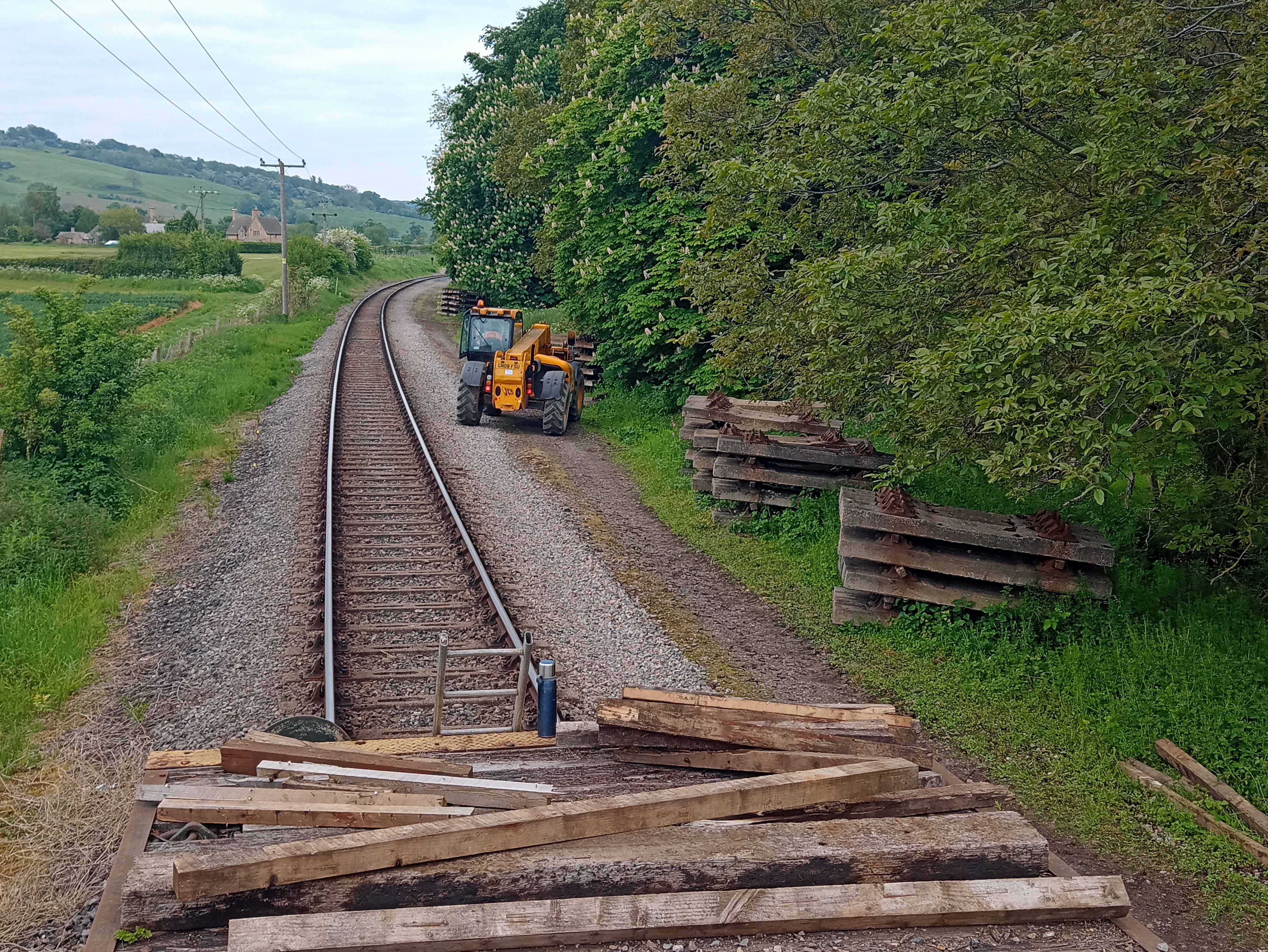


Dave went into the undergrowth to find groups of 8 sleepers to offer up to the wagon.

These first ones here are for the next relay and are full size and weight, so we left them where they were.


We loaded the taller piles that were ready to go, but some long low piles remained.

Paul had to spend a fair amount of time re-arranging these, so that they could be stacked in groups of 8.


After loading 96 sleepers we called a break for lunch, which was very welcome.

It was getting hot. So much so that one of us had to humbly request some water from one of the neighbours.


Mid afternoon we were almost done, when the 03 came back, ready to return the bogie flat to Winchcombe.


We strapped down 192 sleepers, with still another 100 or so to be loaded another time.

Here is the bogie flat back at Winchcombe. The intention is to unload this at our Stanton yard, part of another mission to ballast a small part of the extension, all to be done the same day.

The economy sleepers will be used to relay the C&W yard, and any surplus ones will be offered for sale. The economy sleepers are fine for sidings, but not for main line use (as we have been doing since the 1980s).


Wednesday with the Usketeers.

Cast iron day! We have so far mounted Ogee shaped cast iron gutters and brackets, donated second hand by the RAT Trust. At some point we had to pay out money for those pieces that we did not have - essentially the downpipes, those from the RAT being damaged.


Today was the unboxing. We had three boxes - two containing a 6ft cast iron downpipe each, and a smaller box with accessories.


As you can see we couldn't wait to try them out. You can see from Paul and Dave's smiles how happy they were.


Not every day is Christmas,  but today sure felt like it.
Then we opened up the box with the accessories, and after counting everything we realised that the offset pipes from gutter to downpipe were missing. 

Once home, this turned out to be a transcription error from online shopping basket to company Purchase Order. We can only blame ourselves, but no money was lost, we simply placed a complementary order, so should have those offset pipes next week.


The next job on the list was to move and repaint the Pooley weighing machine that has been sitting, seemingly abandoned, next to the signal box for a large number of years.

We had the idea of killing two birds with one stone - clear that site, and place the weighing machine next to the Usk hut, a plausible asset for a coal merchant.


The weighing machine was very heavy, but we managed to get the Telehandler forks under it, and it was soon on its way across the barrow crossing.


Not long afterwards it arrived at the gable end of the hut, ready for a bit of rust treatment (streaks could be seen appearing from under the old dumpy bag that was draped over the top of it).

It shouldn't take too long...


Meanwhile, our friends from Construction & Maintenance continued with their project of laying one, then two rows of patio slabs along the platform edge.


This crew has slabbed (albeit in larger 3x2s) all of the platform outside Broadway station building, so they are well experienced.

In the background the PWay tool van was being shunted back to its usual position after the gala and its freight trains.


We then took off the faded and tattered dumpy bag, to see how much we'd have to restore.

The answer was, much more than we imagined !

It turned out that the weighing machine is not that old (we guess late 1940s) and unlike older machines has quite a bit of sheet metal incorporated in its upper part. It is this sheet metal that has rusted badly.


The worst piece is this ring (L). It is 'U' shaped, and sits over a rubber retaining ring that holds on the glass over the dial. The bottom third is completely eaten away, probably because that is where the dumpy bag (which is not waterproof) was tied against it. How do we get a new ring like that? It would have been a pressing originally.

The back is one large sheet, less rusty but still affected around the edges. Ideally that should be replaced too, because water has penetrated through the screw holes.

On the back is a plate marked BR (LM). Presumably that dates it fairly exactly?

The mechanism is also seized.

At this point we are somewhat non-plussed, and not sure what to do next.


Life goes on of course. The C&M gang got several more slabs down - maybe one more big push next week?

Behind them the little Standard 78019 ran into the station, sounding its unusual whistle.


Paul spent some time plugging the hole in the door where there were several keyholes in one. In the end a new piece of wood was better than lots of filler here, we felt.


John spent the day applying topcoat to the outside of the windows.

Then the Standard came round for the second time. A bit into the sun, but presumably photo opportunities must be seized before it goes home again.

The little engine is popular, so one day we will have 76077 as our own little Standard.

The other loco out today was Pendennis Castle. With its 4 cylinder exhaust it always sounds as if it's travelling much faster than it really is.


Mid afternoon a mystery pair of boots was detected over the door...


In unrelated work Paul was filling in screw and nail holes in the barge boards and window boards. Once that has gone off we can apply topcoat here too, to make the outside woodwork really weatherproof.

Quite a bit of slabbing progress is visible in the foreground.


The PWay gang today.

Well, several days actually.

Remember when it was wet?


This rather striking image was taken 2 weeks ago by Paul.

Just look at that dark cloud over Winchcombe!


And that poor gang that was out along the track during those same cloudbursts.

Where to shelter....? How about under this bridge?


During their work they came across this axlebox cover.

L N E - D

London North Eastern ... er?

And what to do with it? Our C&W people have no need for it, it seems.


Today, Wednesday was a bright and sunny day of course. For the gang it start off with a training session in the mess coach.


 Then they were off packing joints on top of an underbridge on the approaches to Bishop's Cleeve.

Here is Martin with the Telehandler bringing in a load of ballast to pep up the levels. 

We have track walkers, reports from enginemen, and at intervals our PWay manager takes a ride on the footplate to see for himself.


Here is the underbridge in question. It used to be for farm access, but it now links up with a new housing estate.


Elsewhere along the line Martin was bringing our lifting beam in to be annually inspected.


Wednesday, 17 May 2023

A look over the fence in Scotland.

Tuesday at Toddington.

A follow up job on the new yard lamp. Due to a weekend away in Devon we missed the gala, which was a great success, we heard.


Tuesday saw a lot of tired volunteers around Toddington, and this lovely little Pug being winched back onto its low loader.

Other guest locos were still around, with one, the U boat, actually in service.


While the yard lamp is up now, an issue remained in that the kit of 6 window panes didn't all fit properly. Four glass panes were 1/4 inch too long, and at the blunt end too. This little short bit is rather difficult to trim, but our hero was Paul from the Usk gang, who nibbled off the 1/4 inch for us, so that Neal was able to start fitting the rest.


We then ran into another snag - we had two tubes of clear silicone with us. With 5 of the 6 panes fitted we needed to open up the second tube, but it was found to be solid inside. This was strange, as we had bought them together and they came from the same batch. The piston inside had moved up an inch or so, while the business end was still sealed. How odd.... possibly a manufacturing defect and an air bubble inside?

We'll have to have a final fitting session with a new tube of silicone.


The 'U Boat' was out on a service train, the other being hauled by P&O. Two Southern locos providing our services!

Here is 31806 leaving Toddington, seen from the platform of the yard lamp, where we were touching up some paintwork.


Behind the shed was Pendennis Castle. Not an ideal photographic position, with a lot of servicing paraphenalia standing around.

Itr's amazing to reflect on how this locomotive has seen the deserts of Western Australia.


Later we tried the U Boat from below, which actually gives a better picture.


Trains always leave Toddington heading south very carefully, as they soon have to slow down again to pick up the token from the box.

Hovering nearby was the green Growler, ready to attach to the rear of the up train.


Wednesday with the Usketeers.

A lovely warm day today, and it felt very pleasant sitting in the little hut, with the door open and the birds chirping.


After an early coffee and chewing the cud, we set about our various tasks.

Jules can be seen here cleaning up the pointing around the door.


We have now at last found a suitable locking plate for the second sash lock, so our big sliding window is finally secure. The Railway Archiving Trust (based at Toddington) dug into its vast reserves of spare bits and, after several failed examples, finally found a locking plate that fitted perfectly.

You can buy these new still, but they are all slightly smaller models, and of a slightly different design. This locking plate even had the initials GWR stamped into it, and you can't get better than that.


The lock and locking plate fitted perfectly. Even the holes were the same.

What sort of screw should we use? Brass, obviously. Crosshead or slotted screw? Slotted of course!


Our door is original and probably 150 years old, as is the hut. So it's not surprising that there is evidence of several locks, with a hole for the key of each one.

Paul decided that the best way to deal with the holes would be to cut out the affected area, and insert a new piece of joinery grade wood. He found that in our C&W workshops, so thanks for your help, lads!.


Our gala is now over, and it was a great success, both operationally, but also in terms of customer satisfaction, and last but not least, it was positive for the bottom line. That does matter these days.


John spent the day painting topcoat on the windows, after undercoat last week.

The planks on the side help guide away the rainwater from the incomplete guttering. As it stands now, we got a large part of it second hand from the RAT, but to finish the job we had to order some new, which is expected at the end of the week. So we hope to be able to complete the guttering with downpipes, joints, stop ends and additional fixing ears and a spare bracket next week.


Paul too was caught painting, as the job he had intended needed the tower scaffold, and that was in use until lunch time.


Today was a Southern day for the train service, with P&O and the U class providing the haulage.


The U class drifted out of the tunnel and into Winchcombe under a big plume of surplus steam. This was caused by the type of coal we are using (for now) which (we ascertained) burns very hot and very suddenly, making the keeping of a steady pressure somewhat tricky.


The lads from Construction & Maintenance were on our site again today. Good progress was made with the row of slabs along the platform edge.


At lunch time we got the signal that the tower scaffold was free, and it got delivered to our door too. That is indeed good service.

Placing the tower scaffold at the gable end.

Once the scaffold was secure Jules was up there completing the infill with mortar of the ends of the slates. That was started but not finished when we called the scaffolding off hire. We also took the opportunity of the tower to paint the gable end boards with an additional coat.


During a very quiet lunch period we took this snapshot of the site, to show the progress with the row of slabs. Here it has reached the corner of the building, from where it will become two rows.


Then the U boat came by again. Our valiant footplate crews worked record hours during the gala, and here they are again, covering the regular services.

Hope you all appreciate that. They are of course all volunteers.

Southern U class 31806 chugs into Winchcombe after the bracket signal was cleared.


Our last picture shows the site looking north. This road will be maintained and hardened with spent ballast, while the C&M lads plan a fence and a gate across the bottom to fence off the PWay yard from the public.


A look over the fence: Brechin

This is the Caledonian railway at Brechin, in Scotland, not so far from Dundee. It was visited as part of the excursion programme of the 'Spring Highlander' Pathfinder tour to Glasgow. You could board it at Cheltenham, which is certainly convenient for our railway, and then you ate and drank all the way to Scotland! What a nice way to travel, and it earned your blogger brownie points from Mrs. Blogger. Lots of them in fact, although they are just as easily lost...

Brechin is a small town near the east coast, and it has its own railway terminus.

Here it is, nestled in between Victorian housing and a park. It's a little jewel. The passenger service stopped way back in the 1950s, but freight sort of rumbled on, until the line was completely closed in 1981.


The short line to Montrose (and the main Edinburgh - Aberdeen line) was built by the Aberdeen Railway in 1840, and was later operated by the Caldonian Railway, as is proudly displayed over the entrance.

What is so charming about this railway is that, unlike the GWSR, the line was mothballed virtually complete, and what the preservationists took over was virtually a time capsule.

Just look at this ticket office! Lovely cast iron crowd barriers, original hatches and clock, with a bit of luggage to one side. No modern notices or plastic snap frames here.


Inside there is a horseshoe shaped platform, with cast iron railings and a fully glazed canopy overhead..

On the sunny day that we had it felt like a warm, comfy place to be. You could lean on the railings and contemplate the goings on.

The vintage car parked in the corner looked just like the sort of thing that might have been put there when cars were few in number on our roads.


There are two platforms. One is for the service trains, operated in push- pull mode to the other station, Bridge of Dun, four miles away.

The other platform is for stock storage.

During the station's 30 year slumber without passengers the canopy was taken down, and some of the columns removed. Much of the canopy has been replaced however, and at the time of the visit the replacement work was still going on. The posts in red primer in the distance for example are all new.


The toilets were also a time capsule. They were to be found behind a sliding door, as for a cattle truck. The logic for that was not clear to yours truly, but what a charming arrangement.


Inside the slate urinals were still there, including the magnificent dividers. The arrangement has been strangely modified with the inclusion of suspended urinal bowls, which as far as we can see though add nothing to the hygene.

When we took over our line in 1981 ours at Toddington were also intact, but we ripped them out to create storage.You don't do that if your stated aim is to 'create and maintain a railway museum'.


This impressive modesty screen was inside (the GWR has theirs outside) and was made up out of decorated cast iron uprights, and what looked like sheets of slate in between.

 Surely not - could you have sheets of slate that big?


In the main building was a small museum. One of the artifacts was this one. Something for the signalman to read on the back of the train? It must be quite old.

At the end of the platform was this old building, unfortunately just outside the boundary of the present operation. Interestingly, it figures on this old photograph that we saw in the tea room:

The words, now no longer visible, on a black strip across the facade, used to read 'THE BRECHIN AGRICULTURAL AND TRADING...' and a shute leads down to a rake of wagons. It was clearly once part of a whole, but the building is now in private ownership, we ascertained.

The few passengers in the picture, and the large volume of goods and several cranes attest to the importance of freight for this station.

Just visible on the left is one of those curious very narrow Scottish towers, next to a church. Just a like a minaret.

A bit further along the platform was a small storage building which now functions as a tea room for the staff. Outside in the sun is what the Scots would call a 'sitootery', and busy it was too.

Within the station buildings along platform 1 was the cafe. A photograph on the wall showed how this too was once a storage room, with a heavily soiled floor when first found by the preservationists. It was cosy inside, with a working fireplace. The tall ceiling height was brought down by the use of tea towels, which was a good solution, we felt. The cafe was not volunteer run but a franchise, operated by 3 ladies.

Outside was a charming advertisment for rodent control, perhaps a dire necesssity once with all that agricultural produce around. Note the countersunk, square cast iron downpipe, the same as at Toddington, but not at Broadway P1.

Outside our train was being made ready. Principal traction was by D5314, with a class 20 at the other end. Rolling stock was 2 Mk1s and a full brake.


It suddenly dawned on us that the BG was in chocolate and cream, and had a GWSR sticker on the side. What the...?

We chatted with the crew, who advised that they had indeed bought the coach from us, not so long ago.

They also took over our half scrapped Ashford turntable, which was still one of their projects at the time of our visit.


The columns still in primer are all reproductions put up to replace the full canopy as it once was. What was interesting about that was the fact that they are not made of cast iron, but cut from steel.

That was so well done that you could not tell the difference. It was done at the suggestion of the fabricators, a local company.

The Brechin railway is 100% volunteer operated, so the progress with completing the canopy will depend on the speed with which funds are raised.


Our ticket to bridge of Dun was very authentic looking, in the right colours.

By the way, our (Scottish) guide bristled at some of the attempts to pronounce the name of the town, and so we warn you: It rhymes with 'creakin'...

Two Mk1s struggled a bit to handle two coach loads of tourists, but we all settled down and trundled off to the other end eventually.


This is the view from the end of the Brechin departure platform. On the right is a stack of rail panels; ideally the society would like to reach Montrose one day, with two further stops along the way (Dubton and Broomfield Junction halt). 


We arrived at bridge of Dun. It's very rural out there, with an intact original station building, but quite isolated.

The line to Montrose continues into the distance.


From the road side the station building was quite intact, although it was hard to judge whether, being privately owned (as per Google) it is actually occupied or not. Certainly the original passenger area was disused, but the stationmaster's accommodation may well be inhabited.


The platform side was quite impressive. Just look at those cast iron canopy supports, and the rivetted purlins on top.

The downpipes from the guttering feed into the canopy support columns. As we have seen at Broadway, that was not such a good idea as the constant water and dirt weakened parts of the structure (our downpipes now go along the outside).


Behind the platform seat is a big poster which explains how the footbridge got there. It's not the original, it came from Dunblane.

It's a Caledonian Railway footbridge from 1895, and is unusual with its segmental arch and covered walkway. Network Rail were looking for an alternative place for it and in 2012 they approached the Brechin Railway to see if they were interested in having it re-erected in the place of the former footbridge at Bridge of Dun.

The Caledonian footbridge was cleaned and re-erected in its new location, and opened to the public in 2017. It's a lovely old structure, but with its numerous joints, rivets and angles and its latticework parapets it is vulnerable to rust, which has visibly already started in many places. Broadway footbridge too is vulnerable to rust, but fortunately it is of a simpler construction and has many flat surfaces instead of joints.


We'll close this 'Over the fence' report with a picture of the complete bridge and D5314 underneath. We liked the Caledonian Railway at Brechin, with its unspoilt station and time capsule feel.