Wednesday, 25 January 2023

One roof side slated.

Thursday - an extra day on the roof.

As we don't want the risk of a scaffolding hire overrun, we put in an extra Usk day on Thursday. What a lovely day it was too - crisp and cold, with strong sunshine. That made photography difficult, but we hope you get the idea.


First of all, a cheery 'Morning All' from the Usk gang. It may be cold, but the sense of humour remains strong.


On Wednesday we laid out the roofing felt and battened it down. Then we measured up the first side, and put up the first few slates.


This is where we started from on Thursday. Half slates along the bottom row, followed by full sized ones over the top.


Once the sun was on full beam, we treated ourselves to an early morning coffee and chewed the fat.


Amongst the topics of discussion was the size of Wagon Wheels. Were they shrinking? This was triggered by the sight of an old advertisement, in which the size of the wagon wheel was proclaimed to be 3 1/2 inches in diameter. What size were they today? Paul was persuaded to stop munching (very difficult) until we could find a tape measure, and as you can see it now said 3 inches. That would be a 26% reduction in surface area, (Pi x R2) but later research on the internet revealed the British (as opposed to the original sized Australian ones) were a bit thicker now. The jury is out, but the diameter certainly seems to be smaller. The remaining half Wagon Wheel then vanished, so the evidence is now gone.


Then back to work, with a third and a fourth row started. 

We were amazed to see that it was not necessary to put the fixing nails through a hole, the nails could be hammered in anywhere, and went straight through the slate like cardboard, without breaking any. Amazing - who knew?


Along the side of the building yours truly was painting the Ogee guttering in Hammerite.

More gutters and some smaller pieces remain inside, awaiting strippinmg of old paint.


Winchcombe yard was busy today. A contractor was digging several trenches to trace a reported water leak. This was eventually found, deep under the tarmac, and with some difficulty. Well done that team.

At the same time an artic appeared with two bogies on board. In the picture it is navigating the tricky turn from the side of the workshop to the back of the barn.


On the PWay side of the yard we found the bogie flat, formerly filled with recovered 'economy' sleepers. These have been unloaded, and stacked in the background. More await loading at Hayles.


When the 03 spluttered into life and hooked up the wagon, we thought it was going to be taken out up to Hayles.

But no, it was in the way of some carriage shunting, so was pushed out of the way (and later back to its original position).


Back at the hut the slates were increasing in number.

In the picture the base of the chimney is being reached - but that is the easy bit.

 How to do the middle?

This gap is called the verge - it will be filled with mortar in due course.


The answer to how to reach the middle was a ladder laid across the battens. That spread the weight.


Here is Dave, nailing in another one. Amazing how the nail goes right through, without the slate cracking.


When the last reachable row had been done, Dave had to resort to using the ladder.

That worked fine though, just a bit more fiddley.

This was the scene at the end of the afternoon. Almost at the top. Doesn't it look professional? All thanks to Paul, 50 years in the trade. He knew all the tricks and wrinkles.

The slates nearest the camera need to be trimmed still.


Saturday at Didbrook.

Minus 3 1/2 on arrival, minus 2 degrees on departure at 4 o'clock. A cold day then. And misty too, although Toddington seemed to be a sunny isle, at least until lunch time.


Toddington in the mist at 08.45
 

Simon and Mike, with the foothills of the Cotswolds in the background.


A dozen volunteers met in the car park and slowly made their way down to the train parked at Didbrook 1 bridge.


At Didbrook, the PWay train was waiting for them, as well as - a Portaloo.

It was used by one volunteer, but his experience with below freezing temperatures was not a happy one.

He wouldn't go into further details, so we shall spare you those.


Eventually a dozen volunteers were assembled in the mess coach, together with Tom, our JCB operator for the day.

 No doughnuts were found this morning, but we did have bags of chocolate chip brioches, which were - sort of good, but they would not be recognised in France.

During our few days absence, a contractor had cleared the trackbed of old ballast, and levelled and rolled it. It was now ready to lay track back on, which was our job for the day.


'How does this work then?'

When we laid the Broadway extension we used lifting jigs for SHC sleepers, which do not have chairs, just hoops. At Didbrook we are using concrete sleepers with S1 cast iron chairs, which makes them much heavier. The chains also need a different kind of hook on the end, which we did not have. So a lifting jig had to be hired in, but it was too small to lift more than two sleepers at once, and the full weight also exceeded what the JCB could manage. So in the end we could only lay two sleepers at a time. 


Here is the cleared and levelled trackbed at Didbrook, with 15 panels taken out.


Of course we wanted to start at the other end, so all the tools had to be humped 1/4 mile. Par for the course around here...


We got to the Hayles end, dug the ballast down to the right depth (the contractor couldn't get right in here) and lifted in the first two sleepers.


How much space is a spacer? Bert Ferrule measures...


It took quite a bit out of our day to set this up. Our spacer rig was pretty much used up on the Broadway extension, so we couldn't use it on Saturday, we had to make up individual spacers out of scrap wood.


This is the southern end where we started on Saturday. There is another stretch of 'economy' sleepers from here to Hayles Abbey halt.


At first we laid the first two sleepers, but after consultation it was decided to go back three more.

These are being dug out from under the next panel by the JCB in this picture.

All the rail ends on this stretch will be cropped, to deal with 'dipped ends'.


Once the three sleepers and associated ballast had been removed, we were able to insert two replacement (heavier) sleepers. The space for the third one would have been taken up by the end we cropped off.

New holes were drilled by Tony and Tim later.


Once we got the beginning and the spacing sorted out, progress was pleasingly rapid, especially in view of the fact that our sleeper jig could only place two at a time.


A funny thing happened during lunch - the lights went out! We stepped out of the mess coach into unexpectedly thick fog. Given the early sunshine, we thought that the sun had burned its way through, but new supplies of fog were found. That made the atmosphere icily cold.


Our contractor Tom was new to the railway, and relatively new to the JCB (he was more of a 360 operator, he confessed) but as the line of sleepers got longer and longer, we got used to each other and the operation went smoothly, without a hitch.

We did have a problem with the giving of directions. If you say left, whose left is it? Our modus operandum on the Broadway extension was to shout 'MALVERN' or 'COTSWOLDS' depending on the side we wanted the boom to swing. ('BROADWAY' and 'TOD' were other compass options.) But our JCB operator confessed that he didn't know in which direction the Malverns actually were. 'You're not from around here, are you?' we posited, 'so where are you from then?'

'Evesham' came the reply...


The JCB approaches with another pair of dangling concrete sleepers, over half a ton's worth.


As our starting point receded into the fog, we did a quick count of how many we had laid - 90 sleepers! That felt good.


Near 4 o'clock we had to call a halt, as the faint yellow glow behind the fog was starting to disappear over Cleeve Hill.

We decided to call it a day, and did another count.

116 sleepers were laid on Saturday. We think that is just under one third of the total length we took up, being 15 panels. It should be more next time, as there is no need for setting out the start then.

We are working to a deadline, and don't forget that at some point we also have to relay the 3 panels we took up at Prescott, to allow the bridge works to take place.

And in just a few days contractors will start work on the Broadway extension, dealing with excess ballast, and restressing almost all of it.

It's all go on our railway!


A quickie on Tuesday.


A call from our PWay manager, who can help with replacing two concrete sleepers on the Broadway extension? They are not urgent, but with broken hoops they keep appearing on the faults list, and now that we have contractors on site lifting the track this is a good time to do the change.

Three of us answered the call.


We picked up three replacement concrete sleepers from Stanton yard, and then entered the trackbed at Laverton.


 This is where the 'Broadway extension' started in 2015, with this long straight line. The little dot in the distance isn't a speck on your computer screen, but a hot air balloon. It barely moved. It was ice cold, but warm under the sun.


Although we have laid thousands of concrete sleepers on this Broadway extension, in the last 10 years at least we have never actually changed a concrete sleeper.

Now two have been found, quite close together at MP6 II, that have broken hoops. Not a major problem, but now is a good time to deal with them.

How easily would they come out, in the hands of a team of 4?


The answer was, OK, not too bad. We managed it with bars and a set of chains, wuth three of us pulling. The frozen ground was really the bigger problem, but we got there, and the replacements back in.


Afterwards we robelled the spot, although a tamper will pass through here soon, once the stressing has taken place.


Our two Robels are identical, and sometimes there is an issue with one, and not the other.

How to tell them apart?

We have given them names....


We were working alongside a field with two horses in it, about 100 yds away. After a while a lady came along and said we were frightening the horses with our laughter and orange jackets (!). 

Can you really expect to dictate to your neighbour what colour clothes he should wear, and forbid the laughter?


Here is a detail of a sleeper with a broken hoop, on the right. It's not an uncommon problem, the hoops are fairly fragile.

We now have a growing supply of concrete sleepers with small defects. We gave 70 to the loco dept. to build a new coal storage, but what to do with the rest?


We did one sleeper before lunch, and the other just after.


Here is Andy just robelling the second sleeper.

Job done, we packed up and headed further north, where contractor vehicles could be seen in the distance, at Little Buckland bridge.


There was an impressive suite of construction machinery, including a dumper, 360 excavator, a large bulldozer and a welfare vehicle.


The bulldozer was particularly impressive. Its blade was fitted with apparatus for assuring a level ballast bed, presumably some sort of laser.


Immediately below all this were two more horses.

Stressed by all that orange and noise? 

Certainly not! They were curious about all those human beings, and accepted a little pat on the head from one of the contractors.


Friendly contact, despite the orange.

The big bulldozer rumbled by....


.... as the horses grazed peacefully immediately underneath.
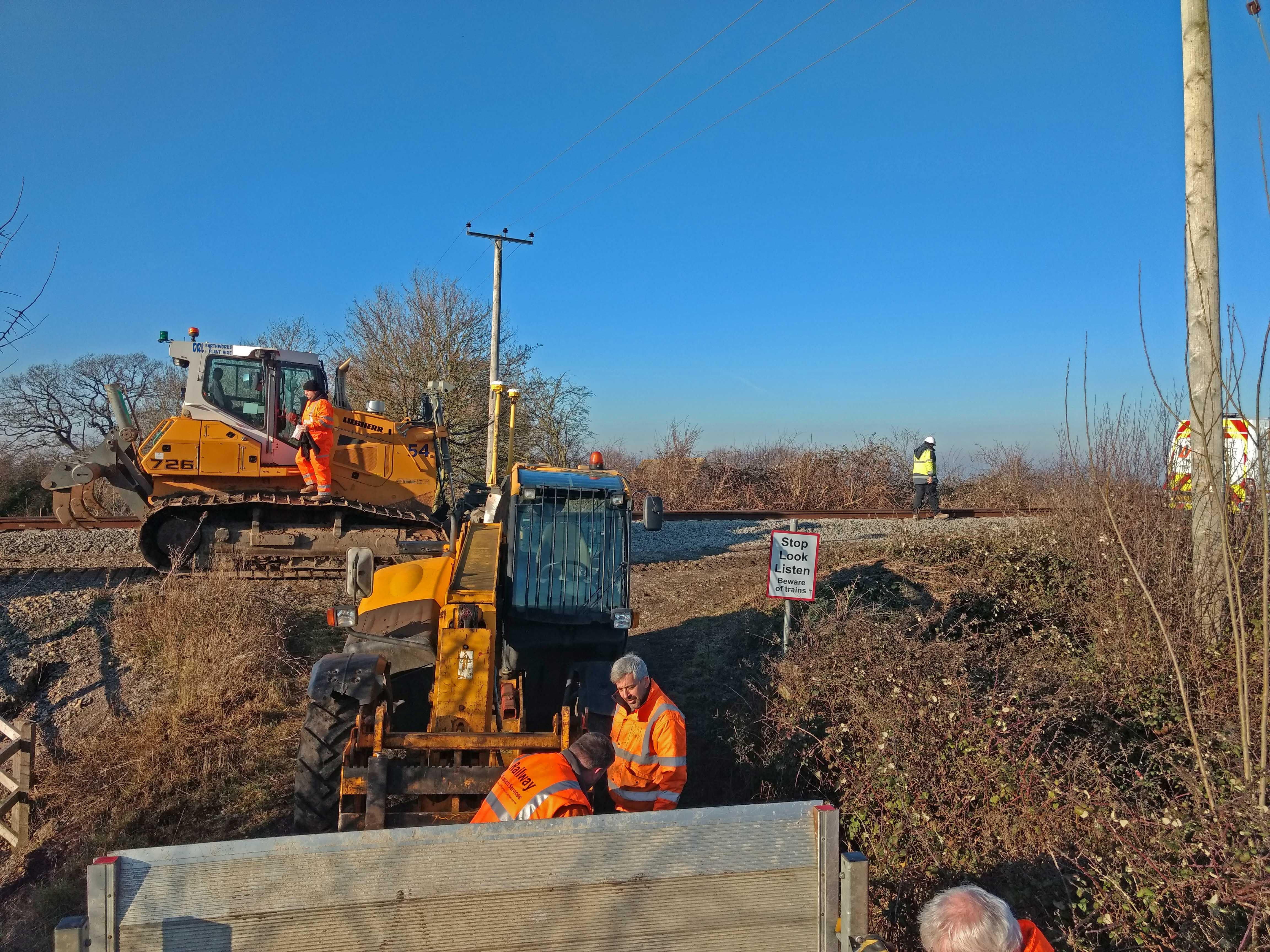

Here is our little gang of 4 after passing through the contractor site. We were pretty pleased with the work done today, it's an item ticked off the fault list - not major, but it kept being reported again and again - and we proved it could be done by 4 men good and true.

Back at Winchcombe we found a large hole in the yard. There's been a water leak, and a lot of effort was expended in trying to find it. A few days ago we were finally successful - there was no evidence on the surface - and the outcome is a new stretch of water pipe near the bottom end of the yard, and the leak fixed. 


Wednesday with the Usketeers.

Good progress today, we got one side fully slated, and made a start on the other.


There's no Jules - now what???


We still had a corner of the Malvern side to do, and the top row, which needs two layers of slates.

No Jules today, due to family circumstances. We'd have to manage without.

However, as it was too damp to strip the guttering of old paint, yours truly switched roles and became Dave's assistant. Paul would make a start on setting out the other side. 


After putting on a slate we immediately ran into unknown territory, how to fit the ends, which are all of different widths. The 'maestro' was recalled from the other side to advise.

Things got interesting after that, and we learned the new skill of cutting a slate in half without any form of saw.


All you need is a hammer and a nail ! Draw the line you need for the right sized slate, and then punch a series of holes to make a dotted line. It really works!


You then break off the bit you don't want, and hey presto! One end slate of the right size.


Another way of cutting off the unwanted bit is to 'saw' along the holes with a trowel.

Paul showed us both. In the end we not only cut the slates on the end, but also all the half slates needed along the ridge, 17 of them. All broke just where we wanted them to.


In this next picture we have fitted all the end slates, and the Malvern side roof is basically done, except for those slates along the ridge.

 Paul then did some test fittings, to establish how a full and a half slate would fit together, and where and on which batten they would be nailed.


Paul also fetched up a ridge tile, to make sure it would sit properly along the upper ends of the topmost slates.


So here is Dave nailing down the last row of full sized slates, with another row of half slates to go on top of that to finish off the side, except for the bit around the chimney, which we will do at a later stage.


A bit later we see Dave, nailing down the topmost row of half slates.

We called him Norman - Norman Nailer....


Beneath, we had him that walked the slates up to the scaffolding.

We called him Slater - Slater Walker....

We do enjoy ourselves.


At the end of the morning Dave reached the chimney with the half slates. That did it for the Malvern roof, the rest is special cuts around the chimney, and flashing. John in the background called out the line of the slates - it's easy to lay them in a curve if you haven't got someone watching the line.


It was briefly sunny as we were about to break for lunch, but the forecast predicted rain at 1 o'clock, so we decided to have a late lunch and sit out the rain.

Paul here is working out the battens for the Cotswolds side. On this side we are using the former Exminster box slates, which are slightly smaller, so the spacing of the battens has to change. You won't be able to see the difference, as you can't see both sides at once...


This is what the Usk hut looked like during the lunch time drizzle. There is now water running off the roof and splashing back on the ground, so that vindicates our decision to mount some guttering.


Mid afternoon Paul could see clearer, and the first few slates went on to his new batten locations. We also lifted about 200 of the former Exminster slates up on the scaffolding, so when the battens are on, we should be able to progress swiftly here.

As we are all busy the rest of the week, we're working just the one day this week, but next week we hope to be able to do a double turn again. There's a lot still to do with the scaffolding in place, including building up the rest of the chimney. We've got it rented for 2 months in principle.


Wednesday, 18 January 2023

We start the roof.

Saturday at Didbrook

Wet and windy again. Some of us have had this three working days in a row, and were a bit disgruntled first thing. The wet caught our Transit out too, it's only got road tyres and two wheel drive.


During a simple 3 point turn, it would only do one point, and got stuck with spinning rear wheels.


Some extra ballast under the driving wheels, and 8 men pushing, got it back on the haul road. The unfortunate driver (ahem) was mercilessly ribbed afterwards.

We have sold both of our 4 wheel drive Landies, so are currently making do with two wheel drive Transits, but they are not really up to the job along the track, what with the many reversals that we do.

We need something that can carry sleepers, have a crew cab, and 4 wheel drive. Is there such a thing?

Staying safely on the middle of the haul road, the Transit is left at Stanton and the gang have to walk the rest of the way, almost to the viaduct.

Two jobs were earmarked for Saturday.

Job 1:

A Telehandler and three supporters, to remove the rest of the 'economy' sleepers and 4 pairs of rail.

Job 2:

Clear rails of excess ballast at Stanton, for the other 8 gang members.

Shovelling at Stanton


While the volunteer gang replaces 1/4 mile of sleepers at Didbrook this winter, a professional gang will re-stress the CWR extension from the viaduct to Broadway, and deal with an excess of ballast at Peasebrook and Laverton. The volunteers can't do everything at once, so sometimes we have to resort to contractors as well.


We had to clear between MP8 1/4 and MP8 1/2, so that the bottom of the rail was free for stretching. This is basically the area where ballast was loaded for the extension, so there was a lot in and around the rails, left over from the loading operations.

Not a very interesting occupation, and tiring on your back.  (But necessary of course)

We took the time to snap this mile post (L), which must qualify as the most unauthentic along the whole line.


Left: A folded sheet of steel, screwed to a piece of round, and stick on numbers. Our old style.

Right: A carved wooden top, lead sheet protection, cast numbers, on a length of bridge rail. Our new, authentic style.

As you may have read on the drainage blog, there is a concerted effort going on to replace the former with the latter. They are doing really well, hope you notice them as you travel along our line.


After 1/4 mile of shovelling we got rather tired, but did reach the Stanton road overbridge, which marks the limit of the loading area.

In the background is the aqueduct, which we completely renewed a while back. We are dealing with the Preston Road bridge as we write, and word has it that our 15 arch viaduct will receive major attention next winter. So we are dealing with our bridges, one by one.


The end of the quarter mile coincided with lunch time, so we travelled back to Didbrook to join the Telehandler team for lunch.


PWay fare: Brownies, with an ovoid. Living off the land...

David made himself very popular by bringing, unannounced, a box full of brownies, home made. They were so good that people asked about their provenance. Home made, David said proudly.

The rain petered out after lunch, and we climbed back down to the trackbed to watch Dave in the Telehandler clear up what was left of those 'economy' sleepers, right back to Didbrook 1.


All the sleepers had been tipped out of the ballast to loosen them, and the rails levered into the six foot.

Dave would then pick up 8 sleepers at once. He did this by picking up what would fit on the forks in the first scoop, and then.....


...... dropping this further up, to create a higher pile.....


..... which he then managed to scoop up, hopefully grabbing eight sleepers this way, but sometimes only seven. But a goodly load anyway.


This bigger load was then driven back down the trackbed, where a large pile was being made.

The bogie flat is currently full, hence the pile to one side.


The sleeper removal didn't need many volunteers, so we were allowed to go home mid afternoon, even as Dave continued to scoop up concrete. He had at least another 8 trips to do, we calculated, plus 4 pairs of rails to drag back, if the daylight permitted it.

We learned later that Dave did remove all the sleepers, but that failing light stopped the removal of the last rails. Once these are gone, a contractor will move in to grade the site.


Tuesday in the shed.

Back to fabricating. Neal on the Broadway uprights, and John with yours truly on the ladder and platform for the yard lamp. They needed cleaning and painting, after manufacture.


Platform after assembly of the parts made by John.

Ladder stripped of mill scale, and ready for cleaning.

The ladder was cleaned with a rotating brush outside (because of the dust) while the temperature was minus 6. At one point we had to nip inside for a hot cuppa to revive, but the job got done.


Neal preparing the half rounds for fitting to the posts

Half way there. The boxes are now complete.

While Neal ground down the excess weld material from around the half round strips, John was painting the long ladder for the yard lamp with a special primer.


Didbrook:

The contractor is now on site, and has started clearing and levelling the trackbed.


Digging up the spent ballast.

Spent ballast ready for loading.

Pictures from Paul, with thanks.


Wednesday with the Usketeers.

We drove to Winchcombe before sunrise, with a sub-zero temperature and frost on the ground. It's winter!


People were wrapping up warm. The PWay job today was out along the line on the Broadway extension. There was more clearing of ballast, ready for stressing, and this soon made them warm.

Two Usketeers were already in the building, enjoying a cup of coffee from the flask, and a doughnut. Dave was hotly expected, as he would have a roll of the roofing felt that we wanted - all black. We found some at last! 

But there was no Dave, where was he? Stress. This was to be the day we start to put the roof on.


It turned out that Dave had had a problem with his bed - a reluctance to get out of it, that is. And we all thought he'd had an accident, with all that ice about. But Dave came, roofing felt under his arm - phew! We could make a start.

In the picture you can see Jules sweeping the frost off the scaffolding planks. It was slippery up there. Then we set about removing our carefully installed and almost watertight tarpaulin, ready for the proper stuff - 'Sark it' it was called. And sark it we did.


We had two tarps on the roof, and in this picture you can see that one has been removed already, while the sun hasn't even come up yet.

A lot of battens and nails had to come out, so that we had a clean surface for the felt. Originally the hut didn't have roofing felt, just bare slates on the trusses, but we thought a layer of felt would be an advantage, while still possible, so we spent £40 on it.


Here you see Jules and Paul tacking down the first sheet. You start at the bottom, and a handy dotted line on each sheet tells you where the overlap goes.


Here goes the second row.

We went to a lot of trouble to find roofing felt that had no writing on it, at least underneath, because say a white felt with blue branding on it is not going to look very 1850 when seen from underneath.


The other side got a row on as well, and when both sides were near the top, one row was folded over the apex, and all was tacked down with temporary battens.


Finally the sun rose, and it became pleasantly warm.


With the felt on and battened down all round, we were completely dry inside for the first time ever. Even with the tarp there were leaks, and it had a lot of pinholes, having first served over the container at Hayles Abbey halt, when the same team was building that.

Paul started to measure up, which was quite complicated.


Other progress was seen on the guttering. With the dry and sunny weather it was ideal for stripping off the old paint from the cast iron. 


Paul had to substitute the temporary battens for those that support the slates. These have to be at exact distances, all measured from the bottom row, otherwise you repeat mistakes.

In the picture he is fitting half slates to the gable end.

Half slates also line the bottom edge - split across the middle, those on the end down the middle.


A little shot of Paul placing slates split down the middle along the gable edge.


Paul and Dave were working along the shadow side.

The other side though was sunny - here you can see the station side with its felt fully fitted and battened down.


Mid afternoon the first 5 permanent battens had been fitted, and Paul and Dave were hammering on slates.


Paul finds something unpleasant in his glove....

At the end of the day this was starting to look like a slate roof. We have enough original Usk slates at 12ins wide to do one side.

The other side will be covered with 10ins wide slates, which we had in store for quite some time, possibly from the former Exminster box, which was recovered, but never rebuilt. So they will find some use after all. Another item from Exminster box that was used was the cast iron lamp vents that stick through the roof. These are now on the box at Broadway.

At the end of the day, and with light starting to fail again already, this is what you could see.

Once the battens have been correctly spaced and the first few slates attached, the rest can follow quite quickly.

To make quite sure that we will not overrun the 2 month scaffolding hire, we are going to double up and do a second day tomorrow. Maybe also next week - we will have to see availabilities, and also the weather. At the moment we are very lucky, as it is cold, dry, and relatively windstill. Pretty perfect really.


Last but not least, we have another picture from PWay Paul of today. The gang spent the day clearing ballast off the rails on the Broadway extension up to MP6, and also ferrying up some stillages for use by the contractors stressing the track.

The stressing operation has been announced to the public by this notice on a footpath crossing near Laverton, warning walkers that the pads will be removed.


Can't read the notice?


 Here is a blow up for you...

See you again soon!