Wednesday, 9 November 2022

The last stone goes on.

Saturday in the Dixton cutting.

Twelve of us on Saturday, out on the road to Gotherington along the line, with a list of interesting faults to address. The size of the team is growing at the moment, which is excellent. Morale was good, boosted by two packets of Pain Chocolat and strong tea in the mess coach.


To pick up our tools this time we had to go to the C&W 'barn', where our tool van had been taken for a little refurb, in particular two new doors, which had been falling to pieces.

We're very grateful for the attention it's getting.


A minor news item is that our blue road-railer Landie has been sold, so we are a vehicle down at the moment. On top of that the gang is larger now (we were down to only 4 once, not so long ago), so transport along the line is currently an issue.

Bert Ferrule lies down to scope the rail, while the others unpack.


Ad interim we are using the two crew cab Transits that the railway has. These are used by C&M and by Drainage, but not on Saturdays, so are available for us. We had 5 gang members in each Transit, and two in the white Landie, itself showing signs of age.


The first port of call was MP14.I, where a badly dipped joint was reported.


Robelling in the Cotswolds.

With a decent sized gang like Saturday, these jobs are a doddle, and we soon had the first joint packed, and back filled by several shovellers.


Another dipped joint presented itself a little further along, in the curve by the Prescott Road bridge.

Prescott was busy today, as we worked all day long to the sound of racing engines climbing their hill. They looked busy, when we drove past last thing, good for them.


Singing in the rain....

The weather forecast was for rain on Saturday morning, so we dressed for that. Mostly the weather left us alone, thank God, but at one point it poured and it looked pretty wet out there, from in here...


The next job was the grinding off of a bit of a lip that had formed on the end of a rail. This reinstated the necessary expansion joint here.


Round the curve at Prescott and into the Dixton cutting we had a number of fishplate issues to address.

In this picture we took out a small lifter which proved to be too high, and replaced it with a plain fishplate. Things were smooth again after that. Of course there are no trains to interupt us, which made us more productive. There are no trains in November, except for some Race Course Specials, and then the start of the Santa trains.


By lunch time the weather was a little more bearable, so while a number of us retreated to the warmth of the crew cabs, a few hardy gang members sat outside. The loading platform on the Transit was converted into a seat, with power adjustable height.


David always brings his own seat. We never really did this, preferring to find seating hapazardly, wherever we could find it. Sometimes that saw us sit on wet ballast. Tony found that the toolbox on the back of the Transit was a good seat too.

The next issue was under Three Arch bridge, where there was a tight (closed up) joint.


Bert Ferrule marks the spot - this one's too tight.


On the other hand, there is almost always an open joint nearby, one that has too much room. Originally the rails were laid with a standard spacing between them, but over time they can move around.

This here is the tight joint, which we opened out using wedges. At the other end of the rail people would call out the decreasing gap, until the two were +/- equal.


The other end, as it happens, was an insulated joint. With one of these the fishplate is dressed in an insulating sleeve of plastic, to stop the low current in the rails from reaching the next. That jacket was fractured, and so doing it becomes a likely site for a track curcuit failure. Our answer to that, after adjusting the gap, was a new set of sleeves, and job done.


Then it started to get dark, and it was only 2.30! We had reached Gotherington Skew bridge though, which was our target for the day, so we chalked this up as a successful day. Our new recruits admitted to enjoying themselves, and the best proof of that is when they come back.


Back home at Winchcombe we put away the tools and then our transport. Time for a chat with Alex, our signwriter, wagon restoration team member and now new director of our Trust.

Alex was doing what he does best - signwriting. Here a Mk1 is being named after the two daughters of the owner, one on each side. You may recall 'ABIGAIL' on the other side already, and now it's 'CHARLOTTE'.

Wonder if the girls argue about who gets to have the corridor side, and who the compartment?


Friday at Broadway museum.

Friday saw the launch event for our railway exhibition at the Broadway village museum, at the top of the High Street. Do go and see it, it's open on the second floor, right up to March next year.

We took a few snapshots of the exhibits for you, perhaps they will entice you to go?


Some local totems.

A stationmaster's desk.

Possibility of watching a film about the railway.

A track diagram of CRC from Cheltenham Race Course signal box.

A book of original 1907 drawings of the line.

The exhibition is divided into sections with different themes.

The opening speech by the chairman of the GWSR.

Items were supplied by a wide variety of well wishers, including Yours Truly.


Even the PWay had some items on display.


 A time line for the Honeybourne line, done in a rather attractive wheel of events.


Wednesday with the Usketeers.

 A fine autumn day, and our gang of 4 was complete again. Today the winds were quieter, so the first thing we did was to put the tarpaulins on the roof.


Jules in fact spent a large part of the day attending to this, making sure that everything was covered, and that the sheet was well battened down, as we are sure to get some winter storms.


It looks rather good from the inside, wouldn't you agree?

That said, looking upwards we could see lots of pinholes, a bit like looking at the stars on a clear evening. The sheets are not new, they were last in use at Hayles Abbey halt, on top of the leaky container we had there. But they should still keep the worst of the rain off the trusses, which is the idea.


With a sort of roof over our heads now, we couldn't resist the temptation to try it out. What's it like inside? A bit darker, is the answer, and kind of snug. The windows were still open of course, and the door is not yet fitted. Window glass is now on order, and should be with us in a week or so. Maybe next time then.


Our friends from C&M offered their services to use up the spare stones that we didn't need. It was felt that a dry stone wall at the northern end of the site would be a good alternative use for them.

Here they are, making a start.

Some interesting planes then flew over, and we were called out in a hurry to look:

Our air force experts will no doubt correct this, but isn't that a Hercules behind a C17? It looks quite close.


Dave helping Paul saw the 4x2 to length.


Back to work then. Before we can lay any more blocks we first need to attach two lengths of 4x2 to the end truss. These will stick out a little bit, and allow the barge board on the gable end to be attached. 


While this was going on we prepared a mix, and then took a look at what the PWay gang was doing in the yard.

The answer is that they are sorting a tangled pile of second hand rails into useable lengths, and then stacking them neatly. This is where Stevie comes in on his own. You see him here in rail mode.


The other members of the gang loaded up some trolleys with tools, 6 sleepers, a generator and some lights, and headed off to the tunnel.

It was a bit ironic that today was the day for that, as it has been really wet recently, and the first dry day happened to be the one they needed to work in the tunnnel.

Oh well.


With the two extension pieces fitted, Dave went up the tower scaffold to complete the blockwork to the right and left of the chimney bottom, started last week.

There was an amusing moment here, which sadly we failed to record for your delectation as it happend quite unexpectedly. Before going up the tower scaffold to lay blocks, Dave reached up a bucket of water, which is part of the block laying process. Unfortunately he hadn't noticed that he had placed the bucket on the trapdoor, through which you have to climb to get to the top. As Dave opened the trapdoor from underneath, the bucket full of cold water upended. We couldn't believe it, we were bent double with laughter. Sadly for us, and luckily for Dave, the gallon of water in the bucket only hit his sleeve, and didn't go down his neck, which would have been so much more fun.

Aren't we awful!


Here is Dave at the top now, with the extension piece just to the side of the chimney. That triangular area, on both sides of the chimney, is what remains to be filled.

Then it was lunch time, and during the morning Paul had already improved our new indoor refectory, by taking two planks and placing them across a pair of milk bottle crates. That made a splendid table. Paul treated us to a treacle tart. Very sugary, but delicious, was the verdict.

Note the coat rack (really a pair of nails) at the back - very homely. John also spent some time covering the windows with plastic sheets, just in case we don't get the glass for next week.


Another look at the PWay yard towards the end of the day shows how they have stacked those spare lengths of rail very neatly.

It's a slow job though. No doubt they will be back next week.

The yard shunter was busy re-arranging the rakes, ready for winter maintenance.


Walt was the driver of the RRV. He's getting really quite proficient at it.


We were charmed by this set of chocks, made specially for STEVIE.


Isn't that nice !


The C&M gang made good progress with the dry stone wall during the day, and took our stone away at breathtaking speed. We wanted just a couple more to finish the gable end around the chimney, and had to guard what was left until Dave had finished.

Here's what they did at the end of the day. The wall marks the end of the area around the Usk hut, the platform and the oak tree, after which it is lower.

Then it was back to the southern gable end and Dave. How was he getting on?

Well, Dave had finished! How about that. All the stone we need to lay has now gone into the building. No more block laying from now on. 

You can see the extension pieces sticking out next to the chimney, and the stone Dave laid around them. Now we will concentrate on the chimney, but for that we need scaffolding.

A contractor came round today to prepare a quote for us. Hope it's not too expensive!


At the end of the day Jules decided to hose down the tower scaffold. We may well have finished with it now, but we'll leave it up for one more week, you never know.

Jules and John step back to admire the scene, which is all changed now. The stone has gone!


At the end of the day we took this picture, which shows the gable end completed, and the last of the stone in. All the remaining blocks were removed by the lads from C&M and used in the dry stone wall they are building.

This area is now ready for back filling, to raise the ground level to the height of the platform. Next spring it can then be seeded with grass.

The Usk hut built to its full height all round, except for the chimney.

Next week offers us several options, depending on weather and supplies:

- fit the window glass

- back fill to platform height

- start slating the roof

- finish the chimney

- start on the floor inside.

Looking further ahead, can we finish the build in time to start with Broadway P2? Lots of interdependencies there, but it might be possible...

Fingers crossed !


Wednesday, 2 November 2022

Chimenee...

Friday with a lamp post.

We swapped out another lamp post at Winchcombe, a GWR original for a 1990s one of uncertain origin.

Here is the GWR original being brought from the workshop (where it was cleaned and part painted) on its way to the platform.

Ian and Neal hauling an original GWR lamp post.

The lamp post we planted today was donated by a supporter in Evesham, and is originally from Evesham station itself. As you can see, we are very appreciative of such gifts, and look after them well.


Here is the post we are going to replace. It's the little one under the holly tree.


Both the lamp post and the holly tree were planted in the 1990s when Winchcombe station was reopened, and the tree has grown to be so big that it overwhelms the little lamp post. We therefore agreed with the Friends of Winchcombe station that we would plant the replacement post a few feet further along.


'X' marks the spot for the new post, or rather this hole. We measured carefully, so that all the posts are the same distance from the platform edge. Neal cut a very neat square hole, and a new channel to the fence, where the mains cable runs. Each post here is fed separately, so it was a simple task to just re-route the corresponding cable to the new spot.

Digging out the hole was quite hard, and we looked longingly at the vast supplies of cakes that were brought up on Friday for the gala on the following weekend. The Sicilian lemon cake seems to find particular favour.

Fancy a piece of cake? Come to the gala! Or any other day...


Here is the new hole dug out, together with its channel for the supply. Then we looked at the old post, which had sunk a little, and sat in a hollow. Its power supply ran along a length of S&T channel, and this had completely silted up with a damp, gooey mess.


The new hole was fitted with a little concrete paving slab at the bottom, on which the new post could stand and be set upright.


As we were doing this, Neil from the FoWS was painting the other post that we planted a couple of weeks ago. It's going into chocolate and cream, to match the 1950s era that the station has adopted. Great efforts are being made to make the station more realistic. The signage for example is being changed from black & white to chocolate and cream. The timetable outside for the gala was headed 'BRITISH RAILWAYS' and signed 'Paddington, October 2022'. We liked that. It shows someone cared.


With the hole ready for filling, we decided that that was the signal for a lunch break, being about half way through our travails.

After consuming our sarnies we rallied some more members of the FoWS gang and planted the post. The GWR one is much heavier than the previous example!


Heave...... !

We tipped it straight off the trolley, with a towel on the edge to protect it from scratches. That way it dropped straight in, needing little lifting. Of course you can't change your mind now about the depth, once it's in. It's too darned heavy. But we had measured twice, and it fitted beautifully. The octagonal bit goes below ground (just under 2ft) but we always allow an inch or so to be visible, so that you can see the change of shape.


We made sure the slab undeneath was level, as this pretty much guaranteed an upright post. Then we backfilled with ballast and Postcrete.


John volunteered to reduce the old foundation block to rubble. The old, smaller post was not dug into the ground, but sat on a concrete base. We used the rubble to fill in the trench left behind when we removed the S&T troughing. You can see the new arrangement in the background, it's much neater.


Here we are in the process of site reinstatement:

The new post is backfilled but for the top inch, and so ready for Tarmac. Neal in the background is tamping down the infill for the old trench under the holly tree.


We then filled the new trench with Tarmac and tamped it down - job done, all very neat! The post can now receive its topcoat, and the decoration around the acanthus leaves.

This is the site at the end of the day. The new post has a brand new 16 inch copper top for it, and that remains to be fitted.

After some discussion with the FoWS team, we decided not to Tarmac the old trench yet. The wider area around it is in a hollow, and water has been seen to be pooling there. (leading to the old cable troughing filling up with black mud). Some thought needs to be given now whether we Tarmac the old trench and perpetuate the low level seen there, or whether a wider solution for the area is preferred, such as raising the surface over a bigger area, or installing a surface drain.

One more non-GWR post remains on P1 at Winchcombe. We are rather dependent on donations of posts for this, so if you have a GWR post in your garden, are moving house or just want the railway to look after it, then please get in touch via the conact page above. We have a good home for it, as you can see.


Tuesday at Broadway museum.

We're talking about the museum in Broadway itself, established in an old coaching inn at the top of the High Street.

Broadway museum.

It's a very pretty building, with an interesting regular exhibition of Broadway life inside, and upstairs on the second floor is a room for special exhibitions of various themes.

Here the railway has been able to place an exhibition during the period 4th November - 7th May 2023. It's a display of railway artifacts, generously lent for the occasion by a number of our supporters. It's arranged in themes, including tickets, signals, branding, staff, engines, PWay and enthusiasts, mostly with artifacts from our (former GWR) region.

Why not drop in some time? There's an electronic donation facility at the end, if you liked it, so it'll do the railway some good. We humped a lot of heavy stuff up the stairs!


Wednesday with the Usketeers

Yes, yes, we know we said we'd work and post on Thursday this week, but personal circumstances changed once again, and here we are, back again on Wednesday. Keep up at the back there!

So here we were today, a fine autumnal day but with high winds promised for the afternoon.


This is the situation at the second gable end, now with the Hessian taken off. 


We have started the bottom of the chimney - three courses at the front, none round the sides or back yet. That area is complicated due to the proximity of the first truss, and the entry of the flue.

The original chimney stack started right on top, but we feel it is better to start a few courses down, and build the gable end around it for better stability. 


The first job therefore was to continue the first course all the way round, and this picture shows what that looked like from the inside.


Taking this very seriously indeed...

Jules was up there, later with Paul, while Dave came and went, also helping out the PWay gang, who were short of a Telehandler driver. The Pway gang were working at Winchcombe in the yard, so that was just a short walk away.


There were two PWay activities today - changing defective sleepers in the foreground, and sorting out the rail dotted about the yard, for a bit of a scrap drive. Under the lifting beam are the old components from the turnout renewed at Toddington last winter.


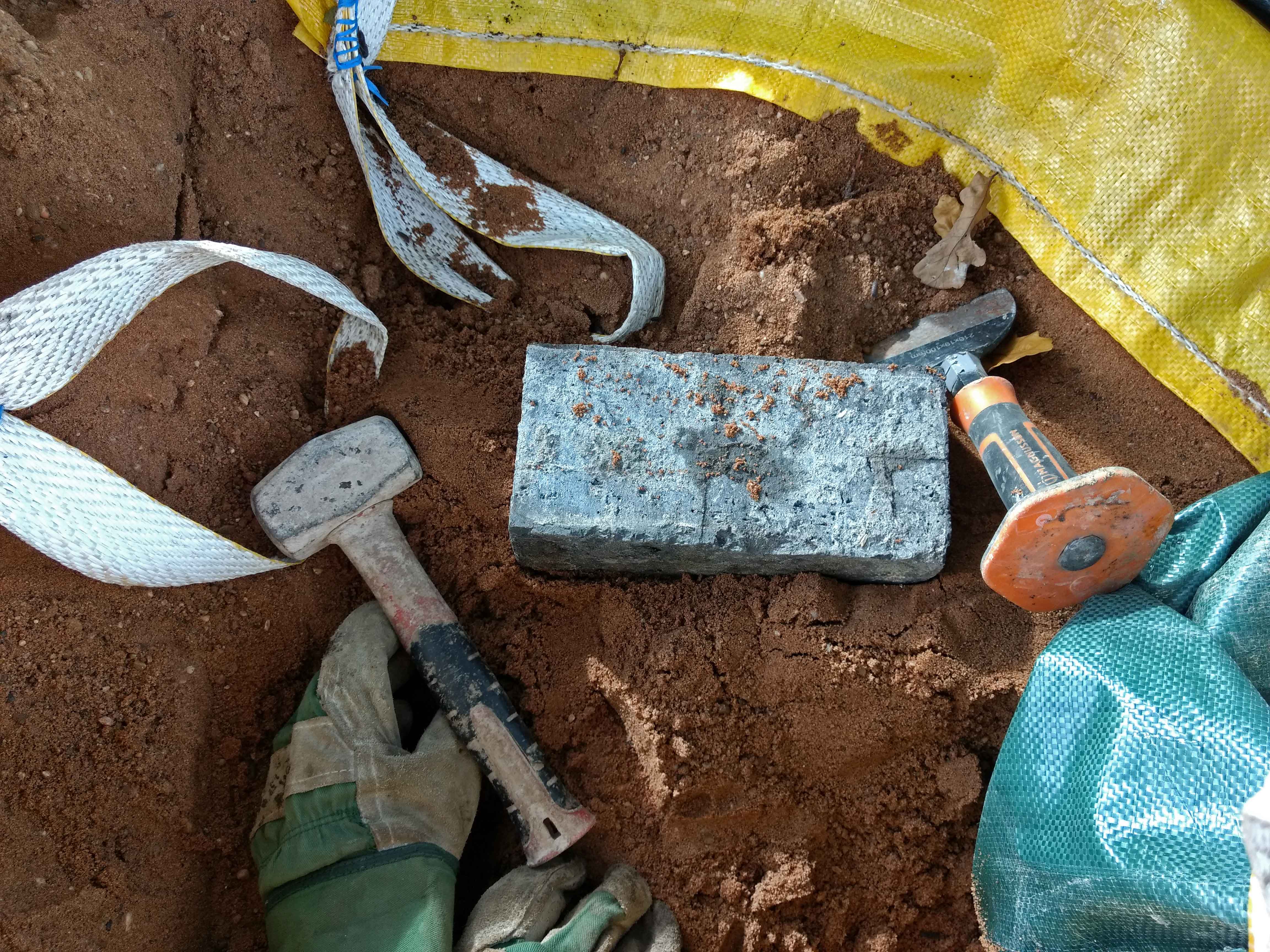
Back on the Usk hut, Paul asked for a number of specials, as he built the first and second courses around the entering chimney flue. The first was for a queen closure, which meant splitting an engineering brick lengthways.


This needs to be done on sand, which absorbs the impact of the bolster and reduces the stress on the brick.


Grrrrrrr....

It didn't work for us though... you can make out the line from L to R down the middle of the brick, but despite tapping it all the way round, the brick decided to part down the middle the opposite way.

We tried a second, with the same result. Curses!

Basic brick cleaning was a better option, making enough clean bricks for Paul and Julian to raise the chimney.

Our bricks are ex Usk (for a part) but also from the platform demolition and recovery at Verney Junction. You can see how useful these recovery operations are, even if you don't know immediately what you are going to use some of the materials for. For example, we now have the material for a platform extension somewhere, should we want one.


John made himself useful by cleaning up two barge boards that we will be using on the gable ends. They come out of a house near Lydney that was being rebuilt.

Underneath are the slates that we will be using.


Dave, back from driving the Telehandler in the yard, tidied up the inside face of the chimney stack.


It's a bit hard to show you what was happening outside, as we are now working in a narrow area, and the build is mostly obscured by Paul and Jules.

Here they are, having a natter, so you can see the chimney in the middle. Still not that clear though.


It's probably best shown from the inside, where the stack is now 5 courses high, and complete all the way round. Paul made his own Queen closure, he has 50 years of experience.


Jules, Paul and John get ready to divvy up the cakes.

By mid-day the wind was really starting to rise. Jules and Yours Truly tried to throw a tarpaulin over the building to dry it out for next time, but it was just impossible in that wind. In fact we had to resort to sitting inside the building to be out of it, at least a bit. This must be the first time the building has been used for something!

After lunch we decided to continue with the chimney stack, and use up the remining mortar, as the wind was getting stronger.


The shoulders of the stack will have the last blocks built up against them. We didn't do that today, as a length of timber to support the barge boards is still to go through there. Next time then, and that should be the end of working with stone.

We have quite a few stones left (as explained last week) and it was agreed with the guys from C&M that they would use them to build a wall at the northern end of the site. That seems like a good use for them.


Room is a bit tight at the top (you can hardly step back for that wider view) so rather than show you the whole gable end at the end of the day, we offer you this one of Jules pointing up the day's work.

The little pile of mortar on the left hides the flue pipe, which is emerging from the wall there and is entering the chimney stack. 

It's all been done very neatly.


The last shot of the day is from the outside, looking up. The 6 courses of chimney are rather hidden by the Hessian we need to apply each time. The Hessian protects the mortar and ensures a more even temperature underneath.

We then went home to shelter from the storm. We wondered what would happen if the oak tree ever fell over, but decided that our sixteen inch walls will hold anything up. We even had a chap suggesting a use as a nuclear bunker. Sounds like a compliment there.