Wednesday, 16 July 2025

Getting too hot for work.

Thursday at Broadway.

A certain lack of materials - to wit, no more concrete blocks in store - forced John to lay bricks along the back on Thursday.
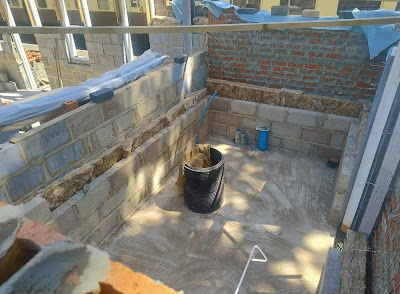
 

The concrete blocks ran out earlier in the week. How far John got, you can see here in the store room. The store room is also being insulated, people working in it won't be cold. It's getting a concrete block interior, as these are stronger for fixing things like shelves or light machinery.

On Thursday then John worked laying bricks along the back, in 29 degrees heat. He put down a row and a half, along the southern half of the rear. 

Under the green timetable on Thursday we had a diesel hauled train (the Peak), and a steam hauled one (35006).

It's getting very dry now, and this big loco set several small fires in the pine needles at Broadway. We put out two of them; the station staff another two. Last week we put out another one, by the signal box. The old MN does seem to leak sparks from somewhere.


Friday at Broadway.

31 degrees announced, and we had a delivery of materials coming too. This meant a lot of manual labour - oh-oh.

The lorry dropped off a pallet of concrete blocks, and another of Thermalite blocks. This was all on the pavement outside the station. No RRV until August, so we were obliged to shuttle this down one platform, over the barrow crossing, and back up the other. The lorry driver was kind enough to split the pallet of concrete blocks into three, so that were were able to ferry 18 at a time, using Neal's pallet truck (of course Neal has a pallet truck, don't you have one?)

The Therrmalite blocks were lighter, so could be split into only two loads, one of which you can see Neal and John pull along platform 1. In the meantime, Yours Truly ((later assisted by Neal and John) heaved the concrete blocks into the store room, one at a time. The total weight of the concretes was 1.3 tons ! 

By 10.30 we had everything over on P2, and stacked inside the building. By now however it was 29 degrees, and we retreated to a windier P1 and collapsed on to the benches. There wasn't much enthusiasm to stand in the sun and lay bricks after that.


Monday in the greenhouse.

The temperature has dropped a few degrees, phew! Neal and Yours Truly spent a day in the greenhouse. While the roof structure is, in essence, finished, there are quite a few little bits that need to be added to the structure. Various plates and angles are needed to allow the fascia boards to be attached to the trusses, and brackets on top of the trusses will allow the corrugated iron sheets and glass to be attached.


Today we had two visitors from the Broadway maintenance gang. How was it all going? Dave and Keith certainly looked impressed, and Neal was only too happy to explain all.


Neal spent the day drilling holes, while Yours Truly ground off millscale on the table visible bottom right. There's a big pile - a wheelbarrow load - of brackets that will go half way up and on top of the trusses, as Neal is demonstrating here. They all have a carefully measured angle, so that they will sit straight when fixed to the slope.


The big plates that Neal is attaching to the ends of the trusses here were cleaned last week, and are typical of the bits and bobs that still need to go on. Up to eight holes need to be drilled in items like these, and Neal reckons that he still has about 200 to drill. Bolts will secure the plates in the first instance, then every bolt will need to be replaced by a proper rivet.


It's amazing how Neal knows exactly what to do, what goes where, and which holes have to be drilled where.

We never see a drawing being consulted - it's all 'up there' ! 


 Another item worth mentioning from Monday is this loco on the unloading road:


It's BETTON GRANGE, about to go away (to the NNR, we ascertained.).

It's a busy locomotive, but of course the owning group needs to earn as much cash as possible now.  


Tuesday at Broadway.

The forecast was a bit dire - showers, and high winds. We decided to have a go! 


John would be working inside the store room, so to some degree sheltered from the wind and the rain.    

We did quite well really, despite the squalls.

Here is a mid morning shot, showing a row of concrete blocks going on.

The pile in the middle was from a delivery on Monday, but at the end of the day it was considerably diminished. Well done, that block layer!


During the day we were joined by members of the S&T department, who were working to permit the activation of the signal box. It's really happening, hard to believe after such a long wait.

In the picture they are easing the compensators, which after years of non-use, had become stiff and touching each other. 


The weather was still tolerable during the morning, but a burst of rain was forecast for 11 - 11.30, so we planned that period for our mid-morning coffee break. It's so nice to be able to drop into the Broadway cafe and enjoy a Cappuccino.  

Back at the waiting room, we see John laying more blocks, cut to size with a huge cloud of white dust by Your Truly. At the end of the day John had consumed three mixes, and laid two courses of blocks, with the associated insulation.

There is no news of our specials from the brickworks. 


We had two steamers during the day. Here's Foremarke Hall, about to steam into a stormy weather system, which completely obscured our normal clear view of Cleeve Hill down the line.

There followed a heavy downpour, which even overwhelmed the station's guttering and downpipe system.

 It was originally a 4 inch system, but we built it as a 3 inch one.


During the downpour (not so visible on these snapshots) the mid afternoon steam/diesel hauled train arrived, and quickly left, as no running round was required.

This time it was a pair of class 20s , which we recognised straight away from a distance, due to all the whistling that was going on. We haven't seen this combination yet at Broadway.


2807 was on behind. It was raining heavily here. At least they were facing forward, and could hide behind the backhead.

After the train left, it continued to belt down.

If you look carefully, you can see John, stoically laying down blocks, albeit somewhat sheltered by the rising walls of the store room.

Still, two courses of blocks by the end of the afternoon, that was certainly worth it.


Wednesday with the Usketeers.

Much better temperature - only 26 degrees. It made all the difference.

Today was a day about drainpipes. We installed the front one last week, but using temporary screws. 

Dave removed the modern screws, and fitted hex bolts in their place. The swan neck at the bottom still needs sorting.
 

The main job was at the back, where a broken downpipe led to a hole in the ground with an unknown, perhaps even blocked, destination.

It is extremely narrow round the back, and error made when the bit of land behind the weighbridge was sold off, and eventually turned into two houses. Damp is almost certainly building up in the narrow slot, and there isn't much we can do about it. The bottom of the slot is only just below the plinth, which is several rows too high.

Luckily the neighbours are friendly, and allowed us to work from their garden. We cut the old downpipe about halfway down (it is broken near the bottom), and on the left you can see Paul pulling through a new 6ft downpipe, which will run diagonally to the corner, and then round.


Here you can see Dave cleaning out the gutter (while we were there, why not?), and behind him you can see the new downpipe sloping diagonally to the corner.

So far, so good. But when we went to try out the next sections, we realiseed that we had failed to allow for crossing the plinth at the end of the new pipe system. A diagonal approach to that would look very awkward.

We had lunch, and chewed the fat.

After lunch the solution came to us, we would raise the point at which we intercepted the old downpipe, and reach the corner at a higher level. 


This picture now shows the amended situation, with the old downpipe made shorter, and the new 6ft length reaching the corner at a point about 2ft higher.

Mid afternoon we had tea and Magnums in the cafe, which was quite busy. The diesel hauled train, sadly, was not. The second train out was hauled by 2807 in black livery, and looked a lot busier.

This picture, taken from the garden, shows the final layout, after a lot of trial and error. We have even put the fencing panel back in, after sawing a small hole into it for our pipe to pass through.


The last picture shows how far we got with the rear guttering layout - to the corner, and properly secured to the wall.

Now we have to buy some additional pipes and fittings, including another swan neck to get over the plinth below. With a bit of luck it will arrive before next time -  watch this space.


PWay notes for Wednesday 

A repeat visit to Gotherington, where some of the job of replacing flat bottom rail sleepers still remained to be done 


Although the day started cool enough, as soon as the sun came out it becme very hot, and this hit productivity.

The interesting news item of the day was the first time use of the Milwaukee electric chair screw wrench.

Before we bought this, our weapon was the motor powered impact wrench. This suffered frequent breakdowns, and when operational, was extremely heavy to carry and operate, and also required you to bend half way over, a poor attitude for the back.

The new electric wrench is not only surprisingly light, it is tall, so that you can use it standing up, without bending. With its two handles at the top it looks like a pogo stick, so that's what we call it... 


We liked it, sure enough! 


An extract from:

THE GREAT WESTERN RAILWAY (LONDON) LECTURE AND DEBATING SOCIETY.


Yes, there was such a thing! 

One item in a 1926 pamphlet that came across our desk was this one, which you might find interesting:

Anti-Aircraft gun damaged.


An unusual accident arising from unusual circumstances led to the disaster you see depicted. This is an anti-aircraft gun on a road motor lorry loaded on a ''Loriot'' despatched with others from South Lambeth to Watchet for Territorial manoeuvres.

The barrel, which normally pointed in the opposite direction to that shewn in the photograph, was intended to have been kept horizontal, first by a locking pin in the elevating apparatus, and secondly by a wire lashing around the muzzle, securing that end of the barrel in a metal crutch by attachment to the floor of the lorry.

On loading, these safeguards were assumed to have been taken because the gun was covered with a War Department sheet, but the pin had not been inserted, and the wire lashing and crutch had not been properly fastened.

The barrel became elevated during the journey, and on the train passing under Milley overbridge at Twyford, the gun rammed the bridge. The effect will be seen to have been quite bad for the gun.


Was that a bang I just heard, Fred? Nah, pass me my mash tin, will yer Mikey?


Wednesday, 9 July 2025

Summer fun.

Friday in the greenhouse.

Another day drilling holes to fabricate the intermediate trusses for Broadway, and grinding millscale off the strips that form a part of them.

It's a somewhat repetitive job, and as it was hot, we decided to drop into the Cotswolds Halt for a coffee, where we met some visitors (on a non-running day, except for a diesel driving day experience) who were interested to see what we were making.

Neal explained everything to them... 

It was good to see that people came to the station to visit our catering outlet, even when trains weren't running. For example, it was seen as a good place to park and have a coffee for several motorcyclists during the day. 


While the main parts of the canopy are now complete, smaller supplementary jobs keep popping up.

Here Neal is drilling holes for rivets to attach a gusset plate to the end of a truss.

While we finished off the second 20 strips for the intermediate trusses, it seems we were not yet completely finished, as Neal arrived with a whole wheelbarrow of bits that he had manufactured in the loco shed, and that needed stripping of millscale and putting in primer. 


While passing through the side gate in the fence erected by the Usketeers last year, we noticed that the overlapping boards were coming loose, as if someone had kicked them from behind. This was apparent over  two or three yards, including an older part of the fence.

What was going on?

Neal diagnosed that the gate was being left open and unattached, and that the wind was banging it shut repeatedly, and shaking all the boards off. 

So if you are a user of this gate, please keep it closed, or else attached to its post. Don't just leave it ajar.

We will buy a 'Please shut the Gate' sign for it. 


Saturday out with the gang.

Seven of us, on a warm, cloudy day, ideal for working on the track.


Saturday's job was to jack & pack two rail lengths at the southern end of the Winchcombe loop.

Transport was a poser - we could walk there from the mess coach, or load up the Ranger and take it down the new ramp to the trackbed, a bit beyond where we wanted to be. 

Those that walked met this modern recreation of the famous Coffeepot service - a coach, and a loco. What was it doing in the platform? 


A few minutes later the shunter, now without carriage, reversed past the bracket signal, just as the Ranger was reversing down the new access slope. 


This was the work site on Saturday. The dip in the Malvern side rail had already been measured, and the drops chalked on the sleeper ends. We lugged the heavy panjacks to the site and slipped them under the track. The we pumped until the bubble in the gauge said that the track was level.


The first few yards had been packed when P&O trundled into the loop. That meant letting the track down again, so as not to damage the jacks.


Once the train with P&O came to a halt, the shunter picked up its coach and placed it on the end of the train, raising the consist from 6 coaches to seven.


The proceedings were of great interest to our neighbours, who peered over the fence to watch all the comings and goings, steam or diesel. We even got a wave.


Then we had to stand back again to let the next train leave, this time headed by 2807.


Here is a video of 2807 accelerating up the hill and into Greet tunnel, marked by a brief whistle:

https://youtu.be/zbkrDM5DLhM 


Then it was back to work, all the way down one side of the track, over two lengths, or 52 sleepers. The Robels do the consolidating of the ballast now, but it's still hard work.

 Once an hour we could have a break, as two trains came, and crossed at Winchcombe.

2807 came a second time. It's a great feeling to watch it from your place of work, you really feel part of the railway like this.

After lifting and packing the two lengths, we switched to a dipped joint on the Cotswolds side, and then, mid afternoon, the siren call of the nearby Coffeepot was too strong. We packed up, and had tea. 

Outside was a wonderful 1926 MG, owned by Tim from the catering staff. Although it's not fast, driving it is every bit as exhilerating as a modern, much more powerful sports car, we heard. The MG has been slightly modernised, with hydraulic brakes and an electric starter.


To compare, we parked a modern 4x4 600 HP Audi RS6 next to it, but it was the little MG that got all the looks.


Monday on bridges.

A day with Neal and Ian, spent on a bridge at Stanley Pontlarge. Here, the latticework parapets have suffered corrosion at the base, and our solution is to repair these in-house, at little cost to the railway.

On Monday, 156 rivets were removed. These were part replaced with nuts & bolts, ready for a speedy removal in early August, for repair.


The full story will be on the Infrastructure blog, with pictures.


Wednesday with the Usketeers.

Back to full strength (er, three) as Dave returns. A merry time was had by all. 

It does help when you come back and bear gifts, to wit, one box of coffee & walnut cake. That went so well with our mid morning break. 


We have received the two downpipe reducers that we ordered, all the way from Taiwan, and the good news is that they work, and are practically invisible.

That confirmation allowed us to make a start on fitting the gutters again, and later the front downpipe. 


Once the Hammerite paint had gone off we got the gun out with the gutter sealant. This time it's not going to leak, we made sure of that. Not only will there be pleanty of sticky sealant, but a nut and bolt to hold the two halves together. (previously absent) 


Then we fitted the RH gutter....


.... with the LH close behind. On checking the levels, we discovered that there was a sharp drop in the underlying brickwork on this corner. This is the corner that had started to lean outwards, and was underpinned at the start of this project. 


Round the elevenses we wandered over to the station, where there is always a lovely business when the two trains cross. We chatted to a couple from Monaco ('We say we are from France, because people don't know where Monaco is'), and outside there was a very large bus from Germany, waiting to pick up a Cotswolds 'Gardens and Culture' tour group. Later, at Broadway, there was a bus from The Netherlands, so we do seem to be on coach companies' radar, which can't be bad.


Once the gutters had been screwed on to the board behind, we had a go at fitting the new cast iron downpipes (previously plastic).

In the picture the reducer from 4 inch to 3 inch is already fitted. You can't see it, which is just how we wanted it.

The downpipe is fitted with 'ears' (the plastic wasn't) so we had to trim one brick to make them fit. The cast iron pipe is quite heavy, so we wanted that secured before we measured up for the next bit below. 


At the bottom of the 6ft downpipe we fitted a sleeve with ears, which will stop the end from moving. Below that comes a short straight piece, and then the swan neck, to take it around the plinth.


At the end of the day the downpipe, short extension and swan neck were all fitted and secure. Something else still has to go onto the end, which will lead to a soakaway in front of the building. There is no stormwater drainage from the building, due to the fact that the ground has been built up around it after the new, large weighing table was fitted in 1945.

 
We had a couple of errands to run at the end of the day - taking two enamel tobacco advertising signs to the RATs shop in Toddington, and this curious machine:

It's an aluminium tape lettering machine, certainly not a very common item. You used to see these sort of things at carnivals and beach side piers, but we didn't see a slot for money on this one.

If you are interested, the RATs will almost certainly sell it to you.  


GWRS newsletter - July 1981

- The society has existed for 5 years now, and it's been 4 months since the occupation of Toddington yard under a temporary lease.

- A plc is formed, to raise capital to buy the line. It needs a minimum of £50.000 by September 16th.

-  2807 arrives on 20th June; also 7821, 7828 from Barry.

Picture by John Lees, in 1981. 

- 1942 Hunslett 0-6-0 King George, arrives, ex National Coal Board.

- 1939 Peckett 1976 arrives, ex Thoresby colliery.

- A scheme to share the trackbed with a cyclepath now looks unlikely to go ahead, as the GWRS intends to buy the whole of the trackbed, and the promoters of the cyclepath look unlikely to raise funds themselves.

- A catering section is set up at Toddington to support the increased activities there with light refreshments from a table. 

- A sponsored 24 hour track laying event is planned for August 29th, starting at 2pm. This is described as a major fundraising event.

Picture by John Lees, in 1981.
 

- Toddington signal box, vandalised and with the lever frame sold to another railway, is being reglazed. 


Wednesday on the PWay.

A day with a difference, as we hosted a party of 12 volunteers from Network Rail.

What could they do for a day? They were not averse to digging, which was good news, so we assembled on Monday a pile of sleepers and track materials at Gotherington for them to work on.


This was good, old fashioned PWay work for them, no electronic machines involved.

There was an added wrinkle at Gotherington, in that the sleepers were spiked, and therefore not so easy to remove. 


But the day went well, as you can see. Here they are, inserting a new (second hand) sleepers already.


Then the next one had to be dug out, a bit further along. To the right you can see a big pile of replacement sleepers, the 'to do' pile.


The NR gang also had a go on the Robels. In the picture you can see a spiked sleeper on the right, and in the centre the replacement uses baseplates and standard Pandrol clips.


All the time trains rumbled through, so it was always a good excuse to pause and watch the train go by. The heavy mob was out today - 35006, and the blue Growler.


Bryan and Savita from Gotherington station were very helpful and supportive.

Savita very kindly provided refreshments on this rather warm day, while Bryan offered trips up and down the branch line on the pump trolley, or his little Wickham rail car. 

At the end of a very successful exchange day, the whole gang assembled on the platform for a souvenir photo.

Everyone enjoyed themselves, and we hope that the exchange can be repeated.