Thursday, 8 August 2024

Rail away.

 Rail Away.

A special day on Monday, with three of us around STEVIE in the Dixton cutting.


It is our plan to remove the 60ft lengths of rail lying along the track in the Dixton cutting. They are left over from an operation to change rail that was deemed of poor quality after an ultrasonic test on the whole line.


The job for Monday was to assemble the scattered rails into more managable piles, so that they can ben loaded on a single day. This looks to be Monday week, another non running day.


Some of the rails were on the other side of 3 Arch Bridge, which involved some very careful maoeuvering with Steve, so that we got through underneath it, without hitting it, or STEVIE falling over. 

As you can see on the picture it was possible, we just did it very slowly.

Here are some of the piles we made up. The nearest one includes two new rails, which we still plan to instal somewhere.


All in all we moved about 20 rails. Because they did not pass the ultrasonic test they are now siding quality, so they are available for disposal. They will be taken back to Winchcombe, where there are others. Scrap they are worth £180 each, but perhaps there is another line out there that is interested?

If so, send a message via the blogger contact form, top right of the blog.


Our rail moving disturbed several mice, which ran up and down the bottom of the FB rail.

No mice were hurt in the making of this blog post.


We achieved more than we set out to do (assemble about half the rails) so we were very pleased to note that they are all now ready for removal, providing we can organise a removal train next Monday.

Back home at Winchcombe, we ran into the former Gotherington down starter, which has had to be removed because the base was rotted. Now what do we do with the remains?


Also a quick look at the new S&T headquarters.

The doors and windows are now in, and the Heras fencing around it has been removed.


Tuesday at Broadway.

Two of us again, with Neal at Toddington on steels. He reports that there's just a bit more drilling to do, some welding, and then the 3 ridge purlins are complete.

At Broadway further progress was made on Tuesday, with yours truly on mortar and brick cleaning, and John on brick laying.


So far we have dug up a lot of metal remnants of the original P2 building, but of course it's all rusted and bent.

Neal collected it in this wheelbarrow, and then took it to the scrap bin at Toddington.

We're trying to preserve as many of the original bricks as possible, as these can be re-used, possibly on the planned Toddington platform extensions.


We're currently working along the front, as we have run out of DPM at the rear. More is expected imminently.

On Tuesday John was working on the fourth course, of the 5 due to come here.

2807 and Dinmore Manor were handling the services, on a pleasingly busy day for the railway.


A shot of the 4 courses completed on one section.


There were large numbers of passengers on Tuesday, no doubt boosted by the summer holidays.

Also earlier in the day, at least one coach load dropped off at Broadway.

Sadly, Auntie Wainwright's bric a brac shop had no volunteers, so that is pure income lost.

Only one course completed at the back, while waiting for more DPM.


On the other hand, one of the front corners was high enough to try out a corner plinth brick. So this is what it will look like.

The final result for the day was 100 blues laid, a very good result. The front now has a very visible wall along it, between three and four courses high.

2807 completes the picture of this all GWR scene.


Thursday with the Usketeers.

A dry morning, and showery afternoon were promised. We shall see. Four Usketeers reported for duty (and cakes).


As you may have noticed, your blog reporter has had a week off on the Isle of Wight, so what did the three remaining Usketeers get up to while he was away?


Here is an updated shot of the drive. We have completed the two gates, and are currently about two thirds of the way up. We counted out how many bits and pieces we were going to need to finish the job, and we are just about OK we think.


During the trip to the IOW Neal finished off the last of the curved ridge purlins.

Here it is, finished. The two others are on the left.

Trusses next! (but see below)


Yes, actually there is one more thing to do, and that is weld joints like these, where the curves attach to the straight pieces.

Then of course replace all the bolts with genuine rivets.
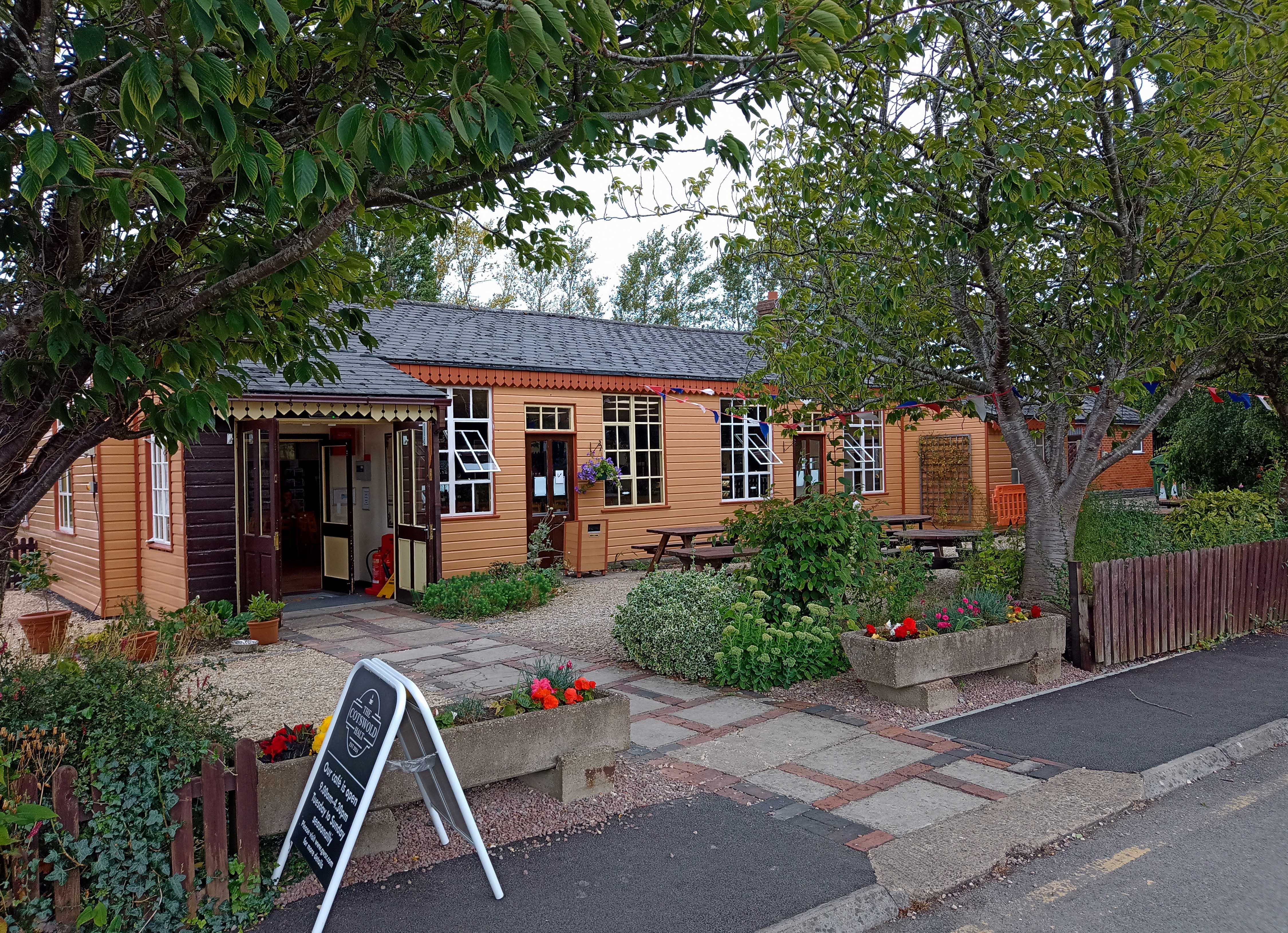
We also had a quick look round the Toddington site. Here is the Cotswolds Halt, now open on Fridays too (despite being a non-running day).

The building has had a repaint, and it now looks more welcoming in dark stone than the previous dark chocolate brown. This is in keeping with the general colour scheme of Toddington, which is pitching for an interwar era theme.

Outside, by the toilet block, is the new area for the appeal boards for the various locomotives that we have. These used to be lined up against the coal bunker, but have had to be moved after the compound around the coal bunkers was enlarged. Foremarke Hall and 76077 have put the first boards up.


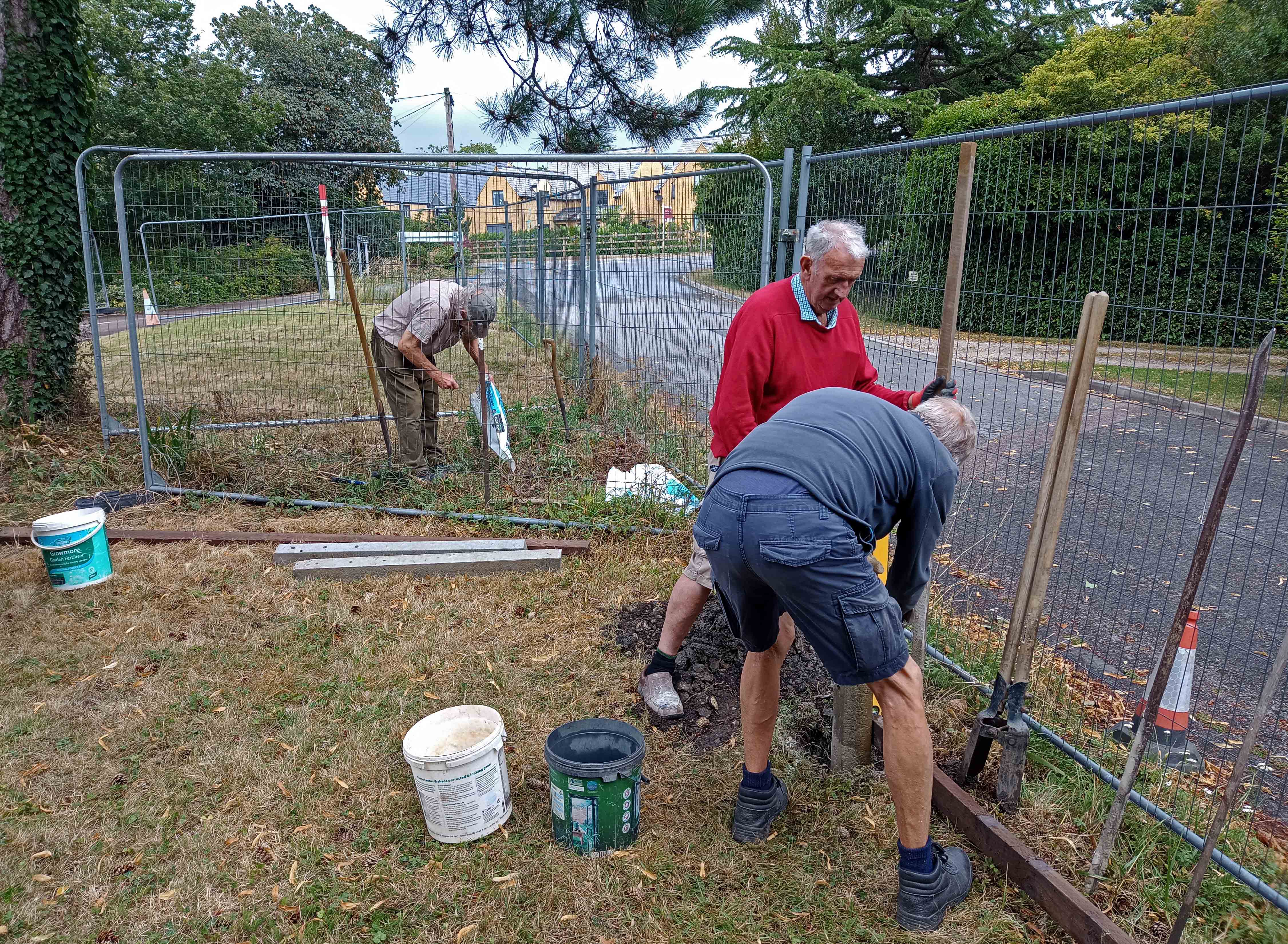
The lads made an early start (8am!) and got one post hole dug and filled.


The weather forecast gave a 10% chance of rain, and we sure had that ! We had 100% !

The drizzle came down so hard that we had to escape to the cafe.


Rain at Toddington in mid August...


Luckily it would appear that it was only a lengthy shower, with quite some driving wind.


At 10am Dinmore Manor prepared to set off south for Cheltenham. The rain had just finished. A coach load of passengers arrived, 5 Dutch DAF cars, and two mini buses from what looked like care homes in Worcester. Interesting to see where our passengers come from.


Dinmore Manor ready to set off, with the DMU about to leave in the opposite direction.


Once the squall had blown over we set off digging holes again.

Here Paul and Dave a fitting a godfather post, while John is excavating the next hole, behind the Heras fence panel.

We also found another use for the post and rail fence - a place to lean on, and chat !


This picture, taken near the end of the session, shows how we are now well past the big tree, and motoring up the drive, with 20yds to go, and maybe 5 or 6 more posts.

Two more were planted today, and the posts and rails fitted for the previous two.

Yours truly creosoted all the rails finally, there must be a 100 of them...


Before tidying up we laid out some rails to get an idea of the size of the remaining job. The target is the red & white gas main marker. Somewhere in that vicinity there we will have a receiver post for a new sliding gate, but at the moment the railway hasn't got the money for that. Some panels of the ugly Heras fencing will remain at the top therefore.


On the brighter side, just look at the ones we have already made redundant. The pile is growing.

The new post and rail fence is behind the pile, just high enough to get a mower under.


Before leaving, we had a quick mosey over to the station, to find the DMU about to depart for Cheltenham.


This is a rather nice subject for a picture, most people taking steam only photographs.

What would W20W look like in this scene?
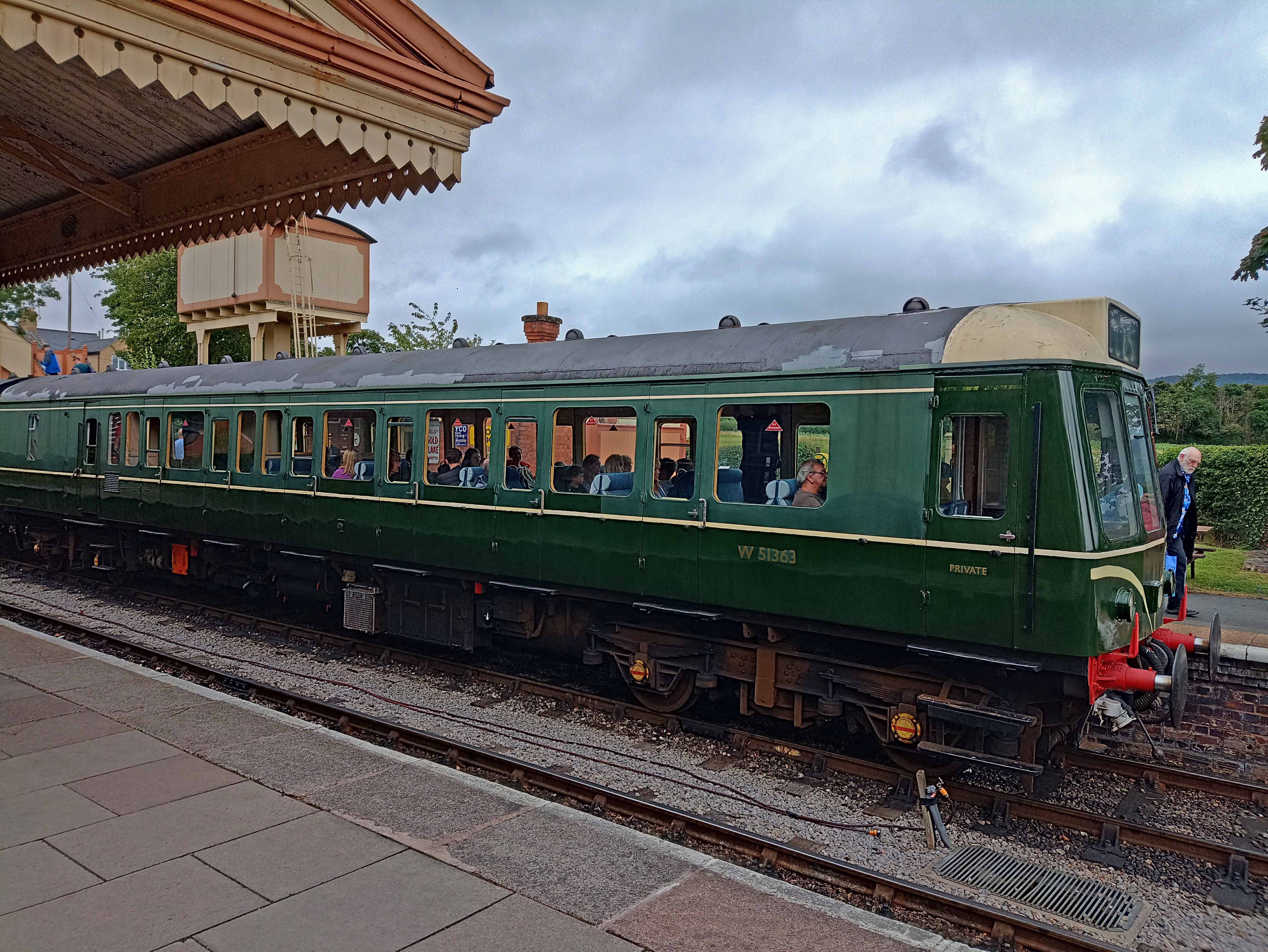


A little close up here shows that the DMU was quite well patronsised. At certain times it can be found to be carrying just half a dozen people, so it was good to see that it was so busy today.


The next blog post is in a week's time, probably also on a Thursday. We sometimes have other stuff to do, you know.


Friday, 2 August 2024

A week away.

'STEVIE' makes himself useful.

STEVIE is a multi tasker, not just for the pWay. When we invested, who would have guessed that the Gotheringon down starter would one day fall over? But it certainly did, the old wooden post gave way, attacked at the base by rot. Pictures (and film!) by Walt.


On Monday, one of our two non-running days, a small gang went out to the Gotherington area.

The first job was to take out to the site a replacement signal post. The original that we put there when we reached Gotherington was a genuine wooden one, but its replacement was a steel tubular post. They don't make wood like they used to. 

Broadway has another genuine wooden post, also the down starter. That came from a supporter's garage.


Walt took an interesting stop frame video of the operation, but don't blink, or you'll miss a chunk of it:


The small Monday gang then moved to the southern Manor Lane area, where some spot ballasting was required.

For this we had earlier loaded a number of dumpy bags with a bottom discharge facility, but annoyingly this was only a partial success, as some of the bags discharged themselves early by ripping.

Dumpy bags do this - they deteriorate under sunlight, and we've had plenty of that recently.


Last Wednesday with the Usketeers. (but no blogger)


You will no doubt recall the heat of last Wednesday, as evidenced by Paul, who had afforded himself the luxury of a sun hat. We don't see that very often.

Luckily the adjacent lime trees give a degree of shade, although they rain sticky bits of syrup on any car foolishly parked underneath to get some of that same shade.

We now park out in the open and accept the heat - lesson learned.

Here is Paul, using an upright that he has made himself to place and support the rails that he is attaching to the post planted the previous week.


We enjoy working at Toddington, as when things get tough, the tough retire to the Cotswolds Halt.

You can sit on the terrace outside with your Latte, and watch the action.

Two locos at once - that reveals that the time is first thing in the morning. They will set off in opposite directions.


We have now passed the awkward spot with the big tree, where because of the thick roots we had to deviate a tad from our brief to leave a 100cm wide strip on the outside for a lawn mower.


John carried on digging holes. He is amazing. He is 86 years old, yet two foot deep post holes keep appearing at regular intervals, and there are never any complaints. 


Here his day's job is complete, and we have planted the godfather posts in Postcrete. They will be ready to take wooden posts next week.


Bit by bit the ugly Heras fencing panels are also coming down.


Thanks to Dave - always off camera this time - for taking the pictures, while the blogger was off on holiday for a week. That explains a couple of delayed blog postings this time.


A look over the fence.

A week's holiday then, on the Isle of Wight. Toes in the sea, OK, but also a look over the fence. Two in fact. The first is the IOW Steam Railway.


This map, from their museum, shows the once full extent of the island's railways. The network pretty much made a cross, with the capital Newport in the middle, and a lateral line running down the east coast. After all the closures in the 1960s, this is the only public line that still exists, cut short at Shanklin. It is now run by SW trains, using ex District line stock. (of which more later, in a future blog post)


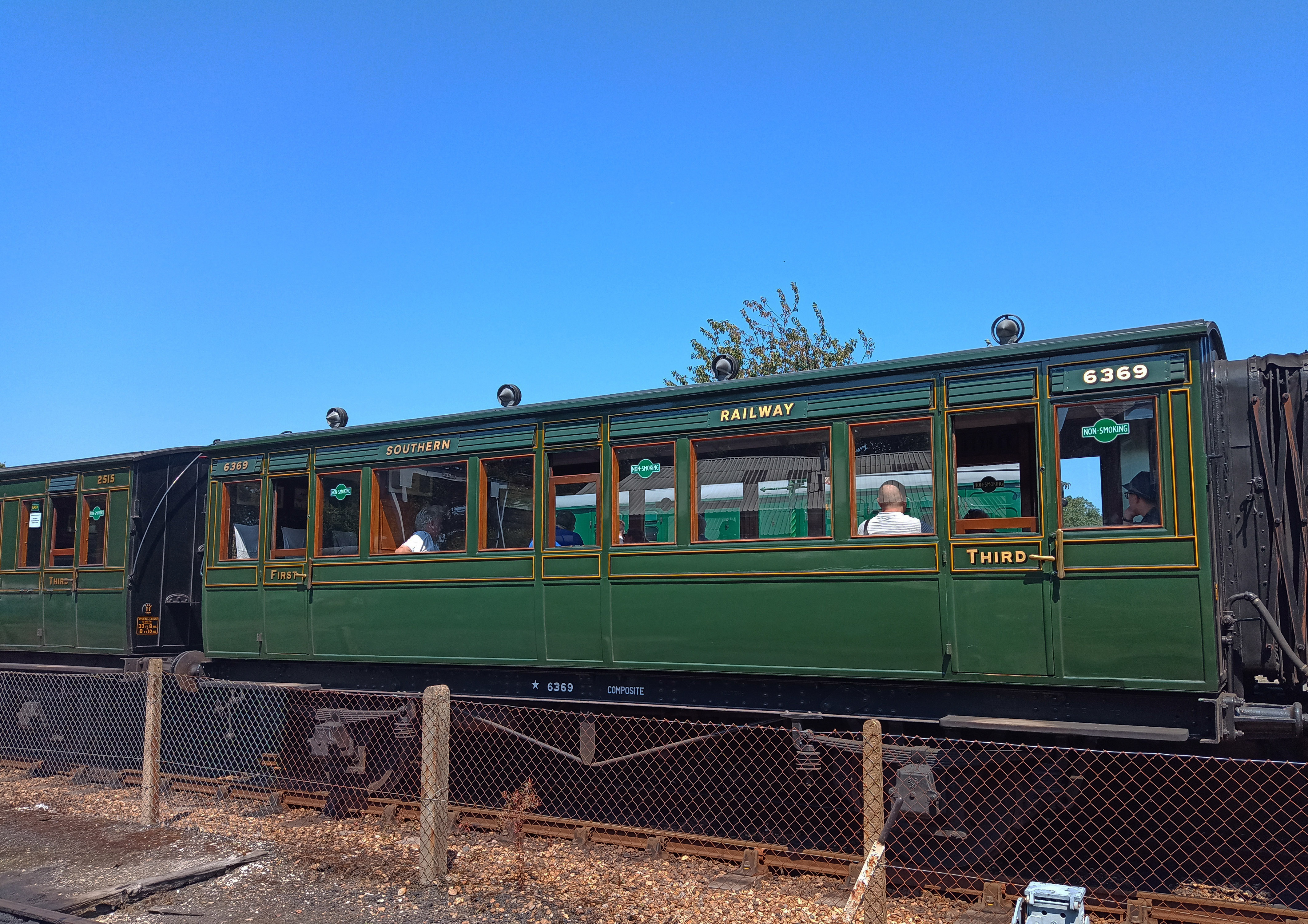
The IOWSR  has a Southern theme and is known for its attention to heritage and period carriages, often restored from carriage bodies dumped in fields as pavillions, or chicken sheds.

It's only 5 miles long, with a base in the middle at Haven Street. This is the entrance. It feels like quite a cramped site, but they have been able to buy adjacent fields to expand.


With a two engines in steam operation, trains meet at Haven Street, where there is an island platform. This was installed by the SR in 1926. On the day of the visit, one rake consisted of bogie coaches and the other of 4 wheelers, very authentic. Not a Mk1 in sight ! Both trains were hauled by Austerities.


The island platform layout - inherited from the SR who installed a passing loop here - makes things a tad confusing for newly arrived visitors. There is a plethora of picket fences, and 4 gates closing off the far side of the tracks, where the original booking office still stands. Often the gates are closed, but you can't join the train that is clearly visible in the platform. Nor can you reach the other side, where the restaurant, bar and cafe are located. As a railwayman you can see that the gates are interlocked with the signals because of impending train movements, but from a passenger's point of view it is confusing. An airport style zigzag of ropes hints at larger crowds having to be marshalled here. We can see the operational logic, but from a human perspective it leads to frustration. We can't think of a better way either, short of completely redesigning the layout of the station, and it is supposed to be a museum. So it's quirky - be patient, and enjoy it.


While waiting for our train we had a quick shufty to one side, where we found the frames of the LBSCR E1. This is to be renamed 'YARMOUTH', in memory of a similar loco that once ran on the island. It needs a new boiler, but is being restored after being brought to the island from the ESR.


Nearby was the carriage shed, a modern building but with a nice attempt to emulate similar buildings alongside with outer brick walls and arched windows. Well done !

In the foreground are the driving wheels of CALBOURNE.


The public can go down the (in-) side of the workshop, and is well informed about the works going on with descriptive panels, and this blackboard, showing progress with a funding appeal. Several buildings have had heritage lottery funds, and there are some impressive new buildings for Haven Street, once barely more than a wayside halt.


This original 4 wheeler has had a stunning restoration, and is typical of the work done on field type barn finds, which have been turned into beautiful working carriages. More are on their way. We read that the island, which was often supplied by second hand stock then dumped in fields after further use, had as many as 120 carriage bodies, of which 50 still remain. Amazing.


Haven Street sits in a dip between two slopes.

This is looking west towards Wootton...


... and this east, towards Smallbrook Junction.


On the far side of the tracks is the restaurant.


This is a new build, and makes a pretty authentic impression. The extension on the near end sells ice creams, and nothing else. Yet we were assured that the sunny hot spell that we witnessed was an exception. 

At the far end is a shady terrace.


The company offices seemed very modest to our eyes, which are used to the lofty edifice of Churchward House.


We took this picture of the menu to show what is on offer, and for how much. There is hot food, and we discreetly ascertained that the staff, all in branded uniforms, were paid staff, not volunteers.

In a field is a large new building, which we learned was a bar. It replaces a beer tent that used to stand there. It is apparently successful, although we did not see many customers in it during a brief look. It is located a bit out of sight.


Not in steam was this interesting Ivatt class 2 tank.

The line is probably ideal for Austerities, but we would have preferred this little beastie.


There's a large new storage shed a bit of a walk away. This is called 'Train Story' and is full of interesting, non-running exhibits, with a nice place to sit outside. It is here that we would have liked a coffee, as it is a great viewing area for passing traffic. 

Given the cramped site, the Train Story shed is a bit of a walk away in a recently acquired field, and we suspect not every visitor was aware of it. We were in a coach party, and this soon left, after the end of the ride.


Mr. & Mrs. Blogger bailed out of the coach party and returned to their Sandown hotel independently, via the Island Line. This gave us the time to fully visit everything that there was to see.


At Smallbrook Junction the IOWSR runs round a curve, to end at a platform parallel to the Island Line one. There is no physical connection, but passengers can interchange. Island Line trains stop, while the IOWSR is in operation.

Here is the train of pre-grouping bogies, headed by Austerity ROYAL ENGINEER. The Island's stock is air braked, so this is a Westinghouse pump on the front buffer beam, with an air receiver at the cab end.

The air pump is quite noisy. Presumably authentic so, but we didn't find it so appealing.

We tried to get a shot of an Island Line train, but it was just leaving as we drew in. Why doesn't it wait for the steam train?

Well, the Island Line trains run to a timetable, and cross at certain places along the now singled operating line. Any delay, say at Smallbrook Junction, quickly affects other trains on the line. The same 'criticism' is levelled at meeting (or not) the boats on Ryde pier, but the same argument applies. In fact our train arrived 6 minutes late, and if we had been on time, the connection would have been perfect.

A curious fact of Smallbrook Junction is that it wasn't a junction until the SR made it so in 1926. Before that, the trains from Haven Street carried on towards Ryde on a parallel line. One idea for the future would be for the IOWSR to do the same again.


At the other end of the trip is Wootton, a small halt just before Newport. Here a road over rail bridge has been filled in. It's not impossible to reopen that bridge and reach the outskirts of Newport, but there are no firm plans, due to 'lack of a millionaire', we we told.

Newport station itself is built over.


Back at Haven Street we loved the idea of  'Buggy park'. It was in use too !

As 100% of the rolling stock is pre-grouping, space on board is limited by history. Enjoy the moment, park up your buggy, and enjoy travel as it once was. It's what you've come to see, isn't it?

At Haven Street we watched from outside the picket fencing, to see the second train arrive, a rake of rescued 4 wheelers hauled by another Austerity.


The passage of this train brought to us most clearly how well the IOWSR has done to restore their barn finds from in the fields.

Just look at this 1886 brake third !


Or this 1887 saloon, which made a set with the brake above.

It's really impressive.


We travelled in the bogie train, which we suspect is more comfortable, and much more modern....


How about this 1924 First / Third composite?


We had a peep into a first class compartment.

You can hire this, with its picnic basket and anti-Macassars.


Even the toilet block had a certain charm, all in SR green and lovely tiling on the walls. Wooden doors, and a clay tile floor.

We got halfway there at Broadway - tiled walls, clay tile floor, Victorian sinks, but formica cubicles, which ruin the heritage effect. These had been ordered prior to the heritage team being involved.


Our railwayman's nose told us that there was a signal cabin hidden inside the original waiting room at Haven Street.


We asked very politely, and were invited inside for a quick photograph and a chat.

This is the frame that was installed in 1926 when the SR installed a passing loop here. Beautiful technology.

The brown lever in the centre controls the locking of the 4 passenger gates - just two of them, or all 4.


Turn to the right, and you can see that the signalman was also selling the tickets. This hatch is now out of use though, and the main booking office is as in the first picture, under the map.

The fittings are all original. The safe, similar to the one we rescued from Broadway which was offered for use but declined, has a handle which is removed and kept in a drawer, as it hurt the signalman' shins.


There is a large-ish shop on site, in an extension to a former gas building. That extension is so well done that it is indistinguishable from the original.

The IOWSR shop at Haven Street.
Note the sign for the museum. Want to see the museum - you need to go through the shop.


The museum was comprehensive. This will be of passing interest only to many visitors, but we did see quite a few attempts to make the site interesting for children.


Next to a simulated steam locomotive in the Train Story for children (we sat outside and heard endless 'ALL ABOARD's and 'whoo-whoo's from inside) there is a playground, a trail to follow, and explanatory panels in lots of places.

With our PWay background we have to take exception to the suggested weight of a rail above, and we smiled at the explanation of 'angular stone' for ballast, as right in front of us beach had clearly been used. This may be easy to get on the IOW (it was tried on the KESR with results so woeful that the site 50 years later is still known by the name of the proposer to use the stuff!) but beach is like marbles, and certainly not angled to grip the track.


Inside Train Story we came across this fabulous first class compartment in one of the Oldbury original coaches, as well as a lovely station clock.


The GWSR's Railway Archiving Trust has a clock just like this one, but nowhere to put it, as it needs to be indoors as here, with a wall behind it and space for the turret clock mechansism. Maybe one day, when we have our own museum...


++++++ * ++++++


Brick laying was in evidence at Broadway, and it looks like the second course was completed on Friday. No pictures though, due to the week's holiday.

Next week's update will be on Thursday, as the Usketeers are working a day later.