Thursday, 14 September 2023

Back from gone away.

Friday 25th on steels.

Three of us on Friday (25th August), John came back just in time for the tricky manoeuvre to get the long, long fascia boards from the unloading road by the shed up to the 'greenhouse'.


We had the 8.30m fascia board and a shorter sibling on the pull along truck at one end, and on a little piano truck at the other. As a non-running day Friday had a car park clear of visitors, so we set out across the emptiness, with Neal pushing in the electric fork lift from behind, and John valiantly trying to steer at the front with a truck that had the front two wheels up in the air.


We got there in the end, but phew! What a journey. At one point the rear wheel of the little forklift dug itself its own little pothole and wouldn't be budged any more. We had to get the larger forklift to nudge it out again. Then we spread all 3 fascia boards out on trestles and pallets, ready for millscale and rust removal.


While we removed the surface scale et al Neal worked on the fourth purlin, which was completed at the end of the day. Heavy cloudbursts then followed, and we called it a day, feeling quite chuffed with what was achieved.


The latest position as per today (14.09) is that Neal and John have made all of the purlins now, including the ridge purlins, but without the curved arches as yet. Bunches of angle were also taken off the MACAW and stored under the 'greenhouse.'

Further work on the steels is now held up until funding for further, minor expenditure on the steels is agreed.


Blog back from the hols.

We're back from N Italy, charmed by the culture there, and a little overweight. But you go there for the food, don't you?

While we were away a few snippets of news trickled in, so we can share these with you. The PWay gang continued with a list of defects reported by a our track patrollers, sometimes in extreme heat. Walt kindly agreed to share these three videos with us:

STEVIE our RRV went out to Gotherington to pick up the bags of ballast that we had filled earlier.

In the stop frame video you can see him set off from Winchcombe, pass through the tunnel and load up at Gotherington Skew. The bags were then discharged at various locations. Doing it by individual bags is much more economical than with a 20ton Dogfish, as we can put just what we need, exactly where it is required.


In the second video you can see the bags being used on the loop at Gotherington, where the sleeper ends were exposed. They're so practical, those bags.

And then in the third video you get a cab ride view of STEVIE returning back to base, with a couple of bags left for next time. Now we have to fill them up again with the mini digger, which is quite a slow job but worth it as you saw.


Yesterday (13.09) this indeed happened, the bags were refilled, in record time. The lads felt that those bags were a really efficient way of spreading around smallish amounts of ballast. Saves money too. 


Here they are, all in a line at Gotherington skew.

Next to them are some of the wartime economy sleepers we lifted from Didbrook, waiting for their re-use in sidings.


Also on Wednesday we can see the gang hand tamping with the Robels some of that ballast that was spread there a week earlier.

The location is the Gotherington loop.


More Gotherington loop is revealed in this shot of our big Pacific passing down the main line.

Pictures by Paul.


Two Wednesdays on the Usk hut.

Dave, Paul and John were busy with both the diamond paver path, as well as the erection of the counter inside.


The paver path has passed the slab outside the door, and can here be seen reaching near the corner of the building, its intended maximum. That was two Wednesdays ago.

Inside, Paul has been back home to his garage, where he was making the final part of the counter.
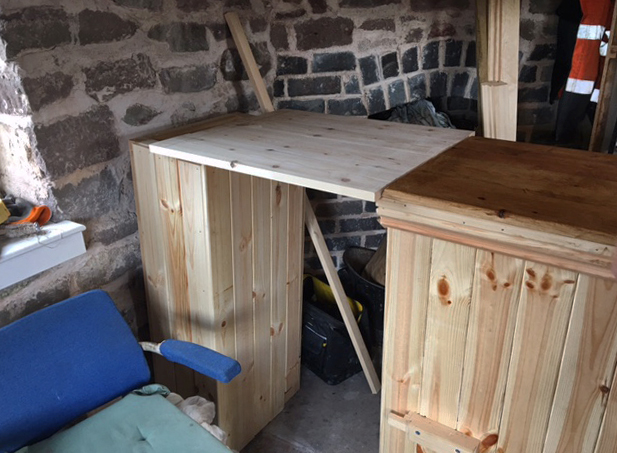

This is what it's going to look like, with a 'Delboy' flap, near the fireplace. It will give access for the coal agent behind the counter, and also allow the fireplace to be cleaned and resupplied.

We still need a few more lumps of coal for the GWR coal scuttle, collected from the lineside.


The flap is attached to a last 9ins of counter, which will be married to the rough stone wall.


John has done a good job applying a waxy stain to the white new pinewood.

He seems to be enjoying it too!


 Here's the end, the first bit the visitor sees when the door is opened.

A blog reader has offered us an ancient office typewriter, which will be perfect for here.

The bottom still needs a skirting board fitted, which is why it's not stained.


The following Wednesday the paver path had reached the end, neatly skirting around the original Usk stone slab. Doesn't it look fantastic? It gives the surroundings age and authority.

Still to do here is a backing around the outside, to prevent the pavers from breaking out sideways. Then back fill, and sow grass up to the edge.


While in Italy we came across this incredible chimney. We missed a trick when we built ours, it could have looked like this one!


One holiday snap for you ( we could have tempted you with pictures of tagliatelle with truffles and wine) and it's of lake Garda from just above, during what the locals call the 'blue hour' just after sunset. It's fabulous!

Enjoy.


Thursday 14.09 update

It wasn't possible to update the blog on its usual Wednesday evening, but in compensation we have the newsy bits from today, when the Usketeers met, exceptionally (personal cicumstances dictating).


 After two week's absence, the grass has grown well, in particular the new area sown 3 weeks ago, centre left of the picture. More landscaping is due in the foreground, once we have recovered the spent ballast that the PWay dept. is giving us.


John was very busy today. While Paul was on carpentry inside, John on his own made the mix with which he supported the edges of the paver path.


 A few minutes later we seem him applying the mortar to the edge of the path. This will stop the outer pavers from turning away from the rest. The gap will then be filled with earth and seeded.


So, inside Paul was on carpentry, here with the skirting boards being fitted around the bottom of the counter. They will then be stained.


After our previous appeal for a vintage typewriter, blog reader Graham came up with exactly that:

Just look at this splendid old fashioned specimen. It onc belonged to Graham's grandfather, who travelled for an insurance company, and this bulky contraption was described as a 'portable' one! The old typewriter is exactly what we were looking for - old, and very interesting.

Thank you, Graham!

We need some more kit to make the coal office representative. How about a set of inkwells, a blotter, or other office items that might have been used by a coal merchant?

And we now need an old office chair. Something of the era (1853), not too luxurious looking. Anybody got any ideas? Send us a message if so (top right on the blog ).


Graham also looked into the history of this typwriter. It was made in Leicester in 1924. He worked this out on the basis of two numbers stamped on the frame.

He also found us an instruction book - which the proud new owner had to purchase at a price of sixpence.


Inside it explains inter alia that when you get to near the end of your line while typing, a bell will ring. TING! Who knew....


The timetable was PINK today - one steam, one diesel. The latter traction form was provided by the blue Growler 37 215.


Looking down from the same spot we saw the area where the PWay mess coach is due to stand in future. The pile of rails on the right has grown considerably, but the random pile on the left is still partially there. It's got a pile of manganese rails on top, all 60 footers, so they won't be easy to move.


Outside the Usk hut Chris from C&W was fitting the missing boards to the MACAW. The previous lot had rotted through.

Each new board had to be drilled through the frame, so it was a slow process. As the original sized boards were not available, everything shoved up a little and new holes had to be drilled to bolt them down.


Two pints of lager? What do you mean?
We again had a number of visitors today, which is always fun. One ordered a round of beer and some crisps. Now there's an idea for an open day!!


Solid brass hinges.


Having done the skirting boards, Paul spent time on marrying the edges of the counter to the roughly shaped walls. In the picture he is cutting the end piece top to the right shape.


The other end of the counter, the lower bit where the typewriter now sits, was married to the rough stone wall last week.

Doesn't it fit well !


The last thing we spotted today was John, having completed the mortar backing of the pavers, filling in the remaining gap with earth and seeding it.

It should look great by next week (if there is some gentle rain)


A bit of GWSR history.

From the Gloucestershire Warwickshire Railway Society (not the GWSR plc!) newsletter of October 1979:

'' Looking at the current situation, it is very easy to become disheartened by the fact that track lifting is well under way and to say that we have lost the battle to save 'our line'. I (the GWRS chairman) however prefer to approach from the other side and to proclaim our (partial) success in having been instrumental in persuading British Rail not to sell the land south of Honeybourne. In so doing we have helped to ensure the future availability as part of a through route from the Midlands to the South West and Wales.

Clearly, removal of the track is a psychological setback but we must accept that British Rail do not have sufficient traffic to justify two routes at the moment. In the light of the world's dwindling oil reserves, I believe this situation will change in the future and, even, that BR might have to refuse traffic due to lack of capacity. This, though, is a few years off, in the meantime we must work to protect and secure the future of 'our line' to ensure that track can be relaid and trains can run when the time is right.

As stated at the AGM we have proposed to the British Railway Board that they sell us part of the line for a nominal sum, with a covenant entitling them to repurchase when required. Currently, the concept is under consideration by the board, especiallyin respect of the legal aspects.We will be actively pursuing this idea and I hope that, in the next newsletter, we can report progress.''

From the same 1979 newsletter:

''CHANGE OF AIM

Over the past 3 years it has always been the GWRS's primary aim to get BR to re-open the Cheltenham/Stratford line to regular traffic, our work and campaign being geared up to this end, preservation being a secondary aim. Recent events, however, have indicated that if the society was to retain its credibility and indeed remain in being, a change of emphasis was necessary. Although BR have stated that they are not willing to sell any of the land so as not to prejudice the possibility of re-opening the route in the future, and in fact have still not officially closed the line despite lifting the track, we feel we have to be prepared for any eventuality. With this in mind it was decided at the AGM  to pursue a policy of private preservation. It must also be remembered that most of the support we are getting at the moment from local bodies and councils is in support of this aim.''


Honour to those that fought for us. Thanks to them, you are volunteering today. Or supporting us!


Before we close for the day, here is an advertisement for our Santa Specials:


You can now buy tickets, so why not treat the children and grandchildren!


Wednesday, 23 August 2023

T shirt weather

Friday special at Hayles.

Just three select volunteers on Friday, a one-off to unload the last of three lots of concrete CS1 sleepers for the winter relay at Hayles. In the afternoon the plan was to to proceed to Toddington, pick up two steel wagons, return to Hayles and pick up the spent ballast there from last winter, and take that to Winchcombe for the Usk hut.

Plan de campagne...


We had a quick discussion outside over the 'ELK' rail carrier about what we were going to do, and who was going where.

The weather to start with was foul, with very heavy rain. Luckily there were brief dry periods, so we were able to escape the worst of it.


The 03 pushed the WARFLAT and a TOAD out ahead of it, over Chicken Curve, down the long Defford straight and to a point just before the Hayles halt. Here the 03 left us to our own devices, to be called back later when we were ready to pick up the two steel sided wagons from Toddington.

Dave trundled up and down with the Telehandler, carrying 8 sleepers at a time. In between times we availed ourselves of what nature had to offer: Some of the biggest, ripest blackberries we had ever seen.


A sea of concrete from above.


With this load we have shuttled over 400 heavy duty CS1 sleepers to the Hayles relay site. The winter works stretch will be over 17 panels, requiring up to 408 replacement sleepers (some rails may be less than 60ft if trimmed in the past, so the exact number needed is not known.)


A neighbour then came out on to our track, over a little style he had made in the lineside fence. He said that the row of concrete sleepers, 4 feet high, spoilt his view of the Cotswolds, and asked us to move them.


This is the row in question. We pointed out that the row would be there for just 3 months, and that it was obscured by nettles anyway.

Nonetheless the neighbour insisted.

Is that reasonable?

Picture by Paul.


In order to avoid conflict we had to start again and move the sleepers (or many of them at least) to this area under a tree.

Unfortunately this request delayed us sufficiently that the planned ballast move in the steel wagons in the afternoon had to be cancelled.


A coffee break was called for; we tried to remain philosophical. In the meantime we took two pictures which will help to explain the work that is planned.

Last winter's relay work, all done now.

180 degree turn, and this winter's work, still to do. It will take us to the next concrete sleepered section, beyond Hayles Abbey halt. The bridge is Didbrook 2, one of the few conrete rebuilds that the line has.

Lunch was taken in the Toad, with some of the load still on board, due to the delay imposed on us. After lunch we took off the remaining 60 sleepers, and the WARFLAT was once again empty, phew!


Shortly afterwards the 03 reappeared to take the empty train back to Winchcombe, without the expected spent ballast.

Dave in the Telehandler thought: Why not take at least one bucket load, as we were going home in that direction anyway?

So this is how one bucket load of spent ballast was dropped beside the Usk hut. If the available spent ballast is of sufficient quantity the aim is to raise the level of the (albeit rarely used) road to that of the lawn around the hut. By the tree it will drop down again.

Last but not least on Saturday a couple of pictures from Paul, who went off with the Ranger to correct two cracks that were found nearby.


The first was a rather clear fishplate crack, in a plate that was not reinforced with a deeper skirt.

You can see it in the picture here.


The second crack was a bit more subtle, so we have found an arrow for you to show where it is.

It's in the bottom of a cast iron chair, so almost underneath the rail and hard to spot. Track walkers have highlighted it with yellow paint.


The fishplate probably cracked because of a void under the sleepers nearby, so after replacing the plate Paul took the Robel to tamp the area and stabilise the ballast underneath the affected area. That should reduce the stress on the plate here in the future.

What to do with the Robel while busy with the camera?

Plant it in the ground!


Saturday with a list of faults.

A modest team of 6, but a large cream cake, donated by Paul. It went.... it went really well, with a strong mug of tea to take the sweet edge off it.

On Saturday we had a list of faults observed by our track walkers, so we decided to have a good bash at them (the faults, that is) and loaded up a Transit and the Ranger with kit and spare parts.


While doing so, we noticed that the doors to one of the box vans were open.

That's interesting, as it is our generator van (for when the PWay train goes out) and the genny inside it rarely sees the light of day.

It's a big old twin cylinder Lister. Enjoy the technology!


We joined the line through Working Lane, but couldn't start until the next service train had passed.

It was P&O, observed by members of the gang standing on the foundations of the platform to be that was never finished back in the 1990s.


Gentlemen, start your engines!

Once P&O and its 8 carriages had passed the Robels were started up, to deal with a dipped joint reported here.

Note the smoke still coming out of Greet tunnel. Very atmospheric.

A bit further along it was a sleeper that needed replacing, one of several we needed to do. We dug it out, but couldn't remove it until the next train had come by.


Waiting for the train, with nothing to do....

This took some time in coming. It seemed to be delayed, but no one knew the reason why. One of life's mysteries.


Here it is at last, headed by 78019 - enjoy, as it is about to return home to the GCR, who lent it to us.

Everyone liked that engine!


Next was another sleeper to be replaced. This one had split into two halves. It came out as one, but then fell into two pieces by the lineside.

Graham is just moving the cast iron chair to one side, with Tim on the pan jack, waiting to drop the track back down again.

The next train soon came along again, but this time in a spectacular squall. It emerged out of a raincloud, which had just passed us. So we were in the sun, while the smokebox of P&O is clearly still covered in raindrops.


We moved on to the next sleeper for replacement. We did 3 during the day. Robels aside, replacing wooden sleepers is still a very slow old job. After a mile of this old wood along the Gretton straight we hit a stretch of concrete sleepers, and that gives us very little trouble.


The rails along the Gretton straight are also very old. At least second hand, but probably third hand. This is where we get most of our broken fishplates.

Paul is recording a broken plate here, accompanied by David.

This is what a cracked fishplate looks like. You can see the crack in the picture Ok, but you need to be an expert to see it in situ, while walking along the track.

The breakages are caused by having rails with crippled ends, very common if you use second or third hand rail.

Bert Ferrule is determined to get this chair off. Unfortunately the chair won.

We then moved on to the start of the concrete sleeper stretch, just short of the Dixtion cutting. Here a small number of concrete sleeper chair defects were recorded.

It's harder to repair defects on concrete sleepers, that is true. But they do last so much longer.

The little Standard came by again.

The driver waves to us, acknowledging our waves in return.

The last shot of Saturday shows Graham dealing with a chair reported to be loose. We covered the thread with penetrating oil, and after a bit of a struggle Graham did eventually get the nut to move, and so tighten up the chair. Job done successfully!


Tuesday on steels.

A warm and dry day, ideal. Unfortunately Neal was called away to one of the several new training course opportunities, which turn out to be compulsory.


Yours truly spent the morning - without Neal - on grinding off the ends of the other facia board panels, so that they can be welded.

Grinding disks bought on Ebay seem to be made of papier mache. Last time a disk lasted just one panel and a half. This time we were using old stock, and all the fascia board ends were done with the same disk, with more to spare. Mind you, Neal will grind them down to the bitter end, a tiny little disk remains...


At lunch time Neal reappeared and together we manhandled the fascia boards round to do the other side.

They are not all the same size - in principle they are 7m25cm long, from a piece 6m long ex stock, so a good 3 feet need to be welded on.

This one was extra long though, with about 7 feet extra to be welded on. It covers not only the gap between trusses, but as it is the southernmost one on the P2 building it sticks out beyond the truss to cover the area of the chimney that is on the end.

Manoeuvering that was a challenge, but not an insurmountable one.


With the ends all ground to an point Neal welded the extra lengths required on to the end.

We can't look at the blue light of course, but the camera can! We sheltered behind the forklift, out of sight.


We took turns with the grinding, and here is Neal grinding off the excess weld to get the surfaces flat again.

Fill'er up, please!

Outside in the yard after lunch a rhythmic beat started up. The Sulzer class 24 was started up and was being refuelled. 

It's a strange, slow engine beat. Does the beat coincide with the engine revolutions? That would be very slow indeed.

The intended train to hook on to was this one, Foremarke Hall arriving from CRC.


There was a little blast on the regulator, to get the train through the crossover. Our newly planted yard lamp overlooks the scene.

We recently saw an old photogreaph of Honeybourne station, and in that was a whole row of yard lamps along the northern platform, with an electric light fitting on top. The yard lamp we retrieved from a car park at Dumbleton had one of those electric fittings still attached to the top - maybe it came from Honeybourne? It could very well be.


Once the train had arrived the class 24 emerged from its wait by the bracket signal and trundled up behind.


Here it is a from the back - a portrait for our diesel loving friends.


When we returned to the project Neal had finished grinding the weld off, and together we dragged the enormous fascia board up the unloading road.

Unfortunately the car park was quite full (which has a bright side of course) and we preferred not to venture outside with our long load. We left it by the gate for another day.


Wednesday with the Usketeers.

Still T shirt weather, it is so pleasant to work outside at the moment. Peter Green is playing as we write this...

https://youtu.be/x1XWzbVktTQ

... one of his best guitar solos. They were good times.

Good times on the Usk project too. Warm and dry weather promised.

But cold at the beginning of the day, so that we could record steam coming from Foremarke Hall as it drew into the station with the ECS for Cheltenham.

What is going on up there?


We started the day with a brew, some maccaroons, a lemon tart, pain chocolat and of course doughnuts.

And then we complained about our waistlines!


After sorting out various things we finally got down to doing some work.

Not that laying the pavers is easy work, especially now that we have reached the big sandstone slab in front of the door. Dave is very careful with his work, and when we got to the slab there was much debate about which way we would go. What would look best? Require the least bit of cutting?


Then we got an unexpected visit from the grim reaper (isn't he always unexpected though) but with a strange request:

Would we like his scythe?

He had finished reaping grimly, and the scythe was now surplus to requirements.

John decided that a scythe was something still missing in his garage, and put his hand up for it.


In fact John spent the morning clearing the side of the cutting (excavated in 1905 by a Ruston steam navvy), together with Rick, who was on the modern equivalent of the scythe, the motorised strimmer.


Rick and John clear brambles and nettles from the cutting side.

A view of Dave through the door. He's just making a start on working round the doorway slab.


Yours truly spent much of the day bringing in barrows of earth fill, to complete the landscaping around the hut.

The source of the fill is a massive dump of spoil in the part of the PWay yard that was used for all sorts of dumping, so the true source is unknown - possibly the foundation excavations of something that we built?

But among the fill was the lower half of this thick bottle, possibly a Codd bottle. What was unusual about it was the name, which we had not seen before. We can read 'WINCHCOMBE' and 'TRADE MARK' with a name partially visible: J RICHXXXX.

We had not heard of a drinks seller in Winchcombe before, does anyone know more about this name?


John spent the afternoon staining the counter. We studied a lot of colours and plumped for two coats of this waxy stain, which gave it more age than the white coloured wood from the builder's.


This is how far John got by the end of the day. That lump of wood on the end still has to come off (was to help carry the counter) and on the right one of the boards needs to be cut to marry the rough stone of the wall.

Then, when the counter is in its final place, the skirting will be fitted around the bottom

Also the flap and another short bit of counter need to be fitted at the far end.


Outside Dave was seen sweeping up at the end of the day. 

In the foreground the site has been prepared for another stretch of newly sown grass, the result of several barrowloads fetched up by yours truly during the day (and picking out all the detritus in the earth, such as PWay ballast stones, old keys, door bolts, broken porcelain, a Winchcombe bottle bottom and an Orignal Brewery bottom from Cheltenham etc etc etc.

This was the scene near the end of the day. We then seeded the foreground, raked it in, and watered it extensively. With a bit of luck it should take, as the rest did so magnificently.


Lastly a look from the other direction. The road on the right will be raised to the grass with spent ballast from Hayles, while the ground on the left will be further back filled to meet the new grass level, then also seeded.

The diamond pavers are being laid until they run out, probably right up to the corner of the building. Thanks to the discovery of a small supply of larger 6 x 12'' pavers the smaller ones we bought will go further.


No updates are possible for the next two weeks, so please be patient.