Wednesday, 16 March 2022

Another GWR recovery.

Thursday in Birmingham.

On a mission to recover a GWR platform lamp post. It was located, standing upright on a patio, in a back garden in Birmingham.

The post was one of two that lit the level crossing at Bentley Heath, not far from Solihull on the line from Warwick to Tyseley. When the crossing was modernised in the 1970s the current owner paid £1 for it (plus 8p VAT) on a firewood ticket, got it home, through the garage and out on the patio behind.


Bentley Heath Crossing


Picture credit: Warwickshire Railways, with permission, and thank you.


Another, earlier picture that shows the post in situ can be seen here:

https://www.warwickshirerailways.com/gwr/gwrbh3927.htm

It's actually quite a big job to dig in a lamp post, lay an electrical cable, wire it up, to the lamp and to a switch in the house, so that never got done. It stood loose on the patio for years and years, and got totally covered in ivy. Eventually the owner came to the conclusion that it would be better off on a railway, and the canopy team was contacted.


We hastened up to Brum, with Neal's van (not the usual Transit) as we had discovered that an 8ft GWR platform post just about squeezes into his van, if you fold the front seat down and have a hole in the partition wall (which Neal does).


Here he is giving the post a little wobble to test it. Is it bolted down? No, it just stood there, but totally covered in thick ivy. It's been cleaned by the owner, except for the top, which was a bit too high up.


We laid the post down on the ground, and with a borrowed crowbar we managed to get the rest of that reluctant ivy off. It really was incredibly clingy.


From this picture you can see that we came prepared. We had a strap round the bottom end, and a piece of pipe through it, which enabled John and Neal to carry the heavy end up to the door.

While the post was not dug in (the good news) a house extension had been built across the garden access (the bad news), so that the post had to be manhandled though the new extension and then back out through the garage to the drive.

Neal came prepared, as he had a piano trolley, and that was perfect for the job of transporting it down the hallway.

(Picture by John Fancote)

You wouldn't think this was possible - a lamp post being trundled through a house on a trolley! But we did it anyway, and without a scratch too.

Outside on the drive it was a question of reversing the van up to the garage, opening the other door, and pushing the post into the van. (Picture by John Fancote)


And take a seat in the front of my van - maybe not....

The picture does show just how rusty the post is. Worst we've ever seen.

The post came with some bits - the remains of the lantern. It has a rather nice, intact finial.

But what to do with the remains? Any takers?


Here is the post the same afternoon, with the worst of the rust already stripped off. Other than for years of rust, it's in generally good condition. We're currently eliminating the rust, and putting it into some sort of protective coat of paint, until we are sure of its future location.


Friday with the tamper.

The B&R tamper has been patched up (a computer issue remains - the drivers have been lost, any bright ideas how to get them back?) and was out along the line on Friday, with yours truly as PWay rep on board.

We kicked off at Toddington.

The Ovoids have arrived! It's a new type of coal being tried out here.

We found the tamper in the loco yard, got permission to use the line (it's the last day before services start again) and set off for Cheltenham, Kayte Lane.

Here we are passing through Greet tunnel, a gloomy tube with a bend in it, so you are mostly in pitch darkness as you cross through it:

https://youtu.be/sT3BeoCqJjM


The previous day the tamper had worked from CRC to the foot crossing north of Kayte lane, so this is where we started again on Friday.


It was a very damp and windy day - as a PWay rep on the tamper you sit in the cab and get jerked backwards and forwards all day long. In between, every 20 yards or so, you get out with the track gauge and check what's been tamped.


Half way through the day we got to the end of the curve, and got to see Bishop's Cleeve in the distance. That was to be our target for the day.


Eventually we got there. Just beyond the bridge is the breather where the CWR starts. Little has to be done to the CWR, it's always nice and smooth. but the jointed track - oh boy, those dipped joints all the time. The passengers love the 'clickety-clicks', but don't realise the huge effort behind them. 

In the picture above you can see such a dipped joint just before the front of the tamper. We got rid of it today, but they soon come back.


A return to Swanbourne

In the summer of 2020 we recovered the diamond pattern edging blocks from Swanbourne, on the re-opening East-West rail link. We also recovered a quantity of bricks from nearby Verney Junction.

Recovery team member Jim had a look at how the two sites have developed, so here are some old and new pictures from yours truly and Jim, taken more or less from the same camera locations.


The recovery team at Swanbourne. In the foreground the platform with those edging stones (many of  which have already been used on the goods platform by the Usk hut) and in the background the wooden ticket office, with intact stationmaster's house just visible behind.


Looking in the same direction in March 2022. Everything has gone, down to the last brick. Sadly our request for some of the slates from the roof of the stationmaster's house was not honoured. They were put aside for us, then all trace of them was lost. We never got them.

Looking east in 2020. Lots of trees, and those lovely edging blocks. The country lane on which Swanbourne station was located - some distance from the village - runs along behind the trees to an overbridge on the horizon.


Looking east in 2022 - trees and platform gone. The country lane is now out in the open.


Then Verney Junction:

Looking west in 2014, when we first had a look at the site for potential brick reclamation. There is actually still one of the two tracks under all this.


Looking west in 2022, the site is cleared and a new accommodation bridge is being built in the background.

The stationmaster's house here has survived, and a screen is being built to deflect the noise of the future passing trains.

It's odd that this seems to be rarely done for motorways, where noise is constant, rather than occasional, as along a railway line.


Looking east in October 2020. Not a lot to see, as the station was behind the camera. The grass strip on the right was once the start of a curve to the right, which led to Quainton Road.


The eastwards look in 2022, with more screens rising for the neighbouring houses.

Looking on the bright side, it's good to see a railway being revived. Now for Stratford - Honeybourne!


Here's a lovely picture of 4270 just passing the new canopy and its big hexagonal lantern:


Picture by John Fancote, with thanks.

It didn't take long, the new heritage canopy has had a modern security camera added to it:

Will it affect our chances in the next HRA awards?


Tuesday at Toddington.

We've had a supply of these Ovoids delivered to Toddington.


Funny things, Ovoids. They are made of pressed dust, as you can see in this close up. They did not do well on our re-opening day, and the two locos concerned really struggled for steam, one having to be rescued. We need British steam coal - with the Russian crisis and energy shortfalls, maybe re-think the prohibition of the proposed coal mine last year?


A snapshot from the workshop - our loco dept. is making a valuable contribution off site (to LMS in Loughborough) by machining parts for 76077.

How do you turn this 'pill' into a crankpin nut? As a sculptor once said, 'take away everything that doesn't look like a crankpin nut'!

Note also the little bag with some brass rollers.... these are actually for the big sliding window of the Usk hut. Another good example of one department being friendly, and helping another.

Tuesday morning saw the two service locos leave the yard (via the now functioning yard throat/main line points) and this is the second, Foremarke Hall. Two race trains are waiting in the station, with happy punters being brought by car and by coach.


Back in the yard a reserve loco was in light steam - 35006 P&O, with her favourite food - two wagons of best Shotton Coal. For not much longer though.


Dinmore Manor took out the first train. The day was sunny, but from a 0 degree start, so there was still plenty of cold in the air.


With the regulator almost closed (not too fast to pick up the token from the box) Dinmore Manor chugged by modestly, with the 'At The Races' headboard on the front. Once out of station limits (approaching Didbrook) the Manor became much louder, and with its smallish wheels the loco could be heard blasting away vigourously from the mess room balcony almost all the way to Winchcombe.

Stirring stuff.


Wednesday with the Usketeers.

What a wash out! It rained non stop all day. Such a shame for the race goers. Luckily the trains were nonetheless packed, and a steamy atmosphere inside suggested that fun was being had. Mrs. Blogger was in there serving drinks. She sounded tired....

During the morning we filmed both race trains going non-stop through the station, and here are the links:

 P&O through Winchcombe

 Dinmore Manor through Winchcombe


During the first half hour it was damp but dry, and we spent some time moving Maxie the mixer to a more level site. We've had a lot of trouble from Maxie recently - she will only start and run if the attitude is just so. Well, we said she had a bad attitude! And that attitude seems to evolve, sometimes it's like this, then later on, like that. It's a fuel issue, but where? Eventually we got her going, but after a few minutes and your back is turned, she'll just stop. Grrr!


Today we carried on with the same corner as last time. Dave was back, so that gave two block layers on the go. Dave did the front, and Paul backed up the rear. That 6 inch block is about to go into the gap on the right with the mortar in it. By now it as already spitting, hence the hood.


We were very happy to see Neal, who brought with him the former he had made for the arch over the big window. That's another big step forward. Unfortunately the laying in of the arch itself couldn't take place because of the increasing rain, which just liquefies the mortar.

Neal with the arch former - isn't it big!


Here is the arch former in place on the inner side, with a test brick on the end. The arch will be two bricks wide.

Neal also fitted a second, much thinner former on to the front. The two will then cover the whole of the underneath of the arch, and enable us to lay bricks in an alternating pattern, to lock front and back rings together.

On completion of the joinery, Neal laid a waterproof membrane on top. This will stay, after being cut to size. In the interim it protects the plywood in the formers from rain damage, much needed today.

Just before lunch we lifted on another quoin on to the corner here. We also managed to lock it in with the buttress blocks we laid last week, so that these are supported right up to the corner now.


We broke for lunch, hoping for some relief from the rain afterwards. No such luck, it only got worse.

Here you can see Paul wading around in almost an inch of water inside.


Dismantling the trestle supports had to be done in sopping clothing, with the hood up, but we still got a smile from Dave.
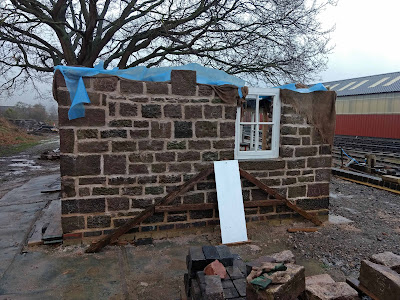


Finally, a parting shot as we ran for our cars. The sample truss we kept from the original building has been placed against the southern wall, together with the new lintel for the small window here. That's another thing we were going to place today, but it wasn't possible in the pouring rain, which would wash all the mortar away.

We're going to bring the second lintel next week, so might end up placing both at once. The weather looks a lot better already.


Before we close, a bit of contact with former steam colleagues in Rotterdam (who run main line excursions with 2500HP Pacific 01.1075) suggests that they use Colombian coal now. They fitted a restrictor ring to the blast pipe, and she steams like the devil now, they say.

But Colombia... that is over 5200 miles away, how much greener is that than a small coalmine in Cumbria?


Wednesday, 9 March 2022

Before we open.

Friday at Toddington

As the weather was rather unsettled for outside work - we still have to finish the footbridge steps - we decided to work in the loco shed at Toddington on Friday.


There we were met by the hired in B&R tamper, which had positioned itself on the unloading road for attention to a leaking hydraulic hose.


Neal went off to help some interesting shunting movements in front of the shed.

4270 was in steam and needed a topping up with water, with Neal on the end of the chain opening the valve in the water tower.


In the loco shed itself John started work on a new platform for the GWR yard lamp recovered from a garden in Frome. That lamp had no platform - a common issue - but did have a ladder, which went all the way to the top (instead of up to the platform as per drawing). The Frome lamp also had two overly long ladder bars, which have been straightened by members of the loco dept and shortened to the correct length.

In the picture the framework for the bottom of the platform is being made up, with holes for the 10mm rods that go through it.

4270 then came into the shed to retrieve 35006, leading to this lovely cloud of steam as the regulator was opened to reverse back outside.


Outside, Neal was drawn to the mystery of the hydraulic hose failure in the tamper...


Earlier at Broadway he removed the now redundant downpipe on the corner of the building. It has been replaced by two downpipes further along, one down each column under the truss.

The removal of this down pipe gives us the room for a pair of quad royal poster boards here. We're still looking for 1904 style posters (not the colourful 1930s type) and after some research, have concluded that the key to the date is the name of the GWR General Manager underneath - this needs to be J L Wilkinson (and not Felix Pole or James Milne, who worked in the 1920s and 30/40s)

During a couple of idle hours Neal also completed the boarding on the Malvern side of the P2 steps at Broadway. The Cotswolds side is waiting for some drier weather.


We also had time and opportunity - with the scaffolding down at last - to fit the PASSENGERS are requested to CROSS the LINE by the BRIDGE sign. It's securely bolted on to two 1899 rails (marked 'Crewe'!) and very heavy.


Just to remind you - this is the more severe version of the same notice, seen at Carrog. We liked the genteel version, and went out of our way to find an example - not easy at all. Eventually we were helped by a friendly blog reader who sold us his for a symbolic price.


Monday at Broadway.

The LADIES ROOM and GENTLEMEN signs have had their metalwork (straps, hangers and letters) shotblasted and powder coated, and were taken back to Broadway on Monday.

They were taken off as they were in the way of the scaffolding, and on closer inspection were found to be rusting.


Neal put them back up, moving the GENTLEMEN sign a bit to one side to be more in line with the LADIES.

Then it was time for more construction work.

The last big thing missing on the footbridge is the completion of the boarding on P2. All the boards are ready and numbered, and were test fitted earlier in time for the pre Christmas trains.


The boards are all individually cut to size, so have been numbered for easy re - fitting.

Well, that's the theory anyway.

During a break, Neal took down some details of the relative locations of the corner of the building and the supporting posts. This is to help him work out the same locations on P2, where the situation is slightly different, as the misalignment of the bridge with the building is only minor.


He also made a little barrier to prevent access to the footbridge until it is ready for use. It's rather kinder to the eye than the previous Heras fencing and corrugated iron panels.

Neal then slowly worked his way down the steps. It started to feel much more closed in here, and of course it will be more protected from the rain.


The boards have been in storage for several months (after numerous layers of paint were applied) and came back with pencil numbers on top.

So why have we got two No.12s, and where is 23? Who put those numbers on!


At the end of the afternoon Neal was about half way down.

We should now be thinking about the repair work of the Winchcombe and Toddington canopies, but we are not in a position to start yet as various replacement pieces are not yet supplied. It takes time to organise this, and with the Covid crisis and shortages in the building industry there are plenty of reasons why something hasn't arrived yet.

Watch this space...


Wednesday with the Usketeers.

With Dave affording himself and Mrs. Dave a short holiday in Devon, we were reduced to just the three of us today - Paul, John, and yours truly. 

With one hand down, we concentrated on completing a few special jobs, which will ready us for the next stage: the lintels and the brick arch over the big window.


Last week we placed the buttress block (under the green gloves) and today we cut around it to make the end fit for receiving blue bricks set at an angle.


In the picture the corner of the window frame is being trimmed to align it with the arch former that it has.


In this picture you can see how the piece removed has given the arch former a smooth curve right to the end.

Next we laid a sample brick and drew a (green) line on the buttress block to show the angled face it needs for the first of the arch bricks.


The next picture, taken from the same viewpoint, shows that angle now cut, and the sample brick perfectly placed next to it.

We will now invite Neal, who has kindly made us a former for that part of the arch not immediately above the window frame, to place the former in position. You may well see that next week.


The buttress at the other end was also cut to the correct angle, but here we have one large and two smaller blocks, which had to be trimmed to fit. So this end is now also ready, once the mortar has had a week to go off.

Paul them backed up the whole corner, but from the outside, where the trestle was. This corner is now nice and level, so we have a level surface from one corner, round the next and up to the big window, This will allow us to start bringing the lintels out of storage.


Paul then moved to the next corner, and bedded down these two 5 inch blocks between the quoins. We'll need two more 3 inch ones to make the top of these quoins, then that corner is at the same height too.


To add a bit of meat to the trimmed down buttress block we found an 8 inch block, one of the bigger ones still in the pile, to fill a 13 inch gap we had. That's the big piece of stone centre left.


After lunch we made a second mix, and used that to address the area next to the door frame. The far side is up to lintel height; this side wasn't yet, but today we rummaged around and found a big block with two faces and a nice corner that filled the area immediately in front of the top of the door frame in this picture.


The missing piece went in here.

While we were fettling away at blocks, we heard a high up roaring - 2x B52 bombers, 8 jet engines far above the clouds. Good luck to you, guys!


Near the end of the day we went to take our usual snapshot of the state of play, but found that it was no longer high enough for you to see what was going on. 

This picture then was taken from the top of the cutting, hard up against the neighbour's fence. Just about....

A similar view could be had from the vantage point of the S&T trolley. You can see clearly here how the wall is now up to the lintels (with a bit more work to do round the fourth corner at the back) and that there is a slight lower area over the big window where the arch will go in.

The arch will have two rows of bricks, then another row of stones on top, and that should achieve what is known as wall plate level (although it looks as if the building didn't have wall plates - we shall see). Once we know that height, we can complete the rest of the building around and up to it.


As we left, feeling very satisfied with progress, we met the tamper returning from the southern part of the line.


Later in the afternoon, the replacement tamper was being loaded on the unloading road at Toddington.

Note the clever stilts, which allow the trailer to be pushed underneath. It's an 08 type Plasser from the hire company Trackwork.


Picture by Bob Lock, for which our thanks.


This is not the B&R tamper, which is being repaired. It's an emergency hire at some cost to the company. 

It looks like the B&R tamper will return for a final fling, before we re-open. It's a mad rush to the end, but we did do a helluvva lot of work this winter, more than ever before. Well done the team (s)!


Broadway signal box.

Broadway signal box is, sadly, still not open for this new season. What's going on?

Broadway box at the end of 2015 - externally complete.

It's a question we have asked ourselves several times, as each proposed opening year was postponed once again. After all, we helped to build it, and the box was essentially complete at the start of 2016, now 6 years ago. Six years!

Broadway box was the first replica structure on the once bare station site. We decided to build it first, as a test case to see how the team would do, before moving on to the much larger project of the station building itself. And the station building is now of course also finished, even with the final and complicated part of the canopy along P1, and the station has already operated for 3 seasons.

So why not the signal box? The frame is in, the signals are planted, the rodding runs laid, there's power in the box and it's connected to its sister at Toddington. 

A sentence in the latest 'Cornishman' explains:

'For full commissioning, we await money availability for a platform 2 waiting room and finished platform surface, and extra signalling persons to staff it.'

These are not insurmountable problems. We have the canopy gang who are ready and keen to progress the P2 waiting room. Completion of the platform surfacing requires the foundation slab of the waiting room to be in. That would be a good start, a bite sized project, for a modest outlay of say £20.000.

As for more signalmen, how about joining us? You could make the difference. You'd be very welcome, and then you'd have the chance to work in the new GWR box that gets bathed in the setting sun, the replica of Shirley box that used to stand further up the line. We'd love to hear from you.


What do people think?