Wednesday, 15 December 2021

Three weeks to go

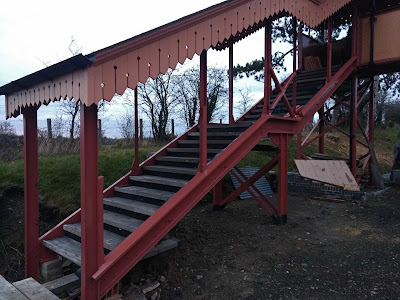
Monday on the footbridge steps.

Warm again, and dry - good painting weather. Just as well, we have lots of it to do. We need to get the boarding back up on the P2 steps, before we start on the next job - the last section of the station canopy. It starts on Tuesday January 4th, and excitement is mounting. We've got all our ducks in line, materials ordered, scaffolders coming, and a 2 month non-running period.

Our painting area has been moved to under the P1 canopy, where John can be seen working on the framework for the boarding. That needs an extra coat, the top one, as it's difficult to paint cleanly once in situ.


We had a new recruit on Monday - meet Henry! He's always got a smile on his face, no matter what the circumstances. Us, we're miserable old grouches, but Henry always smiles.... a bit inane really, but we didn't let on.

Henry helped us today clean out the shavings and sawdust from left and right of the treads. We don't want that area to be a haven for dampness. That took pretty much all day, but now it's clean and ready for Neal.


While Neal was waiting for Henry and yours truly to finish vacuuming he could be seen painting himself. There are 110 boards after all, and they all need primer, undercoat and one side of topcoat. And then again, when Neal has cut them to make them fit.

Underneath are timbers for the P1 canopy work, themselves ready in dark stone undercoat.


Mid afternoon Henry became tired, and was taken back to the car for a rest.

This was Neal's opportunity to start putting the timberwork back on the P2 steps. The bottom lengths go first, now sitting on a damp proof course to keep them dry.

Sunset comes early this time of year, so around 3 o'clock we have to start thinking about packing up, and it seems like our lunch break was only a couple of hours ago. 

In the picture Neal has fitted the bottom timbers, and many (all?) of the uprights, with a cross brace fitted to the small length in the middle.


Three weeks now (!) until we start to assemble the final part of Broadway's canopy. 


Tuesday with the PWay gang.

Yes, but in the local pub. It was our Christmas dinner. We are human after all, so had a gay old time, with a three course meal, raffle and quiz. The helpings were enormous, and few if any had supper that evening.

The following morning (Wednesday) the turnout was larger than average - guilty feelings about weight, perhaps?


Bridge strike video

We came across this one, which is identical to a bridge strike once suffered at Broadway:

https://youtu.be/ZRZEABnkOa8

This one's from 2012, ours was a bit more recent, but the circumstances were the same: A 360 loaded on a tractor trailer, the driver had no idea of his load height, and the jib bounced along underneath our bridge. The damage was surprisingly severe (those jibs are very robust, they have to be) and it was one of those things that finally pushed us over the edge to buy bridge protection beams. They have been an excellent investment, as we have not suffered any serious damage since.


Wednesday with the Usketeers

Warm and dry, great block laying weather.

First of all we had an inspection, as a party of PWayers ambled over to case the joint. Dave (centre) explains how we got that quoin up on the corner (brute force) and what we are going to do next (rebuild the hop-ups).


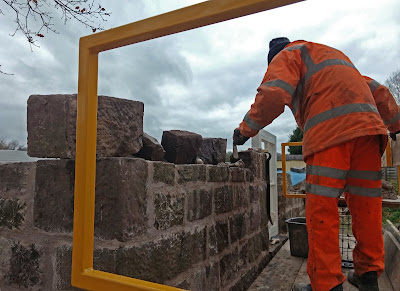
We're going up a level now, so we need these yellow stays on the trestles. These two prevent anyone falling off the ends, and in between there will be a guide plank and a kick board (for those standing underneath, likely to suffer from objects that fall off).


This is how you deal with last year's cake.


Having negotiated the loan of these stays (thanks, Jim, much appreciated), added extra fill underneath to achieve a perfectly level base, and then put everything up, we decided we deserved a coffee and a piece of cake.


Then we were all set to go. We got this next quoin up on the corner, and last week we prepared the row that has been tipped back in the picture, which allowed Dave to put down a bed of mortar for it.

A slight problem was how to get the mortar up there. All those safety boards are now in the way, we had to sort of spoon it through with the shovel at an awkward angle.


Soon afterwards, Dave had done the deed and this row was in. There's another row of thinner blocks to go on top to match the height of the quoin on the corner, and you can see the start of that by the window. Above that, it's another 5 inches, and then we are up to the top of the window. With this new height of trestle we reckon we can go right round, up to the edge of the roof. We'll need proper scaffolding for the two gable ends, and we are going to put off the evil day for as long as we can, before we have to pay hire and inspection fees.

In the meantime we had a quick wander up to the site of the slip works.


After last week's wind they have made good progress again, and are almost up to the end with the piling rig. Conditions were excellent for the job today.


Back with the Usketeers, and what we are also doing is back filling round by the big window, so that we have some level ground here for when we have trestles in front of the arch that we want to build.
Luckily there is some fill not far away, and during the day John and yours truly shuttled back and forth with wheelbarrows. It's slow, but steady.

The scene at lunch time, with the trestles up inside and out.

Around lunch time, yours truly had to leave, and the next 4 pictures are from Dave, who carried on with Paul and John until dusk.


Dave's first picture, with great pride, is the bit of wall shown earlier, but with a small quoin additionally placed on the right, up against the window frame. That means that the next one will reach the top, we have to think about that now when selecting the heights of the blocks. The top quoin needs to be level, so that we can lay a lintel across.


The second picture is from above, showing the blocks from the previous picture immediately being backed up from the inside.

Once a set of trestles is up, we have to stick to that place for a day, to avoid having to rebuild them each time. So in future we might do a lot more on one corner say, at the (temporary) expense of progress on another.


Half an our later, the same stretch of wall shows that it's now fully backed up from the inside. With the trestles in place, you can get helicopter views from now on. That's a 16 inch wall there.

On the left is the next quoin (the smallish one) with a new window bracket already attached, just visible.


Lastly, the lads did a bit of skip surfing. That always pays, you never know how. This time, we found some old office chairs, and they are perfect for our 'welfare unit' (that corrugated iron lamp hut, formerly at Broadway).

If truth be told, while it was cosy in there, some of the chairs weren't actually very comfortable, as they were so low, we could hardly get out of them.


Wednesday, 8 December 2021

Winter storms

Monday on the footbridge

An icy cold morning, with rain and wind. Not the best weather for painting, but it must get done.


John and Neal were on the platform, giving the structural timberwork another undercoat. Is there no end to this? At least they were in the dry.


Yours truly was up on the centre span, applying primer to the T&G boarding (after Neal had cut it to fit the sides of the steps) and that cold was very hard. It's breezy up there, and after a while there were raindrops in that wind too, and the work was getting covered in a fine mist of rain. We finished off the primering, then took all the boards down on to the platform, in anticipation of the storm announced for Tuesday. It'll stay dry there, for next time.


After finishing his painting job, Neal could be seen here taking measurements. This is good news, they are in anticipation of putting up the final part of the canopy.


Later we could see Neal on his hands and knees on the platform. What he's doing there is making a stencil which will tell him where to drill the holes on the truss, which is currently at Toddington.


We're going to have a few mince pie specials touching Broadway, but as soon as they stop, our scaffolding is going up. That'll be on January 4th. Our excitement is starting to mount!


Tuesday in a stormy Dixton Cutting.

The day started cold and wet, and during the morning the wind got stronger and stronger, reaching a wet crescendo at lunchtime.


We started the day by clipping up the rails laid in by the previous gang.

John was in the little mini digger again in the background, raking ballast towards the track.


Now that we have laid in all the replacement rail, we have sorted what came out into poor (for sidings) and passable (might be used again further on).

This involved cutting off the ends of the rails moved up, and of those to which they would be joined. That is intended to removed the crippled ends along this stretch of the line.


John found himself in the 4ft. It was a good place to work from, but it was not clear how he would get the machine out of there once the rails were back in. Climbing the machine over the rails felt a little hairy - watch this space, is all we can say.

Manoeuvering the Telehandler back and forth across the drainage channel at the bottom of the slope did not always go well, such as here. The concrete channel segments have been twisted and smashed in this area.

The weather slowly got worse during the morning. A brief 2 hour bit of storm was forecast over lunch, followed by calm, and then the full storm overnight.

This picture, taken from the Landie on site, gives you an idea of the rain that was lashing down. There are people out there!


During a brief lull, the Telehandler was sent back down the line to fetch two more reasonably good rails.

Very cautiously, using our new lifting beam, it was brought up to the rail head where we were working.


At 12.30 we decided to break for lunch, as the rain was getting intolerable, and everybody had icy cold wet hands.

Our bodies were reasonably well protected, as we are experienced and have bought (ourselves!) the right sort of kit, but there is little you can do about wet hands.

Are we going out in that again?

The rain drummed down on the roof of our diesel powered 'welfare facility'. Turn on the kettle, and the diesel slows down audibly. It accelerates again when you make the brew.


Unperturbed by the machine gun drumming on the roof, we munched our sandwiches and, thanks to Chris, half a dozen mince pies.

Checking our weather apps, we found that around 2 in the afternoon there would be another lull, so we set forth to the rail head once more. A few minutes too early, we might admit, as it was still raining, and we all got wet again, before the sun came out.


This is as far as we are going to swap round rails. The final two lengths can be seen in the 4 foot here.

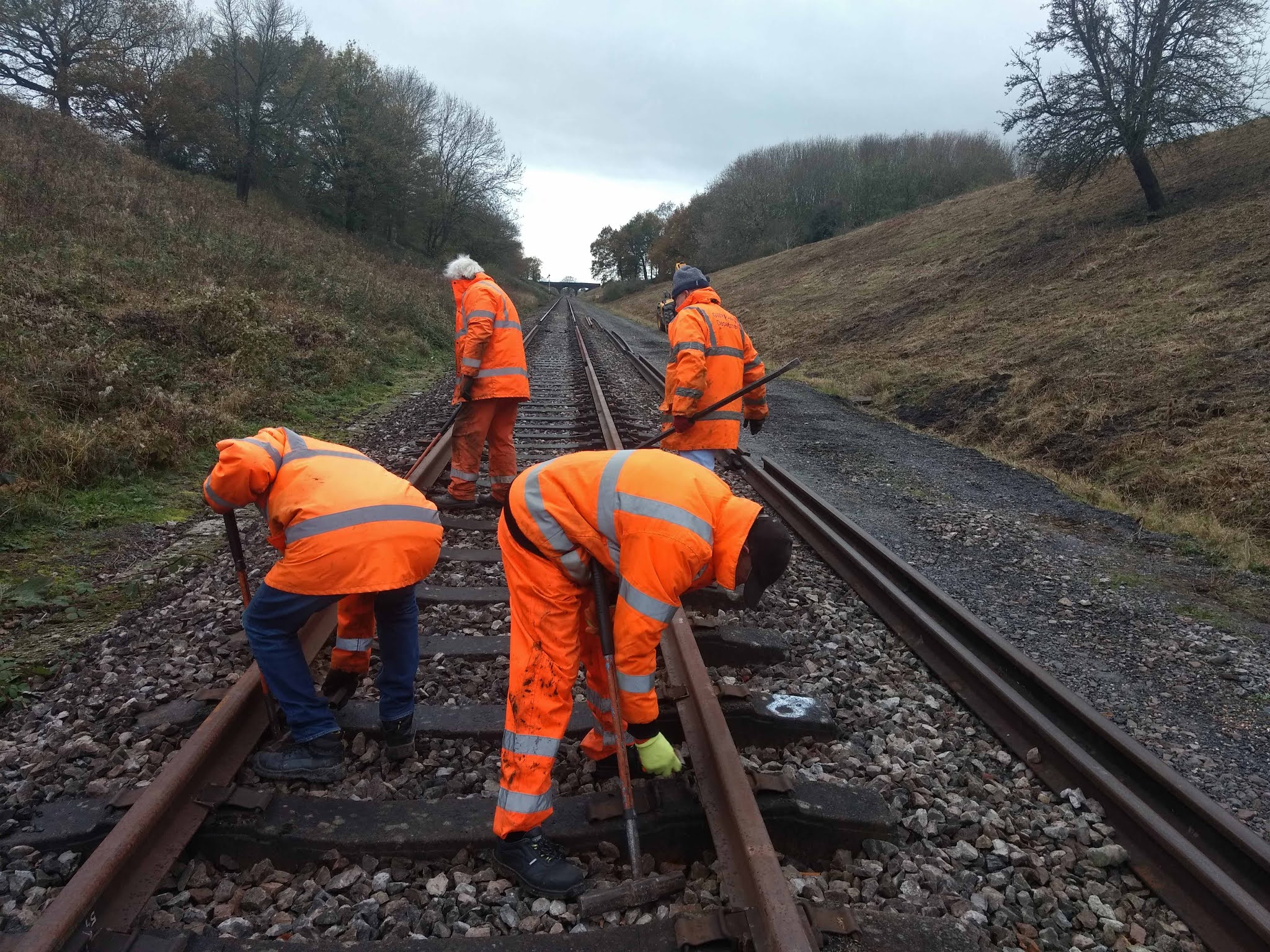
As Peter and Chris prepare to cut off the crippled ends, yours truly, Walt and Paul did the last few yards of clipping up.


This is as far as we got today.

The plan was to lay in the last two rails, cut to length, to reinstate the track, but we only managed one, as you can see. Unfortunately the pull cord on the disk cutter failed. We tried to repair it, did one more cut,  but then it went finally. Chris eventually took it away for repair at the end of the day.

By this time next week we would like to see the site finished off, so that we can move our kit to CRC, where we are due to start the replacement of the northern loop turnout.. This has an old crack in the nose. Nothing serious, it's been there probably since it was put in in 2000, but now something has to be done about it.


At Toddington we also have two turnouts to replace. One is at the northern end of the loop (remember how we took the crossing out there in the summer?) and the other is at the southern end of the loop.

The southern one is in fact a crossover, and is one of the oldest PWay installations on the whole railway, dating back to the 1980s. It is worn out, and will now be replaced.

(Picture with thanks to Andrew)

As we can't do all 3 replacements, this third one will be done by contractors, with a complete set of replacement rails and fittings. Out GWR Trust is paying for the job, made possible by your generous donations and legacies.

In the picture you can see it being built in the factory. Pretty cool, huh?


Wednesday with the Usketeers.

A bitterly cold start to the day. The outside temperature was 4 degrees, but with the leftovers from storm Barra the windchill factor gave a feeling of minus 4. It went straight to your hands, a part of your working body that is difficult to keep warm and dry. We went to the nearby mess coach and had a cup of coffee over it, hoping that the rain would die out.


The rain did die out, so we ventured forth into the weather. We were a bit hesitant about starting up a mix, so decided to sweep out the interior of the building (it's a building now, see?) which contained most of the leaves belonging to the oak tree that stands over us.


Half an hour later the rain had gone, so we went for it. We did three mixes today, not exactly a record, but remember that the weather is foul and the days short.

Our three brickies ('Blockies'?) were Jules, Dave and Paul. Each took a corner of the building, while yours truly fussed with choosing future blocks. John shuttled back and forth with barrows of sharp sand.

Jules above took the NW corner and did a splendid job backing up the two halves of the corner. That clears the way for the next quoin on the corner there, which has been selected and placed nearby, ready for lifting into place next time.

Paul worked on the fireplace (sorry - forgot to take a picture of this) and put two courses of blocks over the arch, changing the courses from semi circular to straight here.

Dave took the NE corner, and backed that up too. In the picture you can see what he did, a complete row of undressed blocks from the door on the left, to the side of the big window on the right. That gave a level surface on the right which, at the end of the day, permitted us to place the first stone that reached the top of the big window.

This is that moment. This block will support the arch over the window, so we have chosen a big fat one. It's a tad too long, so the overlap for the next joint is a little close, but we think just about acceptable. The important thing was the right height and the right weight of block here.

Another block for the other side is ready, but at this point we ran out of mortar, and the light was about to go. It'll be for next time, and then we are ready for the arch former to go on. Neal of Broadway fame is helping us there.


During the day we had a look at the slip repair works, and a chat with the site manager.


They've made good progress with the installation of the sheet piling, it's about half way along here. The machine you see sits on top of existing piles and walks along them.

Once the piles are in, the slope will also be soil nailed.

The tiny mini digger is there to back fill the space behind the piles. The whole works should be complete in time for our first trains in March 2022.

There was no work today though. The remnants of storm Barra were too strong to allow the crane to work. The team was on site and watching the anemometer on the crane very closely, but the maximum allowable wind speed on it (14mph) was always exceeded during the day, not dropping below until after it was dark.


Bridge 8 appeal:

Success!

From the Trust website:

Bridge 8 Appeal has raised a staggering £200,000 in less than a month. I give my heartfelt thanks to everyone who has donated – your combined efforts have achieved a fantastic result and the work can proceed in January 2022. 

That appeal is now closed but we are always pleased to receive donations for future projects on GWR. I therefore invite you to donate to our General Funds to be allocated to future projects as and when required.  

Ways to donate are shown on the GWRT website. Thank you all for raising this very essential amount. Work can now proceed, the traffic lights can be removed, and we will have shown that we can look after our structures.


Wednesday, 1 December 2021

A snowstorm

Saturday on 76077

A snowstorm greeted us on Saturday. Only some sleet was forecast, but that turned into thick snowflakes, which together with the storm that was crossing the UK, quickly built up an inch of snow on the road. Despite some traffic, the B4632 was quite white, and the descent into the little Toddington roundabout was 'interesting', as the ABS came on, even at walking pace. There was clear evidence that someone had approached it at more than walking pace, as one car track in the snow went straight on and ended up against the roundabout wall. Well, that's how you learn.

Saturday was a Santa day, so there were quite a few volunteers about. One braved the trip from Gloucester, so we knew that there would be at least two of us on the intended 76077 day. In fact there would be 4.

 Just as the snowstorm stopped we quickly took this atmospheric shot of our signal box.

This is 1963....


It reminded us of Derek Palmer's 1963 shot of 6111 coming off the Princes Risborough line at Kennington Junction.


Back in 2021, Foremarke Hall took out the first train, and as we arrived 4270 was just coming off the yard to take out the second, with a Growler at the rear.


We can't run round at Winchcombe due to the slip repair just beyond, so the Santa trains are being topped and tailed with a diesel.


4270 paused at the box, then advanced in the snow to join its train standing in the station.

The 'Santa Special' board is already on the bunker.


We repaired to the mess room for an early cup of tea and a warm up, then watched the tankie take its train out in the direction of the 'North Pole'.

Looking at the snow covered hills behind Hailes Abbey, you could quite believe that Winchcombe was the North Pole.


Then it was time for work.


The job was to polish two of the coupling rods of 76077, our Toddington Standard. Most of the loco is with LMS at Loughborough, but some pieces like the motion are at Toddington so that we can do some work here as well.


One of the rods had already been cleaned (the top and front are cleaned, the bottom and rear are painted black) but the other, in the picture, was still pitted. This is an ex Barry engine, after all, but has also stood outside at Toddington for probably an equal number of years.


The second coupling rod was worked on with an angle grinder and a belt driven sander, the latter proving to be the most effective at eliminating the hundreds of little rusty craters.


The second rod had been worked on before, but a thin coating of rust quickly appears if you don't apply a coat of oil at the end of the job. We did, this time.

Closer examination of the rods revealed the previous owner, hammered into the top. Both had the same number stamped on them.

The grinding and buffing kept us going all day, until we ran out of the buffing sandpaper, and called it a day at 3pm.

The Santa trains also came back home to the roost at about the same time.


Here is Foremarke Hall poking its nose into the shed, before reversing out again. The steam escaping from the cylinders allowed this very atmospheric shot.


Monday on the Broadway footbridge

Monday sure was cold. We kicked off with minus 2 degrees, and finished the day with a comforting 2 1/2 degrees above zero.

There was snow everywhere, as you can see on the picture. Not only on the footbridge, but also inside the footbridge, all over what we were painting. After a warming cup of tea we set to work. We brushed all the snow off, and underneath the woodwork to be painted didn't look too bad.


Broadway (...Shirley) signal box in a wintry setting

It was another day of painting for us, even Neal was reduced to the lowly task of brushwork, as there is no more carpentry until all the boarding is back painted where we want it to be. Then it can be reassembled on the Malvern side steps.


A secondary painting area has been set up down on the platform under the canopy. This area was in fact the driest on Monday, and John was able to pain the structural woodwork for the Malvern side steps all day long.

As you can see, we're still only at the primer stage, it needs an undercoat of dark stone still.

At the end of the day, when it started to get dark, everything had another coat, so we were well pleased. The whole lot is another stage further, despite the cold.


Canopy Hex Lamps

Great news from our lamp manufacturer, the long awaited set of two hex lamps that go under the Broadway canopies at the bottom of the footbridge steps is ready for delivery.
  

The new hex lamps in the workshop of the manufacturer

Its been a long process of study, interruptions by Covid and finally manufacture, not forgetting supply issues with some of the materials. But we are there at last, and aren't they beautiful? The name 'BROADWAY' is etched into the glass, and there are 4 imitation gas burners with little LED bulbs. As with the three canopy lamps already in place on P1, these will be suspended by an imitation gas pipe and would originally have been supplied by acetylene gas from a hut on the other side of the road.

The design was developed by study of original 1904 photographs of the station, as well as of similar lamps that we know of, for example at Birmingham Moor Street.

The cost of these lamps has been entirely covered by a generous sponsor, and will cost the railway nothing. They underline once more how keen our supporters are to have an authentic heritage railway. We are extremely grateful to the sponsor who made this possible. There may be another, similar thing to sponsor, if that tickles anyone's fancy. We are at an early stage of research at the moment.


Tuesday in the Dixton cutting

A good productive day. A team of 8 advanced the rail head, as it were, to the end of the replacement rails laid out.


The first job was to clip up the rails replaced (but not clipped up) by the team working on Saturday.

The replacement rails are in here, with the duff rails with the squats parked to the right.


No, Chris isn't feeling tired, this is him observing the magnetic thermometer stuck to the rail to see what the temperature was. The indicated 10 degrees gave us a gap of 10mm to establish.


Here Chris has woken from his 'slumber' and announced his temperature findings.

Peter on the left now drives in a wedge to open the gap out to the required distance.


Meanwhile, John has secured himself a sitting down job for the day in this mini digger. It really is very 'mini', this digger. It took a long time, even with the engine set to 'running hare' instead of 'tortoise' to drive from skew bridge to our work site.


The last pair of rails laid in the previous working day has the rail ends not quite in the right place on the sleepers, so the latter needed persuading a bit with the Duff jacks.

Then we were finally ready to fetch the spreader beam, and lay in the next pair of rails. Peter and Chris walked it forwards using the Permaquip trolleys.


Walt in the Telehandler then recovered the spreader beam and started on the last pair of rails. The old ones were lifted out, and in the picture you can see him manoeuvering the Telehandler into a central position viz a viz the rail to be lifted in.

Note how the wheels of the Telehandler are in the 'crab' position, a very useful way of travelling half sideways as here.


Far away in the distance John was working away with the mini digger. The idea here is to scrape together excess ballast for use some way further along. 

John spent the whole day doing this, and was quite puffed at the end of the day.


This is the end of the normal track replacement area, with 14 panels replaced. It's not the end of the job though. Some of the rail we took out was partially good, so we are going to move up and deal with the next section as we go along. The poor rail will be removed and put in store for sidings, so nothing is lost.


Walt cutting off two 5m lengths.
Having reached the end of the normal relay, we had a gap of approx. 5 yards, so cut some of the rejected rail into 2 x 5 yd lengths to plug the gap - on a temporary basis, to get the Permaquips across, for example.


Not all the new rail had fishplate holes, so that was another job to do. The drill only cuts out a circle, so that a little plug comes out, revealing a new fishplate hole.

Such a plug can be seen centre right, on the gauge plate.


Here's our last picture of the day. We have just lifted in the two 5 yd sections of temporary rail. It was extraordinarily heavy, six of us only just managed it, right on the limit. But that's what we live for, we don't want a job that involves looking out of a window with a cactus.


Update on the Stanton Bridge 8 appeal.


Two weeks into the appeal, we have raised £101.000. This comes from a little over 500 donors, giving an average donation of £195.

We're half way! The target is still £200.000. Fancy helping us? Details on the GWRT trust website.


A look over the fence - North Warwickshire line

A trip to the Christmas market at Birmingham New Street, using the North Warwickshire line from Stratford on Avon.

A bit kitschy...
Next to a trip to the market, we thought it would be interesting to travel on the northern extension of our very own Honeybourne line.

The train from Stratford fair rattled along, sometimes at a cracking pace, especially on the approaches to the hills around Birmingham. It made us think, did the trains on our part of the line travel at that speed as well? They probably did, our line speed was 70 mph!

There was no sign of any land slips or repair work. The earlier part of the trip was fairly flat, but near Wood End it got quite hilly and there were some lengthy embankments, just like ours. They led to Wood End tunnel. The entrance to Birmingham city centre was quite dramatic, over a high embankment ending in Moor Street station and a tunnel to Snow Hill.

A class 68 at Moor Street, on a Marylebone train
Moor Street station was quite beautiful, a lovely modern day station but beautifully preserved in Victorian GWR style. It's perfectly possible to reconcile the two.

We were surprised to see this class 68. It looked like a push-pull service to Marylebone. Sadly we had to leave before the loud class 68 burst into life for its trip back to the smoke.

On our return to Stratford, we took a few pictures for comparison purposes. The station resembles the Honeybourne line architecture, but is a little older. The original footbridge is of the older type with a break in the steps and a turn towards the centre span, which is therefore shorter. A modern footbridge and disabled lifts were installed behind it, but had little custom as far as we could see. Most people preferred the original footbridge, which was more open and easier to access.

Note the layout of the canopy supports over the end of the steps, very similar to what there was at Broadway once.

The Stratford canopy, similar to Broadway's.

This is the view from the disabled footbridge, over the new one. There are two trains in the station at once, which go to different destinations, but have to set off north, as the line further south, to the Cotswolds line, is lifted. Fingers crossed that the promoters of the reinstatement succeed in their aims. It looks like such an obvious thing to do. Travel north to go to London? Eh?


Class 165 unit, destination north (to London)

Stratford on Avon - a heritage station. We like that. Can Toddington say that if we have a modern visitor centre in the middle of the historic site? We think not.
This is the end of the platforms at Stratford. A No Trespassing notice, but no dire warnings of £1000 fines, as we have at Winchcombe.


A last general overview of Stratford station. It's really quite pretty, they have done well to preserve the atmosphere.


Wednesday on the Usk hut.

Four of us on site, and steady progress under a threatening sky to start with. We met in our little corrugated iron shed, and then the sun came out, so we set to work with renewed vigour.


The first thought was, why not measure up the four sides of our stone built hut, and see if it is still square, and are the sides the right length ?

Dave and Paul got the big tape measure out and went round the building. Just 5mm out here, and 10mm there - not bad for a building made up out of roughly hewn stones! We were right chuffed.


We made up a mix, and then Dave put up a quoin, which needed quite a bit of support from behind. We use wooden wedges, which we withdraw a week later when the mortar has gone off.


Paul repaired the sample truss we took with us from Usk, to make sure the constituent parts didn't get lost among the other odd lengths of woodwork round the site. 

In our humble view, this truss is not original, so the roof may have been re-done at some point.


The previous layer having settled down, Paul fixed the upper part of the big window frame to the nearest stone block. It should be very stable now. See how close to the top we are now!

He then sawed off the corners, as these were originally designed to be included in a brick built wall, whereas our is a block one. Remember, this window is from another weighbridge, as the original one at Usk had collapsed due to the absence of a lintel or arch above it. Ours will have an arch now, Neal from Broadway having made us a former already.


We also had a go at tidying up the fireplace that Paul built. It had the old former in it, and a lot of builder's rubble, so that's all gone now. It looks the part, doesn't it?

The next course above it will be in stone from now on. Only the actual fireplace was originally in brick.


A quick walk up to the Greet Road bridge allowed us to photograph the works of the slip repair.

Not much to be seen since last week, they were waiting for a machine that inserted the sheet piling without vibration, to spare the neighbours.

We were also given a figure for the distance that the 'Lego blocks' will be pushed back - 2m. That seems adequate now to secure the up line reinstatement, should we ever want to. Or extend the loop once again.


 Dave then transferred to a different corner, to bed down a quoin we had placed with Jules last week.

First he tipped it backwards, so that he could put down a layer of mortar. We then gave him a hand with lifting it on, which has to be done very gingerly so as not to damage the mortar bed, or loosen any of the stones around it.


A bit later the quoin looked like this, with a few more blocks placed on the right at the same time. Note how the quoins face in alternate directions as you go up.


In this picture we see Dave pointing his work to the right of that same quoin, so that's another course completed on that face.


With the remaining mortar he bedded in two more blocks on the other side of that quoin. The weather forecast for the rest of the afternoon was rather dire, so we decided to protect the site against the forecast rain, and subsequent frost tonight. Lots of hessian, and a plastic sheet over the top, also over the big window to keep the woodwork dry.


On the big window we are now within 9 inches on each side of the top. Two more quoins next week will see us to the top, and they will be the jumping off point for the arch over the window. That will consist of two rows of engineering blues. The 9 inch stones were selected today, but we need to wait another week to make sure the mortar below is firm.

It was just as well we stopped when we did (about 3pm) because the heavens absolutely opened up. We just about manged to make it to the cars and jump in. This is what we saw through the windscreen... winter weather is here.

See you all next week!