The cataract surgery was completed successfully on Monday, so we are back at home, blinking a bit but free of pain. They did a good job there, good old NHS. The drawback is that we are prevented from working for a while to minimise the risk of eye infection. The nurses told a horrible story of a man who got an infection, and lost his eyeball. Eek! So blogging can continue, but content is a bit dependent on correspondents for any material to post. Got anything that's interesting? Send it along.
Digging out the paved area at Winchcombe.
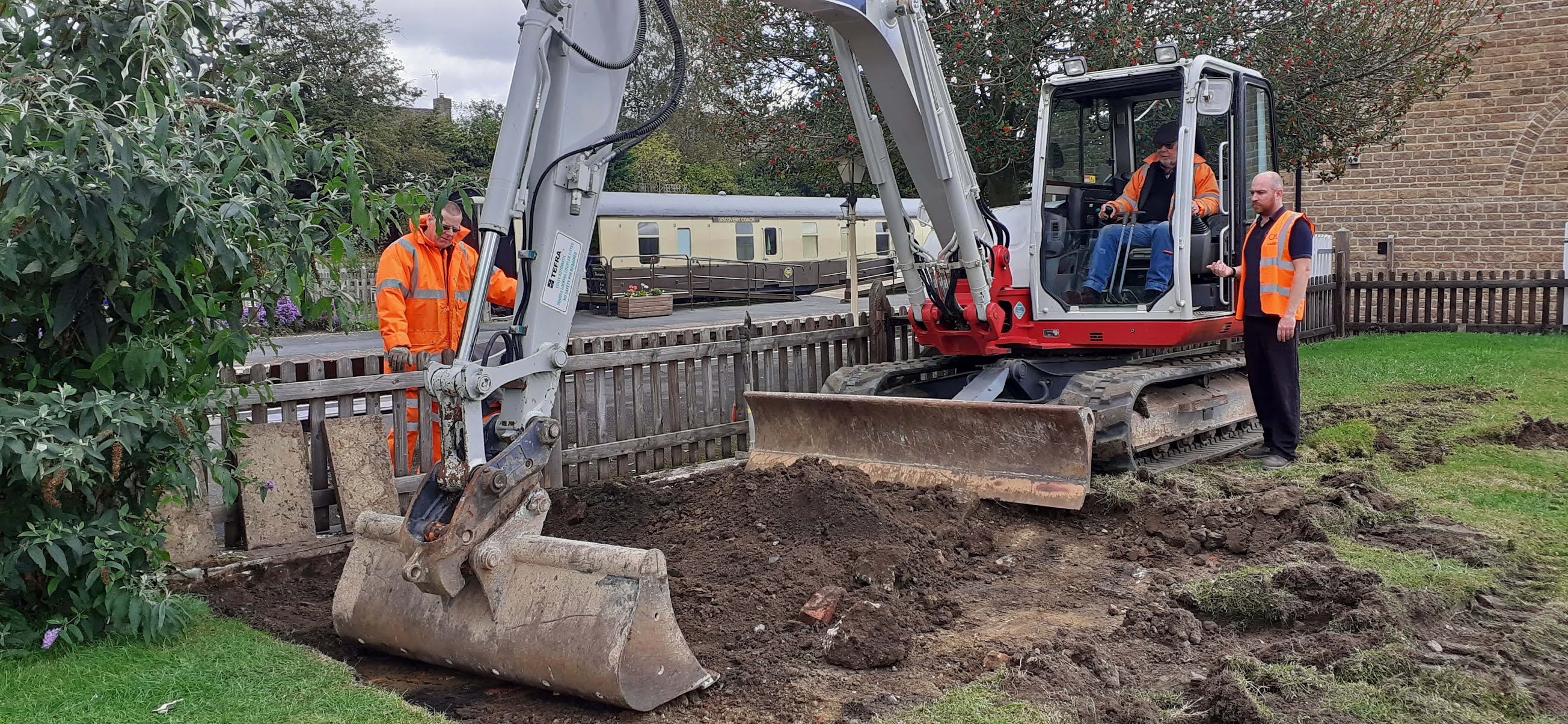
PWayer Dave sent us these two shots of the area excavated, prior to the slabbing posted last week. We've been having some digger lessons, to give us more flexibility when a digger is hired in. At the moment it is easier to hire in a 360 digger, than to get an operator for it.
To make the lessons more productive, it was decided to do an actual job, and here you can see John (aka 'The Duke', as he is 'of Gloucester') trying to keep his bucket straight, while scraping out some material. Jonathan looks on.
The second shot is from the inside.
Thanks to Dave of the PWay gang, repairer of Landrovers and irreplaceable track walker to Gotherington in all weathers.
Pway progress.
Following the ultrasonic testing of our entire line, it was found, unsurprisingly, that some of our second hand rail was, er, a bit second hand. Remember that the entire railway was relaid from a bare trackbed from Toddington to CRC in 15 years, using rail scrounged from here, there and everywhere.
Anyway, some of it needs replacing now really, so we've found a small budget to buy better rail for a number of short stretches. The first 16 rails FB were unloaded at Toddington, together with 2 BH ones, and the C&W blog has a good picture of this happening. The rail was transferred on to a bogie flat, so that it can be taken to the various sites for offloading. We've also ordered ourselves a spreader bar, something we have never had. So good progress there.
The less good rail we're taking out is still useful, as we can use it in sidings, for example for the carriage shed that we'd like to have at Winchcombe.
The closed season will see us drop this new rail in, as well as complete the refurbishment of three turnouts that are getting life expired. We're hoping for a lot of volunteers, so if you'd like to join the gang, do consider it. It should be interesting work.
The three Usketeers
Just Paul, Dave and John today, or pretty much the usual gang, but without yours truly. Dave very kindly forwarded some pics of the day's work, so that we can see what's going on.
The first thing they did was to move Maxie the Mixer nearer to the
sand pile, and level ground. This should help with starting, she was always tilted too far back.
Last week we prepared the ground for the third and last window, by placing loose blocks around the cill, with a length of wood to represent the size of the window frame. So this week the window was brought out of storage, stood on its spot, and then the surrounding blocks could be bedded in. The other two windows, the big one and the other small one, now seem fairly secure, so placing this last one helped to tidy up the interior. Only one of the two planks is now in the way.
 |
One supporting plank has been moved to the new window, the other removed finally.
|
None of the windows have any glazing in them yet, so that's a cost for the future.
As the Telehandler came to dump some
more soil (our area remains in use as a general dump as before, unfortunately) so we asked to borrow it.
John and Dave then moved all the
remaining crates up and around the oak tree. We had to transship some as
the pallets were broken. They've been standing here for 2 years, so they don't get any stronger.
We now have 14 pallets of rough stone, 2 of slabs and 2
of slates with ridge tiles on top. The two pallets of slabs were for the floor, but many are broken, so more will have to be bought. The roofing slates are known to be insufficient in number, as many were already broken or missing when we took the building down.
We had secured an supplementary lot of slates from the Swanbourne stationmaster's house, which still had a good slate roof. We secured agreement to have some of them, and they were indeed put in a pile for us, but during the Covid crisis the pile disappeared, and we never got it. It's a mystery.
 |
More stone now nearer the actual place of use, mostly the rough stone for the interior. The dressed stone is on the other side.
|
Finally, here's a quick shot at the end of the day, with the last window now firmly in place, and surrounded by its blocks. You can now see that there were three windows and a door, one on each side.
The smaller window nearest to the camera was to enable the weighbridge operator to look sideways to see what was coming. That is why it is off set from the middle. All the windows can open as well. We still have to put the sliding sash windows into the big one. They are held pending the refurbishment of the 4 running wheels that were underneath. Three had seized up at some time and had therefore worn flat. That refurbishment is held up because someone's certificate has expired. It's like that these days. You qualify to use a piece of kit, and soon 'you are out of date'.
Risky perambulations
During our week away we walked a part of the Pembrokeshire coastal path.
We're on the edge of a 300ft cliff here, it's a sheer drop. Do they place railings all the way round the Welsh coast?
No, they don't.
It's enough to place a small notice to remind people of the risks, and to take care of themselves.
We loved it. You are responsible for yourself.
A look over the fence - Exmoor Associates
The real purpose of our visit to north Devon 2 weeks ago was to attend a meeting by the L&B track acquisition vehicle, Exmoor Associates CIC. After the meeting, to inform supporters with various updates, we were offered the opportunity to visit what we had supported a year ago with donations - Bratton Fleming Station. It was a great day.
Mrs. Blogger had arranged overnight accommodation in a real farmhouse, tucked away in a steep valley. The farm was very old, and the huge kitchen, now the dining room, still had long benches for all the farm hands when they met to eat.
Was it busy... well, this was our welcoming committee. Shall I get up and greet the new visitors? Nah....
This, we learned, was the dog's normal sleeping place. It sped things up when the farmer went out on his rounds at dawn.
Roads steep in North Devon? Whoever said that! Get used to it.
Up Porlock Hill at 1 in 4, down the hill into Lynmouth at 1 in 4, and this 1 in 4 hill doesn't even have a name. Normal for Devon.
 |
The Blue Ball inn, overlooking the bay at Lynmouth.
|

The recommended place to eat was here at Countisbury. As a self confessed GWR lamp post afficionado, your blogger always casts a casual glance over any lamp post seen in a garden. And here is a lamp post outside the door of a pub that looks familiar... could it be?
Midland railway? What is it doing here in SR country, many miles from the nearest Midland station?
We have alerted a Midland lamp post collector, who has helped us find GWR posts for Broadway in the past. One good favour deserves another.
On to the EA meeting, which was held in a a local village hall, EA not actually having a physical presence locally.
Bratton Fleming station was finally acquired on November 3rd 2020, and after some repairs an enthusiastic tenant has moved in. This will provide a steady rental income until the actual railway is built to here. The appeal to purchase the little station was well supported but did not quite reach the full amount, and some of EA's scarce cash reserves had to be used to make good the final amount required. The tenant very kindly also paid a year's rent in advance, which helped. More opportunities lie ahead, so we can expect to be asked to contribute. The opportunity to acquire a further section of trackbed up the line from Bratton Fleming has resurfaced, and EA are hopeful of concluding the deal this time, after the last attempt fell through.
Attendees were also invited to visit Chelfham station, which is in close proximity to the meeting venue. (it is not linked with EA though, being an early acquisition of the current L&B at Woody Bay). We were made very welcome there.
The first thing you notice in the pretty side valley where the station is located is the enormous viaduct overhead. It is 70ft high and 132 yards long, with a curve at the southern end. The viaduct has been fully restored, including new parapets, and is said to be 'good to go'. It is by far the largest 2ft NG viaduct in the UK. However actual use will not for the near future, as all rebuilding efforts are being concentrated on the Woody Bay - Wistlandpound section.
Walking up the station approach your first sight is of the Chelfham stationmaster's house, Distant Point.
This was secured by the L&B back in 1999 with an innovative time share scheme.
To the left is the start of the viaduct over the Stoke Rivers valley, and to the right you can just glimpse the station building itself, which is quite small, having only two rooms.
There is a very dedicated team working on restoring Chelfham station, and they have come a long way, without going as far as to actually laying any running track.
The building is a little jewel in the woods. On the left is the ticket office, and on the right the waiting room, with authentic furniture. The ticket hatch separates the two. The SOUTHERN poster board is very convincing, as is the chocolate machine, which is made - of wood!
Next to it is the re-created signal cabin, out of which the new starter signal was being enthusiastically demonstrated.
Some original relics remain, like this SOUTHERN concrete running in board.
The down starter is also new (although it clearly points uphill....) and then you can see the trackbed, after a level section for the viaduct and station, rise up again at a ruling grade of 1 in 50. The current L&B own the trackbed until it veers left at the end of the sight line.
Of course since 1935 all the buildings had been altered or added to. It took a while until the original station building emerged from under its annexes. To one side is a stone built Gents urinal (there were no facilities for the Ladies, who had to wait until Bratton Fleming in case of need) and that was converted into a diesel generator shed.
The urinal was then converted to a store with shelving, until the current station restoration team had a brainwave, and bought an old billiard table, with which they are restoring the slate urinal. The back plate is already in, and these leftover bits will be used to make up the dividers.
We had an original slate urinal at Toddington until about 10 years ago, when it was ripped out and the slate put in a skip.
On to Bratton Fleming then, further up the valley. Best to park by the village store (in a container, try their tea and cakes) and then it's a walk down - Station Road. This soon turns into Station Hill, for a reason. Bratton Fleming station sits on a ledge above a valley, a couple of hundred feet below the village. It's steep - did we mention that before?

We sauntered gaily down the hill, a bit puzzled by the tired faces we met, struggling back up the hill the other way.
In this picture you can see Station Hill as it crosses the line, a brief flat bit. The station bridge parapet can be seen on the right.

Just before station bridge is the original entrance. This leads down to the trackbed. The roof of the station building peeps out on the right. Original SR concrete gate posts survive in front.
Unfortunately the station and its approach were separated and the neighbours now own the drive. But there is communication.

Here's a view over the parapet, showing the trackbed disappear underneath heading north, the valley on the right, and the station building on the left. Supporters are chatting in the garden in groups.
This is the view from the station site further down the valley. Very rural indeed. It's at the point where the railway starts to emerge from the wooded lower slopes and on to the grassy slopes of the moor.
And here is the station building itself. If you contributed, here is what you bought. The target was £350.000, to cover the purchase costs, fees and some repairs like an electrical rewiring.
The track ran right in front of it, under the concrete patio. The VR postbox is to be re-positioned in the front wall where it used to be, and during the meeting was in use as a box for donations. The trees on the right indicate the limit of the property, as where the approach road comes down currently belongs to the neighbour.
This is the view from the opposite angle. The original station building is a bit more recognisable here. Successive owners have added extensions, to turn the little railway building into a bungalow. In due course they will be removed, but not before there is a prospect of rails arriving from the north. In the meantime it will be kept residential, as that provides a useful little income.
To see the original stone building inside, you have to imagine away the conservatory and the ugly white extension on the left. Then add on a little porch on the right, that was taken down at some point. As the original lintels are of red brick, the grey lintel on the right hints at change, where the original doorway was blocked up.
The window arrangement on the front was, from L to R: Window, window, door, window. Another thing that is missing are the finials on the ends of the ridge tiles. A broken original has been found, and a specialist potter to make a couple of new ones. This won't be cheap, and there was an appeal for donations towards the cost of this little project.
We don't know exactly what the finials looked like (but EA do) but searching internet images it looks like they resembled cock's combs.
What they could look like - and someone still seems to be making them, as these houses were new - we saw in Newport, Pembrokeshire.
Aren't they splendid!
The tenant at the station is quite a keen railway enthusiast, and he would like the station to resume, as much as possible, without destroying his home, its original railway appearance.
This picture shows where a goods spur used to be, which once led to a small goods shed. It was demolished; someone put up a garage and a shed instead. They're not a great asset to the site, if we're honest.
Now as it happens some supporters of EA recently took over the small 3cyl diesel RUSTON locomotive that used to be stored at Lynton station. The engine has a cracked cylinder, but an identical replacement has been found, and the little loco is currently being overhauled off site. Since EA have no physical presence in the Yeo valley at all, it would be a useful idea to build a replacement goods shed in the place of the garage here. This little building could house a little workshop, stores, some volunteer facilities and act as garage for the Ruston. A planning application is being submitted as we write, and no doubt there will be an appeal to cover the cost. It sounds like an excellent idea to us. The building will be made of wood, in traditional style.
At this point it's worth noting that while EA have changed their legal form to that of a Community Interest Company, there is now also a charitable trust called the Barnstaple and Yeo Valley Trust. EA CIC will continue with their principal aim of acquiring trackbed parcels as they may arise, while the trust will seeks donations, which can be gift aided, to fund grants for the nice to have extras, such as the planned goods shed at Bratton Fleming. However, the B&YVT can now also make grants to the EA CIC, so that it is possible to give towards trackbed purchases, and generate gift aid, which was not possible before.
Back to the garden. Here is a view looking north towards Whistlandpound. That steep road is the 'flat part' of Station Hill mentioned earlier! On the left is the area of the goods spur. On the right are the remains of a dead ash tree that was cut down.
The final shot is under the bridge. The trackbed curves away to the right, and belongs to a neighbour. Next station: Blackmoor Gate!
NB Please respect the tenant's privacy, and don't go poking around his garden or calling without permission.