Friday at Toddington
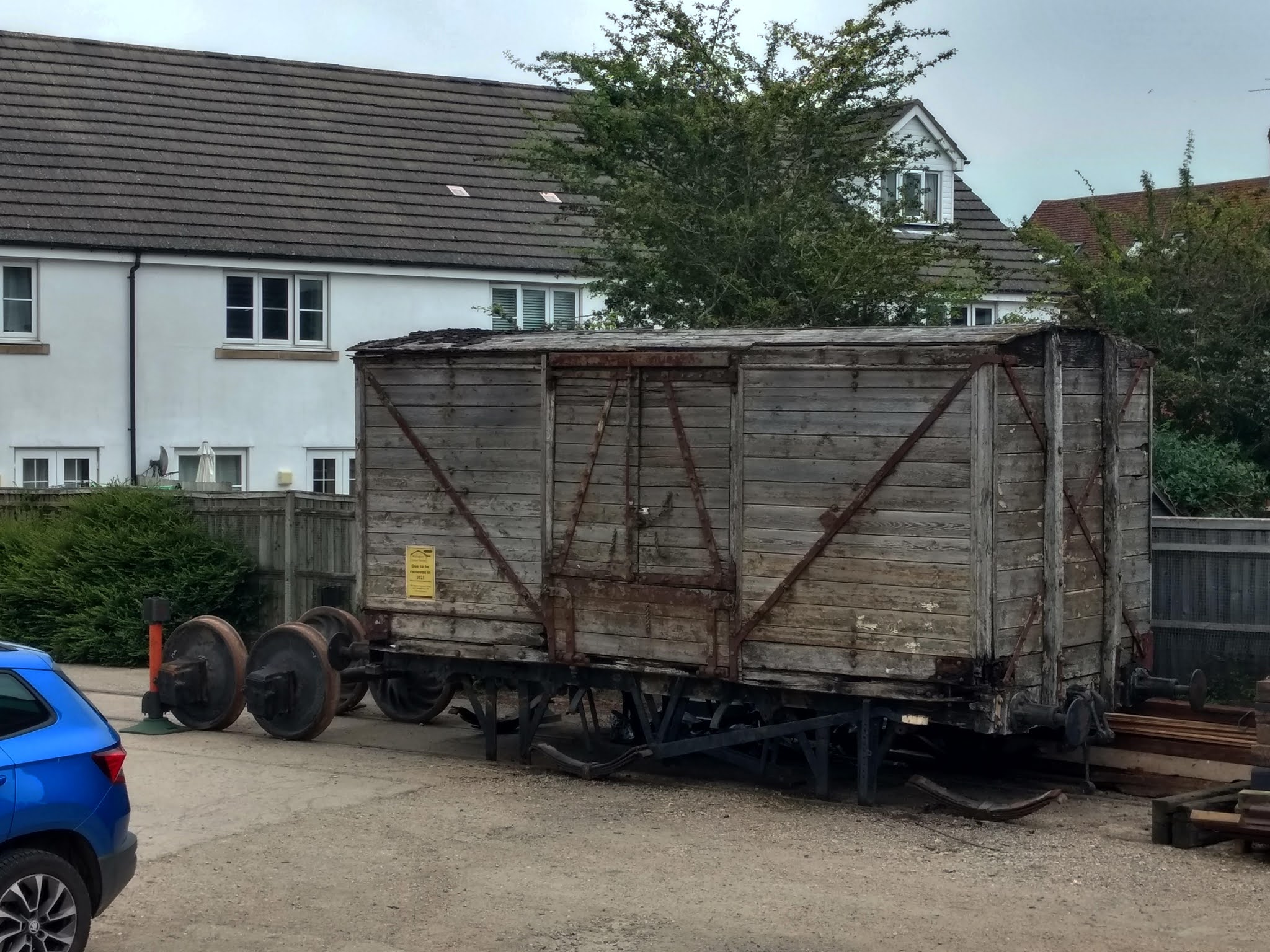
A day spent working with a new wagon repair group. Their aim is to bring some of our stored wagons back up to scratch.
One van is already in the good hands of a small group in the C&W shed. It is getting a thorough stripping down and rebuild, funded by a supporter.
Our means at Toddington are a little more modest (read: nil) so the vehicle we have picked is getting a technical check, and a repaint only. The woodwork is still reasonable.
The wagon is a GWR design, but was built late, some time during the war. It's not entirely original, we think the corners have been replaced at some time, and it has Oleo buffers, which are nice, but not original.
There were four of us on this job on Friday and we achieved the rubbing down of all the wood and metal parts, with some undercoating late in the day. The final colour will be dark grey, as per GWR practise.
Alex zeroed in on the lettering, made of plastic. We suspect the replacements will be hand painted by him personally...
Friday was a day of dreadful rain, all day long. We heard the constant pitter-patter on the loco shed roof as we scraped away underneath.
Wednesday last on the contrary was a day of sunnier climes.
 |
Oh dear, I seem to have been caught by these lovely land girls.
|
Some people were having all the fun, such as our 'spy' here. John had himself captured (and not for the first time), and never have we seen a victim more pleased with himself.
Picture by Mike, from the PWay gang.
Saturday on the PWay
The weather suddenly changed. It rained heavily on Friday, and on Saturday the engines coming off shed generated huge clouds of steam, an effect we haven't seen since the winter.
Who's that then? We don't know, engine in hiding...
It hissed nearer and nearer, until we too were covered in steam... (it proved the be 35006 P&0, which has its drain cocks facing very much forward)
Today's gang was a respectable 8 strong, something we haven't seen for quite a while.
At the south turnout, we had the same phenomenon, but with a different engine. We went to place a 5mph TSR, as the crossing which we had placed 3 years ago was showing accelerated signs of wear. The nose was delaminating along old welds, yet the rails had 0mm wear on them. Something strange going on there. We put the crossing in in good faith, and something has let us down.
The main job of the day however was the redistribution of ballast along the 20 carriage long north siding in the cutting north of Toddington station.
At last we were able to work continuously and to our heart's content, as we were not judged to be on a main running line, and could work through. It meant hard work, but that is what we have signed up for. It's good for you too! The job satisfaction was also important, we need that to get us to turn up.
We shovelled ballast into the barrow, and Steve took it further up the siding where there were voids.
When the service trains came through we stepped aside and took a breather, a good excuse to do so. Once it was out of sight, we resumed, just like in the good old days. But this time we were on a siding.
P&O returned from Broadway, watched by a ganger. Steam on and a long rake of carriages, this was surely the Cornishman coming down the double track?
P&O was unkind enough to lift her rods just as we clicked the shutter, but it's still a great express train picture.
After crossing P&O at Toddington, Foremarke Hall chugged out of the cutting towards Broadway.
For lunch we sat in typical PWay style out in the open air, on anything that we could find. Steve had the best seat in the house. He's been around since the earliest days of 1981, and knows how to reserve a good lunch spot.

After lunch we also started packing the northern end of the siding, where the ballast drop and / or the Tamper seemed to have stopped.
We got our packing ballast from further away areas where there was too much (It's very difficult to drop ballast exactly as per requirements with the Dogfish that we have, where it's all or nothing once you open the doors).
Two of us filled the barrow, and Steve then shoved it up the four foot to where it was needed.
All our kit came by Permaquip trolley, so when this train left Toddington, we requested permission to push our barrow with kit back to the unloading road.
Here we are, waiting just outside the block by the trap for permission to occupy the section.
Then it was magnums all round for the gang. They went down well, but needed tea afterwards to wash them down.
Funnily enough, we did the same thing last Saturday...
Can you believe that we were told of a complaint against us? We keep the track up to standard so that passenger trains can run, and then we should not sit by the cafe, when there is plenty of room?
On the way home we noticed these gate posts and spearhead gates by the Toddington entrance. Good Victorian ironwork, but are they genuine GWR?
Completing the Broadway canopy.
We've been working on the final segment of the Broadway canopy for over a year now, admittedly mostly at Toddington, making all the steelwork.
Now that the two posts are up, people are asking us, what are you building here? Not just members of the public, but people from our own staff! So it's time for a recap, an explanation for what it's all about.
Although we opened in 2018, the station was not finished. The signal box wasn't opened, P2 buildings and platform unfinished, the footbridge steps were missing, and the final part of the P1 canopy was not yet in place.
 |
5022 WIGMORE CASTLE in charge of the Down Cornishman in 1954 (John Diston)
|
It was essential that the station started earning some money as soon as the track was passed fit, as we had spent a lot of money on it, and we needed to tap in on the cash flow. It was a good decision, the public was enthusiastic, and the money started flowing. The northern end of the canopy had a plywood panel fixed to it to keep out the rain, and at Toddington we made up the final elements of the riveted canopy construction: Three purlins and two heavy fascia boards are now ready and in store, together with a final truss. The supporting posts have just gone in, as you saw. Now we are waiting for a low season period without trains, so that we can have scaffolding erected, and finish the jigsaw.
Looking at John Diston's photograph, you can see that the station building and the footbridge steps were linked by a final segment of canopy, which gave rise to a large circulating space underneath. In 1904 this was lit by a large hexagonal acetylene lamp, and a supporter of Broadway has paid for two replicas of this to be made, one for each side. Indeed, the connection between the building and the footbridge was repeated on P2. In fact, as the station building had no front door (see Toddington station building) the main entrance was through the gate at the side, and under just this part of the canopy, hence the big lamp to welcome you.
You'll notice that the posts are in a slightly different place now, as originally they were at the bottom of the steps, one to each side. This change has been forced on us due to the misalignment between station and footbridge. The covered circulating area will be much smaller now (4m long, instead of 7m) but the canopy will be almost its original length at 6m, thanks to some ingenuity from Neal, who managed to push it out over the steps, rather than have it finish at the bottom. So we hope you won't be too critical, we did our best.
The original size of the circulating area can best be seen in this picture of sister station Hall Green, further up the N Warwickshire line and still largely intact.
 |
Hall Green station, almost identical to Broadway as was.
|
Here too the main way in was (or rather is, as the station is still perfectly active) through the gate at the side and under another span of the canopy, leading to a large, dry circulating area. Entrance to the booking office was about half way down the building, and there was only one door, on the platform side, just as at Toddington.
At Hall Green, this is the view of the bottom of the steps, seen from the end of the station building. Note the big truss resting on the two posts, stabilised by the three purlins and with a big skylight above. As the HIA footbridge is not quite in the spot where it used to stand relative to the end of the building, our today's posts stand under the end of the ridge purlin to the left of the steps, and the other one is actually in the far right corner, as its original position would place it in the middle of the steps today.
Under the truss at Hall Green, in the picture above, you can see the 'wings' jutting out form the posts. They were not present at Broadway, but when Hall Green was built 4 years later they were present, as they add extra stability, so we are including this modification.
 |
Hall Green, looking south towards Broadway.
|
The last picture shows the view similar to John Diston's, looking past the end of the building. So our steps will be rather nearer, but the last span of the canopy, reaching out over the roof of the steps as far as can be, is almost the same length.
When all is finished, our passengers can enter the station in the dry, go to the booking office under the platform canopy, and ticket in hand, cross the line by the footbridge, go down on the other side and wait for their train to Honeybourne, all in the dry.
Monday at Broadway
Just two out of three today. One was fitting the boards on the Cotswolds side, the other applying wood preservative and paint to similar boards upstairs on the centre span.
This was where Neal started in the morning, working on the bottom section. There was lots to cut and drill, to get the boards on and fit with all the bits sticking out.
 |
So what do you think of it?
|
About lunch time Neal got to the bottom, and was captured on camera during brief pause for a chat with a visitor.
Then he had to take all the boards off again, as they now had bare patches where bits had been removed to make them fit. There are only 55 of them... on each side. Upstairs, yours truly was applying preservative and primer as fast as he could, only barely keeping up with the panels being sent back for further treatment.
During a pause Neal showed us what was likely to be the next stage - the fitting of the 'wings'. This is more or less where one would go, only higher up. This one will connect with one of the angles holding up the roof of the steps here.
This shot, taken mid day, shows what the Cotswolds side will look like, when finished. Of course by the end of the day Neal had taken half of the panels off again.
We felt that the newly planted posts weren't as obvious as we had first expected, so maybe that will change when we put the 'wings' on. Let's hope so.
Tuesday at Broadway
Neal took off the remaining boards from the forecourt side, and there is now a vast pile awaiting preserving / painting upstairs on the centre span. Once they have had a topcoat, the boards can go back on for definite.
Today was a fun day, as we decided to put up some of the 'bat wings' that support the truss (to come) on each side of the two columns.
In the picture above, Neal is taking final measurements, as the parts fabricated at Toddington need a couple of trims before they can be bolted on.
And then the first one went on. This one is a bit more complicated, as not only does it bolt to the column (the easy bit) but also to one of the roof stays on the steps, where it has to go both sides at once, and prepare for a twin brother to be bolted on from the other side.
Also, some bolt holes need drilling, but we knew that, and brought the Mag Drill.
The footsteps roof will finish here, at the level of the angle with the four holes in it. The rest of the space will be covered by the final part of the canopy. In this way the bottom of the steps will remain dry, which was not the case at Henley in Arden, where the footbridge was away from the building and the rain rotted the bottom part of the steps. That was one of the main reason we had to make a completely new set.
Neal bolted on a second 'bat wing' on the back of the first one. In fact all of these brackets come in pairs
Trains came and went while we worked, this time with two GWR engines, Foremarke Hall and Dinmore Manor. It looked reasonably busy today, but our COVID arrangements continue to puzzle customers. A comment we picked up in the afternoon was ' I saw empty coaches, so why won't you sell me a ticket?' It's hard.
 |
| Foremarke Hall draws into Broadway, admired by a small crowd. |
In the afternoon we had time to bolt on a quadrant. From up on the footbridge you can see that there is now a level area along the top and over the column, and this is where the truss will sit.
The second quadrant was soon bolted on to the back of the first, held together by one bolt in the top LH corner. In dues course the remaining holes will be filled with rivets.
The Broadway gang will be re-fitting the slabs at the bottom too.
 |
Detail of the quadrants fitted on Tuesday.
|
This is the end of the day shot, with two pairs of quadrants fitted to the platform side column, and bolted to the footbridge roof support.
On the right is the second column, which will have a pair of longer brackets fitted to the nearest side, and these will reach over to the other footbridge steps roof support.
Wednesday on the Usk project
A hot day, and a day of backing up. Remember, every course on the outside needs another, similar one on the inside.
But we are making good progress, as the pile of stones nearby is slowly reducing, and we had to send the Telehandler away today to get some more pallets around us.
We were looking for the rougher stones for the inside in particular, as we seem to have collected the dressed stone blocks in the first instance.
We welcomed back Jules today, after a three week absence. That certainly speeded things up.
We had two people on block laying (Jules and Dave), while Paul was on a special task today, sorting out the fireplace in the corner. This took him most of the day. The fireplace is made of bricks, which resist the heat better than the sandstone used in the rest of the building. We kicked off with a concrete block to gain some height, and this will be buried in the floor at a later stage, so will be unseen.
Jules took on the southern side, inside, and soon got into his stride. He had a barrow of mortar to himself, and with three people using mortar today, we got through four barrow loads of it.
The blockwork on the inside is much rougher and ad hoc, so consumes more mortar, and lots of little stones and off cuts to fill the gaps.
Having completed the southern side, Jules moved over to help Paul on the fireplace.
Paul did the front, while Jules filled in the rear and sides.
Dave was busy on the platform side, and spent some time working out which blocks would be suitable for where. Some are the wrong shape, or too deep, so it was a case of hunting around to see what you could find to fit.
John was busy on the big replacement window (ex Minehead) and did a nice job of cleaning off the old paint. Next, we shall be treating it with some preservative and give it a coat of primer. It also needs a bit of repair work, as the little rollers underneath are stiff or seized. The steel strip along which they roll was heavily pitted, so we have had a completely new one made.
At the end of the afternoon the brickwork on the fireplace was high enough to put in the grate. This too has had remedial work done too it, visible by the green bars, which are from cut up spears from the fencing at Broadway. Waste not, want not!
At the end of the day we rolled out the hessian, and hosed it down to keep things damp, which the mortar likes. We also cover it with a plastic sheet, to stop any rain from washing it out.
Here is our end of the day overview. Note that we have now used up the contents of the two crates that were stacked on the inside, so there is a bit more room to move.
In summary, today saw the grate installed and the bottom half of the fireplace built out of engineering blues, and on three sides of the building we backed up the first courses.
Derek - the end of steam at Oxford
All these photographs were taken on 1st January 1966 which was the last day of steam at Oxford shed.
A line up of locomotives on the coaling road. Last chance maybe? [A12.22]
Anyway this West Country was in luck. [A12.23]
Next to a Black 5 that we can't quite make out (44691? It could be, as that had a 2B Oxley shed code, and the shed code in the picture is a short one) is Bulleid West Country 34018 AXMINSTER. She's ready to go, looking at the safety valve blowing off and steam to spare or leaking all round. If the number is correct, this loco was actually shedded at Eastleigh and must have had a lengthy journey behind her, perhaps evidenced by the patch burned on the smokebox door, which unfortunately also obscures the shedplate. 34016 moved to Nine Elms six months later, and was withdrawn at the end of steam in July 1967. Cashmore's of Newport cut her up.
Note the classic coaling stage - a wagon on a hill. You don't get simpler than that.
7924
on a southbound freight approaching Oxford. On the move again after
last week's view of the same train. Just heading into view is a DMU
heading north. [A12.24]
7924 on the freight train was modified hall THORNYCROFT HALL that we saw on a freight at Oxford last week as well. Still earning its keep.
Finally three views of Standard
Class 9F 92234:
Firstly seen tender first heading north near Walton Well
Road with a short freight. I am not sure where it left this before
returning to Oxford MPD on the same day. [A12.25]
Now seen heading for the turntable having bypassed the coaling road. [A12.26]
And lastly on the turntable. [A12.27]9F 92234 looks magnificent with that beautifully clean tender. The rest of the loco is freight engine dirty though. The two enginemen pushing the 140 ton locomotive round by hand is a lovely human touch. While the fireman is pushing hard, the driver has noticed Derek watching them.
Nine 9Fs survived the end of steam, but 92234 wasn't one of them. Always a southern engine (shedded at Banbury at the time of the picture) 92234 was moved north to Birkenhead at the end of the year and was eventually scrapped by Campbells of Airdrie early in 1968.
Remember that you can order full sized scans of these slides ( about 5 Mb) from breva2011 (at) hotmail.co.uk.