Friday, 10 May 2019

The yard lamps go in

Good progress with the two yard lamps for Toddington today.

Both posts have been taken to their respective sites now. One by the water tower, the other nearer the throat of the yard.

Early in the morning Nigel was pulling through a heavy duty cable to feed the lamp top that is due to go on it.


A short while later Peter came in the Telehandler, with which (after a bit of wriggling) we hoped to be able to get the post into the hole.

The second post, near the yard throat, was placed there on Wednesday.


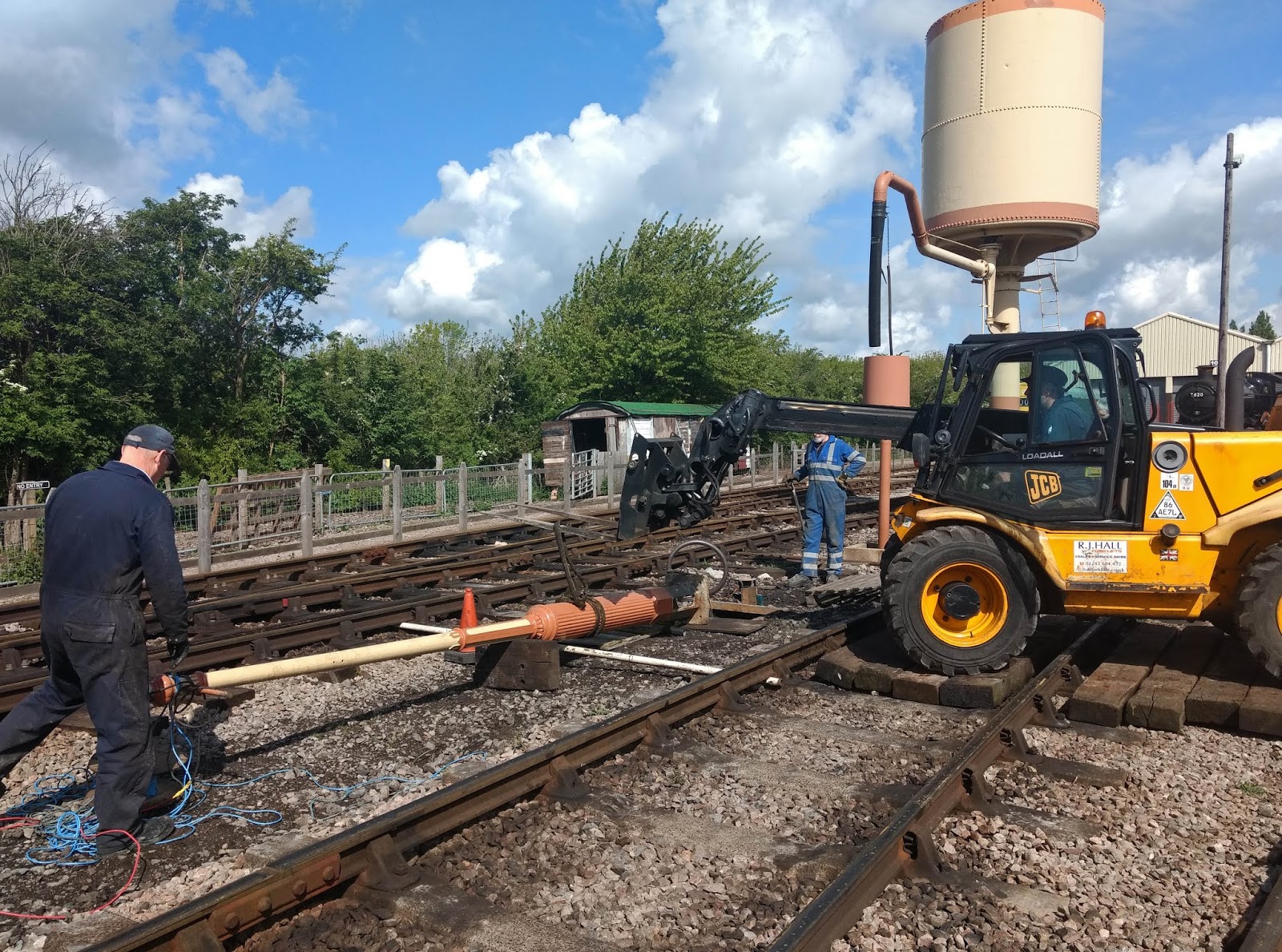
After juggling with the exact placing of the straps, we wriggled the end into the hole, making sure that the supply cable faced the right way. That also ensures that the ladder bars at the top are facing in the right direction.


And then it was up! Here the loco dept,. gang are securing the post with guy ropes, which will hold it in place until the concrete comes. It was booked for the afternoon.


A little wait for that then, so a look round the loco shed, which is always interesting.

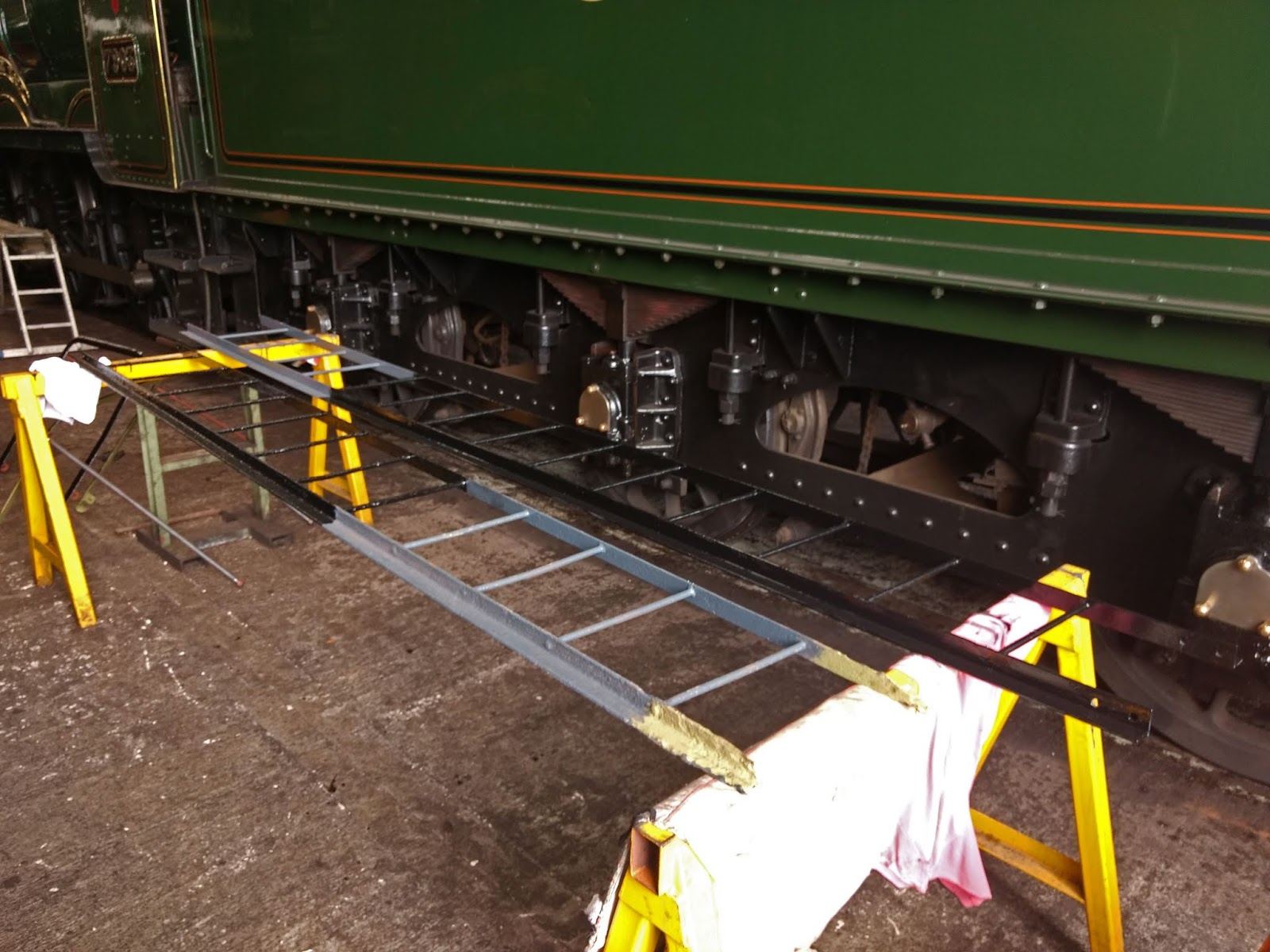
Here are the two ladders for the posts. They're just being painted. In the foreground is the shorter original (the posts are of different lengths) and in the background the somewhat longer copy that we made.


Deeper into the shed, and the King has come. King Edward II rests serenely next to Foremarke Hall.


The blue and gold has something special about it, and so does this bogie and valve arrangement.


In the afternoon, and after carefully avoiding the Stanton bridge weight restriction, our friendly concrete mixer lorry arrived.

So where do you want the 5 tons of concrete?
The lorry reversed up to the side of the shed, so that the Telehandler, now equipped with a bucket, could park behind it for a helping of instant concrete.

You've surely seen these machines about on the road, but did you know how they work? The big container on the back houses two bunkers of sand and ballast, which are transported backwards by a conveyor belt underneath. The concrete isn't made until it comes out of the chute at the back, where the water and cement are added at the last minute.


With its bucket full of concrete the little Telehandler cautiously made its way to the furthest post, still held upright by its guy ropes.


The contents of the bucket were then shovelled down the hole by these two gentlemen, plus your blogger.

Although the bucket was big, we did the job without too much difficulty. It did need half of a second bucket though, and this picture was taken after we had finished.

Now don't lean on that post too hard, Tim!


While we shovelled, the mixer lorry - from Honeybourne, how fitting for us - reversed to the wood store behind the diesel shed. The store is getting a new body - a container - and this needs deep foundations, as it sits on the edge of made up ground. The container is the former oil store, the new oil store is parked where the new mess room will be built, so with this job we are advancing the cause of the new mess room. Cause and effect, as it were.

Then it was the turn of the second lamp post, the one by the water tower. Again we had to shovel, as the Telehandler bucket is far too wide to be tipped into the hole.

The sky was rather spectacular, but the rain held off. We were very lucky.

Here is the second hole almost full. We had to go back for a refill here, but the job is now done and the concrete is going off as you read this.

A last bit of the mix-as-you-go concrete was delivered to the top of this pit cover here. It has brick sides but to stop vehicles damaging the tops of the bricks we gave it a concrete ring all round.

That brown container will become the new wood store, if we picked this up right, and the new one will move into its place and make room for the goods shed extension / new mess room.

Our final picture shows both lamp posts in situ. The second is at the rear, in front of the water tower. Notice how tall the posts are. The GWR took an existing, classic, 8ft lamp post design and stuck it on top of a fluted extension piece, which you can see here quite clearly.

The ladder bar is not for the ladder (that would be too simple) but for the handrail of the platform at the top of the ladder. This is fixed to the post with bolts. We remembered to have the ladder bars facing the right way too, before setting the whole caboodle in concrete.

We have a design for the two lanterns on top. These will be reached by standing on the platform at the end of the ladder, so no messing about wobbling on top of a ladder. The lamp is bigger than a platform one, and has 6 sides rather than four.

A decision on how to fund the two tops, costing £3000 together, still has to be reached.

Wednesday, 8 May 2019

30ft of rubber insulation strip

A lousy weather forecast: heavy rain, followed by showers.

Miserable with this unpromising start to the day, only 13 of us gathered in the mess coach to sip our tea and nibble at Jim's doughnuts.


What to do? It pelted down, even after a second cup of tea. Finally some of us in the best wet weather gear got the white Landie going and loaded it up with redundant GWR throughbolt chairs, something that would keep 2807 supplied for their boot scrapers, as well as tidy up the yard a bit.


Suddenly the heavens cleared a bit, and the forecast for mere showers looked a bit more plausible. Dare we risk it? We dared to take the risk.

We got Maxie out and fed her a dusty diet of sand and cement, which didn't go down too well, it made her cough.


We banged Maxie on the back to stop her coughing, or is there a Heimlich manoeuvre for concrete mixers that people know of?

We also gave her a bucket of water to drink.


After all the coughing and slobbering, we thought it best to wipe her mouth.


And it worked! She 'coughed up' a load of the finest mortar, just what was needed for the small group of block layers that had ventured out into the damp.

Jim and Peter decided to build up the tower at the northern end to see how the courses would run up to the top.

The red and white pole on the right has a black stripe round it, and this is the platform level. The stick on the left is marked (on the other side) with the level for each course.


Here are Jim and Peter checking the height of their tower, course by course, against the 'ruler' that Jim made.


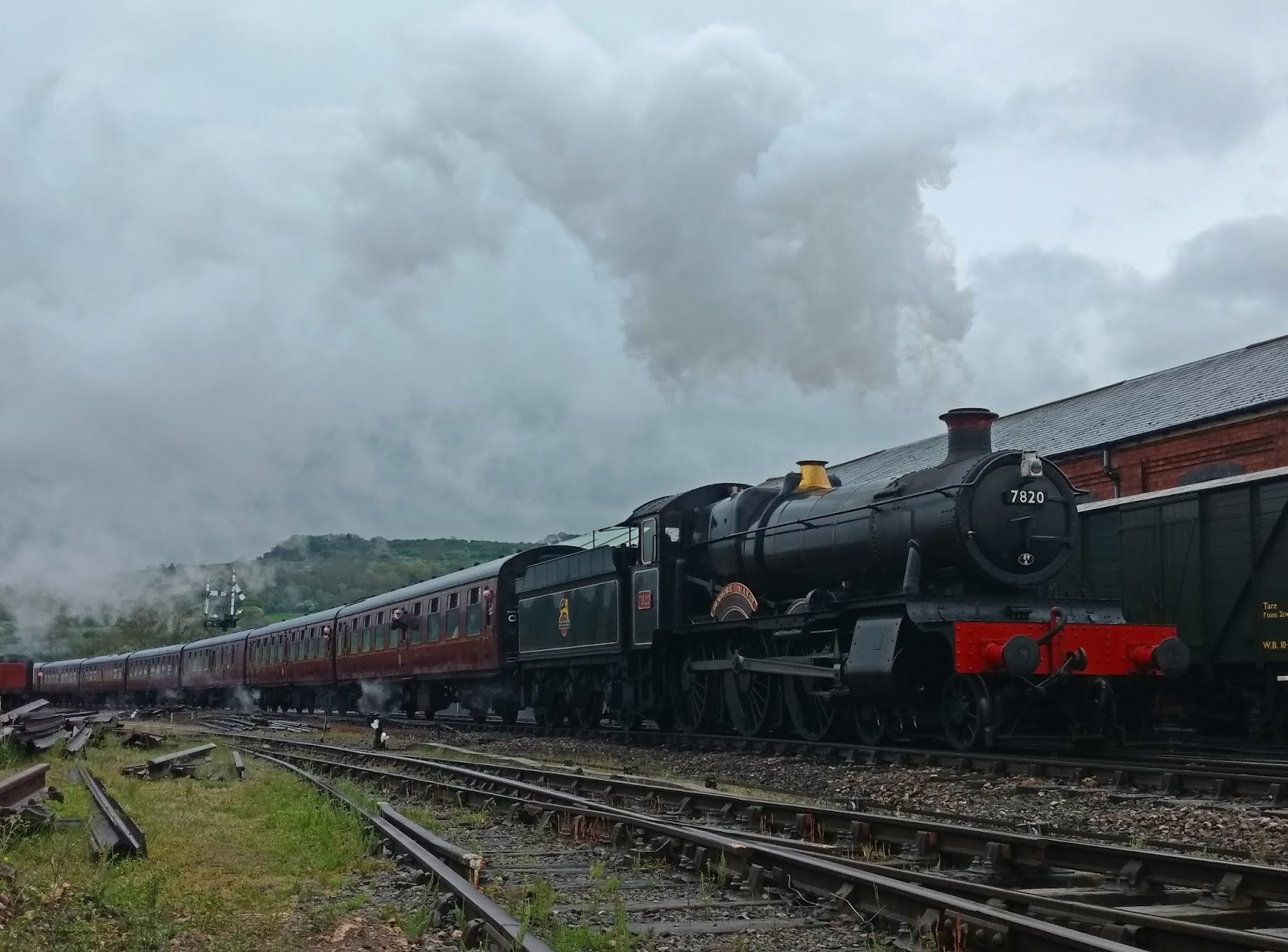
Trains interrupted our work from time to time, this one being the first one of the day, headed south by Dinmore Manor to pick up eager tourists from Cheltenham.

The rails were wet and it was a spectacular start as the loco started to pull its heavy train away from the bracket signal, trying not to slip.

Later in the day P&O pulled away heading north, but less sure underfoot and we heard a brief slip.

In the foreground you can see block laying, and a little supply train bringing more blocks. We need to lay 100s of these hefty things.


We were delighted to see Paul back from a brief spell at home. He must be feeling better, as the air, despite the rain clouds, suddenly got a lot bluer!

Paul pushed the tower higher, still with Peter in attendance, while Jim moved further along.


Nearer the middle of our 30m wall Dave started to help raise this tower, which also had its own 'ruler' to guide the levels upwards.


After raising the middle tower a bit, and with a drier weather outlook, Dave thought he'd start the last, short stretch of the wall, where no blocks had been laid at all yet. This was daring, as it floods easily (we noticed the last two working days, which were equally wet) but John here brushed the water to one end and scooped it out.

The water that was too difficult to scoop was retained by a neat little dam.

By this time Dinmore Manor had done a complete round trip, and is seen here heading south for the second time. Again, a delicate start on slippery rails.

The weather, while drier, had now settled down to a mixture of short spells of sunshine and heavy showers. Twice they were so bad that we had to run for the shelter of the corrugated iron hut (from an orchard in Bredon, should you ask) and we were even entertained by a hail storm which rattled down on top.

In between the hail and rain showers, short spells of full sun! Peter takes 5 sitting on a rail, while Dave seems to be laying an imaginary block. Well, they are lighter.

The unbuilt on length of platform wall by now was almost fully built on. Dave was doing well, some labelled him a 'Blockstar'. Such puns. But please don't sing.

Just a handful of blocks to go here, and when we come back next week they will have gone off and given us a dry surface to work on, floods or no floods.

The block tongs are also in evidence here, they are so handy, especially when you are laying the bottom row.


An unexpected visitor mid afternoon was this diesel loco without a train. It's marked D5081 but can also emerge as class 24  24081. The loco has been active throughout its preserved life (since 1981!) but over the last few months has had a bogie refurbishment, which looks to have been a success as it allowed itself a turn to Winchcombe to see how it went.


Near the end of the afternoon there were more spectators than block layers, the last of which was Dave, still putting them down at ground level. Well done Dave, we really advanced the wall today.

This spectating was thirsty work, or else it made the mind think of tea, because after washing up the tools the Coffeepot was the universally agreed destination.


'John, you made the tea really well'  ' Aw, shucks...'
Seven of us concluded this very happy day with tea, and more fascinating tales from Paul, which we can't repeat here as this is a family blog. What a rich life he had, our Paul.

See you next week!

Oh, yes:
30ft of rubber insulation strip?

Heading for the Coffeepot, we met Peter from C&W coming the other way, bearing a parcel.

Got a cake in there then, Peter, you lucky lot in C&W?

No, it's.......


Wednesday, 1 May 2019

Slowly the goods platform rises

Just the 5 ' Usketeers' on the job today. Other members of the group were active at Toddington, where a start was made on spot resleepering the main line south of the new turnout in the direction of Didbrook. This was interrupted by heavy rain in the afternoon.


The little gang of 5 is seen here from the other side of the tracks, strung out along the line of the new platform. The self seeded oak tree will be pretty much in the middle of it, with the Usk weighbridge building to be sited to the left of it.


Why a picture form the far side of the tracks? Well, 2807 was on its way with the first train south of the day. It had a rather authentic clank to it, which was nice. Old freight engines often had that.


So here is us, with two people laying (Neil and Peter), one guiding (Jim), one bringing blocks (John) and one muck maker (ahem).

It's a lovely sunny day, and we were quite hot after a while.

The BBC forecast said there would be increasing chances of light rain, rising from 5% to 10% to 15% right up to about 40% at the end of the day.

We could live with that.


Neal was laying blocks at the northern end, and Jim's guidance meant that interim measurements should be taken to make sure we are laying the correct distance from the track, and that we are not too high.

Distance from the track was fine (see picture) but height became a problem as Neil found himself laying on a rising row of blocks underneath, which wasn't right. The answer was to use really thin layers of mortar, and try to recover the excess layer by layer.


Last week we used almost all of the first lot of concrete blocks we had on site, so today we were looking round anxiously to see if any more were being delivered.

Luckily the cavalry came just in time - Fairview came with another 400 blocks, which this time were dropped in close proximity to the job, not on the far side of the tracks as last time.


It turned out that their driver and our Jonathan (in the picture) had gone to school together. It's a small county, Gloucestershire.


John was delighted with the delivery (the block layers less so) and soon had the big barrow out, with which he ran blocks down the siding track up to where Neil and Peter were laying.


2807 then came back from CRC with the first load of happy passengers.

Scattered about in the foreground are some of the wooden stillages filled with Usk materials, which we will be using once the platform is finished.


Outside the C&W shed was this delightful little branch line goods train, the whole in perfect condition. It is really nice to see the work of our wagon restoration team.


Of course the main C&W team are not exactly idle either. Just look at this coach here, parked outside the shed. It's like new.

It's quite an interesting coach as it's a BCK. While not really rare, there are fewer of these than your regular Mk1, in fact just 276 were built, while other series numbered in their thousands.

Looking at the windows, left to right, we have a luggage compartment, a guards compartment, a toilet, two first class compartments and then three second class ones, followed by another toilet. Quite an unusual combination. That makes it a BCK - Brake, Corridor, Composite (both first and second class). Well, one C became a K in the designation, OK.

The other thing that makes this coach unusual is that during its life time as a preserved coach two of the second class compartments had the dividing wall removed, so turning them into one large one. This makes it rather attractive for small groups or families. Certainly unique on our railway. As a brake vehicle it is also particularly useful. It will replace a (non-seat) BG, so provide extra capacity, as well as giving us a spare brake coach, should something crop up with one of the others.

Hope we got all this right. We grilled a high ranking member of the C&W team, but took no notes...

Further up the yard (the sliding gate that divides the public station forecourt from the locked operating yard is on the left, end on) we can see the new building that the railway is buying. It's the one with the 4 gable ends, and a very useful yard to the left with covered hard standing. It's not had much publicity, but is a major positive step for the railway. It will give the S&T and C&M departments better workshop space than currently (S&T housed in an old carriage, C&M in an ancient temporary site hut) and will offer office space for several of our office staff that are currently housed in temporary Portacabins at Toddington.

And of course we are buying back a bit of our original yard,  a bit which was hived off in the 1980s when we first moved into Winchcombe. So good news all round.

Today the new visitor centre could be seen end on, without the usual carriage parked in front. The arrangement of the northern facade is now clearer, and the odd way in which the fake bricked up rail entrance was sited off line to the tracks leading up to it. A real goods shed would have the doors for the tracks to one side, so that goods could be off loaded on to road vehicles on the other.

We carried on laying the blocks (the intermittent demand for muck allowing your blogger to stray a little from time to time) and here is Peter with the start of the fourth row.

It's so much easier now that the level on which he is laying is well off the ground. It's really hard having to lay them right down on to the deck. But we are (mostly) past that stage now.

Peter has also made himself a nice seat from which to spread the muck.

Here's an overall view of the goods platform site. Good progress is being made at the far end, where both block layers have reached level 4.

The gap in the foreground still needs filling. Unfortunately we are currently one block layer short, due to  - we hope temporary - health issues.

Then the slight rain forecast on the BBC website first thing started to materialise. We re-checked the forecast, and it now said that the likelihood was 98%! What a rapid change from this morning's 5 - 10%. We carried on in the rain for as long as possible, but there came a point where it became unbearable, everything was getting really soaked.


We sought succour in the good old tin hut, just the same as last week, with the rain drops pattering away on the roof.

Trains of course kept on running, but we had to sit it out until the rain had reduced to more bearable levels.


And it is from within the tin hut that we bid you farewell for this week. The atmosphere inside was damp, and we sat on sacks of cement for seats. Morale nonetheless was high, as we had laid a fair number of blocks in the morning, and raised the level from three courses to four, on the bit on which we were working.

From inside the lamp hut John, Jim, Peter and yours truly bid you fare-thee-well until the next time.

Post Scriptum:

Two of us treated ourselves to tea in the Coffeepot, which allowed us to witness the class 26 pull out of Winchcombe, with that unmistakable Sulzer splutter. We liked the sound of that.

You can hear it on the video here:

https://youtu.be/Ivv8GQNTIuM